
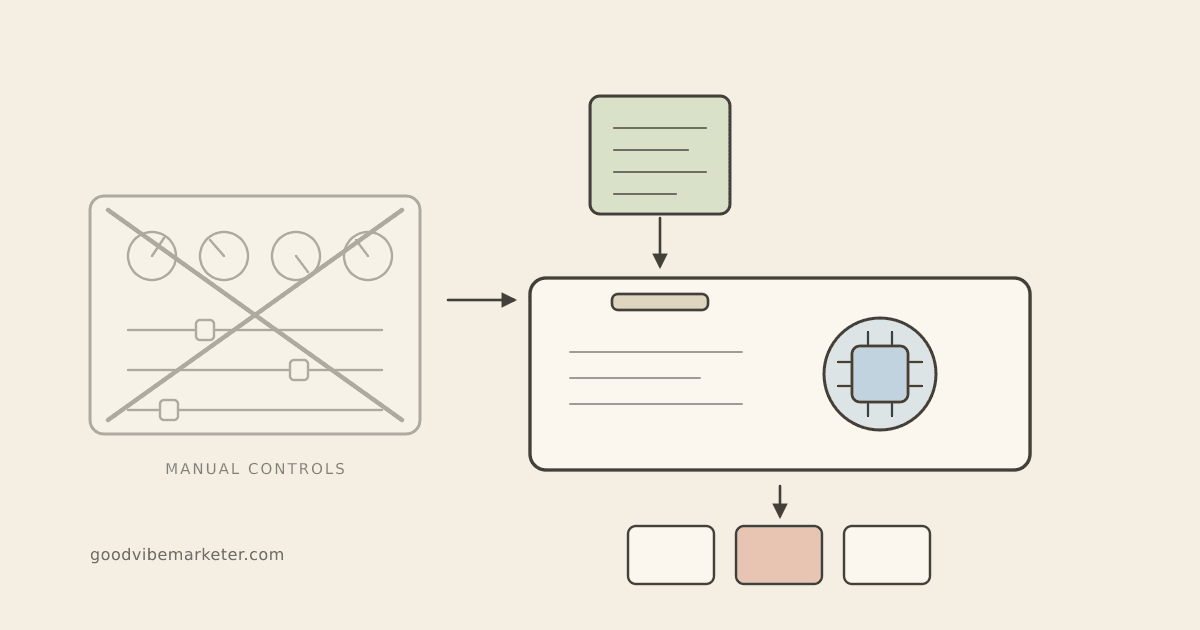
Every major marketing platform just replaced manual controls with brief-driven AI, and most marketers are preparing for the wrong shift.
Scroll LinkedIn for ten minutes this week and the mood is unmistakable. Marketers are anxious. Not about whether AI matters, that argument ended months ago. They’re anxious about which skills still count.
The common answer is “strategy.” Be more strategic. Think bigger. Let AI handle the execution.
That’s half right. And the half that’s wrong is where it gets interesting.
Because what happened across Google, OpenAI, and GA4 in a single news cycle wasn’t just another round of feature releases. It was a coordinated replacement of the controls marketers have used for twenty years. Keywords, match types, manual targeting, URL selection. The levers are being removed and replaced with a single input: the brief.
The skill that survives isn’t “strategy” in the abstract. It’s the ability to write a brief that makes an AI do precisely what you need it to do.
Brief Writing Is Now a Technical Skill
Google’s VP of Search and Commerce said it plainly: “The future is definitely more automated.” But listen to what they actually built. AI Brief, the flagship tool inside AI Max, doesn’t ask marketers to set keywords or configure match types. It asks them to write a brief. Creative vision. Targeting guardrails. Messaging guidelines. Audience parameters.
The brief is now the control surface.
This is a structural change, not a feature update. For two decades, performance marketing skill meant understanding keyword architecture, bid strategies, and match-type logic. That knowledge isn’t worthless overnight, but its half-life just shortened dramatically.
The marketers who’ll run the best campaigns next quarter aren’t the ones with the deepest Google Ads certification. They’re the ones who can articulate, in writing, exactly what a campaign should achieve, who it should reach, what it should say, and what it should never say.
That sounds simple. It isn’t.
Most marketers have never had to write a brief that precise, because the manual controls did the precision work for them. You picked the keywords. You set the match types. You chose the URLs. The system executed your mechanical inputs.
Now the system executes your intent. And if your intent is vague, the output will be too.
Here’s What That Looks Like In My Own Work
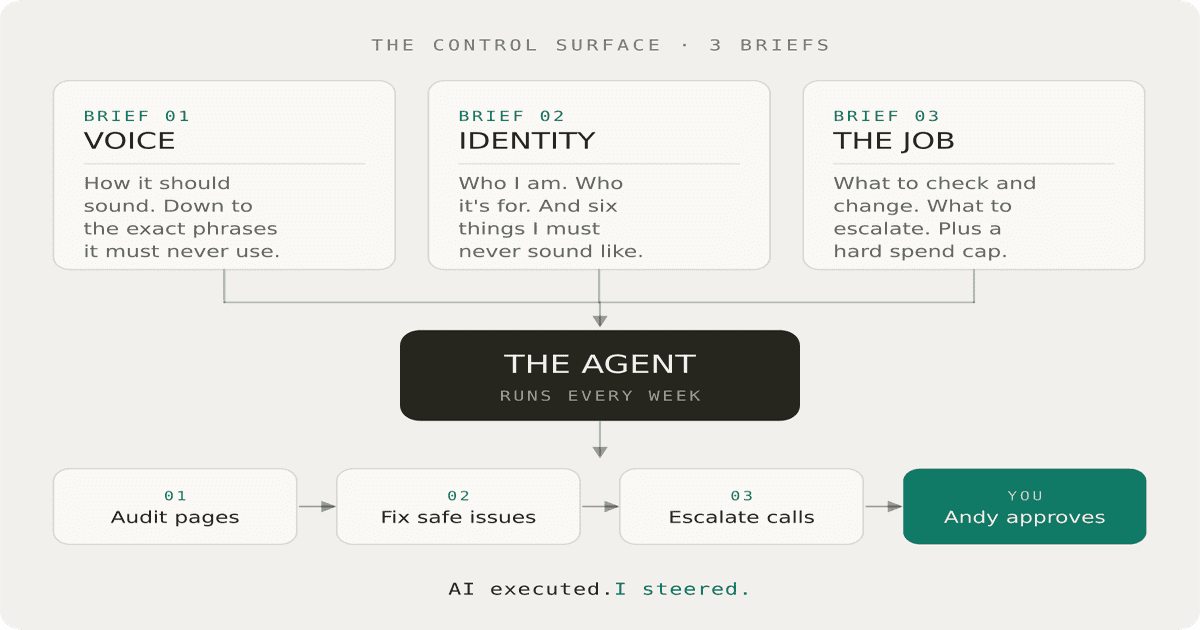
Recently I built an AI agent that audits goodvibemarketer.com for me. It runs every week, checks each page for the things that help it get found, fixes the safe stuff, and hands me the judgement calls to approve. I built it with Claude Code and I deploy it the way an engineer would, except I’m not an engineer. I think in outcomes and let the AI handle the syntax.
Here’s the part that matters for this argument. The agent doesn’t take settings. It takes a brief.
There are no keywords to configure and no boxes to tick. There are three written documents. One describes exactly how the writing should sound, down to a list of phrases it is never allowed to use. One describes who I am, who I’m talking to, and the six things I must never sound like. The third describes the job itself: what to check, what it can change on its own, what it has to escalate to me, and a hard spending cap so it can’t run away with the budget.
That’s the whole control surface. Three briefs.
And I learned the exact lesson this article is about. The first time I ran it before I’d written the positioning down properly, it produced precisely the generic AI-newsletter mush I spend my life trying to avoid. The agent wasn’t the problem. My brief was. The moment I forced myself to articulate the positioning sharply, the output sharpened with it.
Now look at what Google actually built into AI Max. Creative vision. Audience Guidelines. Matching Guidelines. Rules for what a campaign should never say. It’s the same three documents I wrote for my own agent. Different platform. Identical control surface.
The brief was the skill. It always was. The agent just made the gap impossible to ignore.
The Uncomfortable Part
Here’s what most commentary on this shift misses. “Learn to write better briefs” sounds like good news for senior marketers. Finally, experience and judgement matter more than platform mechanics.
But brief writing exposes gaps that manual controls used to hide.
When you set keywords manually, you could run a decent campaign without ever articulating your positioning clearly. The keywords did the thinking. You could target by intent without ever writing down what your brand actually promises or why someone should choose you.
A brief-driven system doesn’t let you skip that step. If you can’t articulate your differentiation in two sentences, the AI has nothing useful to work with. If your audience definition is “decision-makers in mid-market SaaS,” the AI will produce mid-market SaaS mush.
I’ve watched this pattern before. When I first built a marketing function from a one-page website using HubSpot, the hardest part wasn’t learning the platform. It was forcing clarity about who we were talking to and why they should care. The tool just made the gap visible.
AI briefs do the same thing, faster and more brutally. Vague strategy used to produce mediocre campaigns slowly. Now it produces mediocre campaigns instantly, at scale, with your full budget behind them.
That’s the bit most teams miss.
”But Won’t the AI Learn to Fill In the Gaps?”
Fair objection. Google’s system already uses Merchant Centre feeds to infer targeting and creative decisions. AI models are getting better at interpreting loose instructions. Maybe brief quality matters less over time, not more.
I can hear this argument because it’s the comfortable one. Let the AI figure it out.
Two problems. First, every competitor using the same platform has access to the same AI inference. If everyone’s briefs are equally vague, the AI optimises everyone toward the same middle. You don’t outperform by giving the system less to work with.
Second, the features Google actually built tell you where they think the value sits. Matching Guidelines. Audience Guidelines. Text disclaimers for regulated industries. These aren’t autopilot features. They’re control frameworks designed for marketers who know exactly what they want and can specify it precisely.
Google isn’t building toward “no brief needed.” They’re building toward “better briefs win.”
The gap between marketers who can write a sharp brief and those who can’t is about to become the primary performance differentiator in paid search. Not budget. Not bid strategy. Clarity of intent, expressed in writing.
What Changes Tomorrow Morning
Pick one live campaign, your most important one, and write the brief for it as if you were handing it to an AI system that knows nothing about your business. Not your current keyword list. Not your existing settings. The brief.
Write down your positioning in two sentences. Define your audience specifically enough that someone outside your company could identify them. State what the campaign should say, and what it should never say. Specify which searches you want to appear for and which you want excluded.
If that exercise takes less than twenty minutes, you probably aren’t being specific enough. If it takes more than an hour, you’re overcomplicating it. The sweet spot is the brief that’s precise without being rigid.
Then compare what you wrote to what your current campaign is actually doing. The distance between those two things is the gap that brief-driven AI is about to expose.
Close it now, while the tools are still rolling out and competitors are still debating whether to pay attention.
The marketers who write the sharpest briefs will run the best campaigns. Not because they understand AI better, but because they understand their own business better.
That’s always been the real edge. The tools just stopped letting you fake it.