Scroll LinkedIn this week and you can feel the anxiety before you read a single post.
Designers posting hot takes about Claude Design. Threads arguing whether “vibe design” is an insult or a job title. Figma’s stock dropping. Another profession watching AI walk through the front door.
I run GoodVibeMarketer, and this is the kind of week it exists for: a lot of noise, one structural change underneath it.
The common reaction is that AI is coming for design jobs.
That’s the wrong frame.
What’s actually happening is more interesting, and more structural, than a threat to one profession.
The Universal Medium Nobody Asked For
Anthropic launched Claude Design on 17 April. OpenAI released ChatGPT Images 2.0 in the same week. Both tools let you describe what you want in plain language and get back polished visual work. Both sit inside platforms that already handle writing, analysis, and code.
That convergence matters more than either product on its own.
Three disciplines have now been absorbed into the same conversational layer:
- Writing. The first to collapse into a conversation, and the one everyone argued about.
- Development. Claude Code turned a written description into working software.
- Design. Claude Design and ChatGPT Images 2.0, both launched in a single week in April.
Look at what Anthropic has shipped in the past year. Claude Code for development. Claude Design for visual work. Managed Agents and Routines for recurring tasks.
The pattern is obvious once you step back.
Code is becoming the universal medium for knowledge work. Not code as in “learn Python.” Code as in the underlying layer that turns a written instruction into a working output.
Writing was first. Development followed. Design just got absorbed into the same workflow.
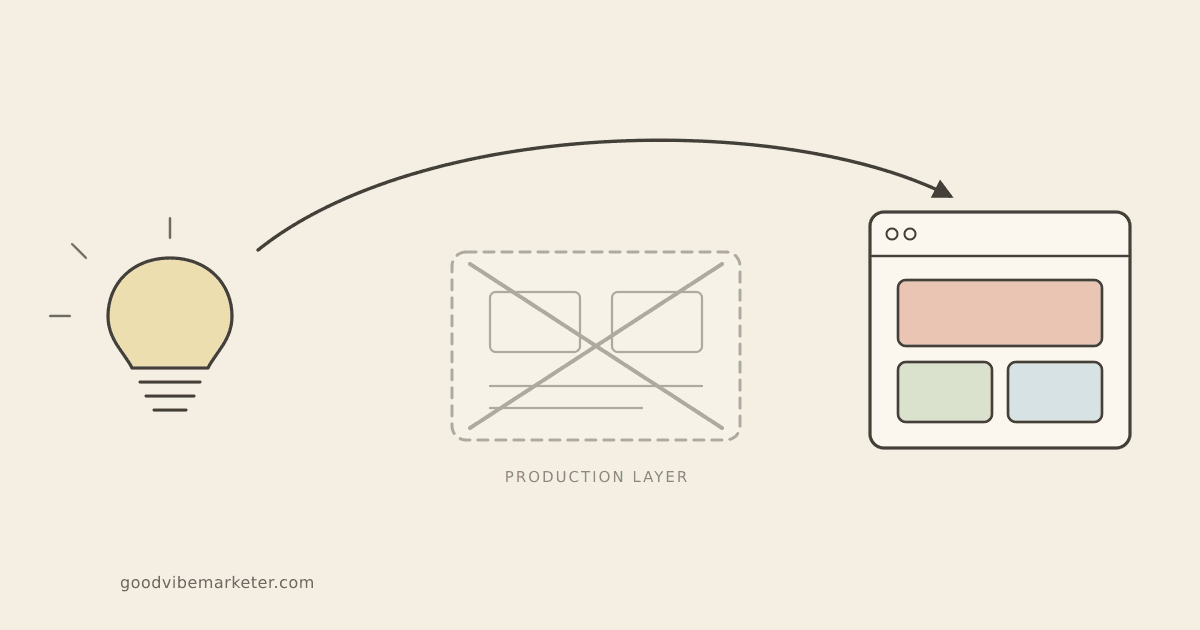
The common thread isn’t that AI can now do design. It’s that the gap between describing what you want and holding the finished thing has collapsed to a single conversation. Across every discipline. Simultaneously.
That’s the shift.
Production Was the Moat. Now It’s the Commodity.
I’ve watched this pattern before.
When I started in marketing, print was the dominant channel and production was the bottleneck. You needed a designer, content writer, a print buyer, a distribution partner. Each step needed a specialist. Each specialist was a cost centre and a timeline.
Digital compressed that stack. Not overnight, but relentlessly.
The people who thrived weren’t the ones who held on to print production skills. They were the ones who understood that the value had migrated upstream. To strategy, positioning, and knowing what to say to whom.
The same migration is happening now. Faster.
I created a practical guide to Claude Design this week (using Claude Design, of course). Six steps. Write a one-paragraph brief. Review three AI-generated directions. Collect team feedback. Iterate on live controls. Export.
The entire production cycle that used to need a brief, a designer, two rounds of revisions, and a Figma export now fits inside a single tool and a single conversation.
It’s called “vibe design.” A deliberately casual label for something with serious implications.
The label has form. I wrote in February about vibe coding escaping engineering and becoming vibe working, and design is that same move in a different discipline.
When a marketer can go from brief to shippable asset without switching platforms or hiring a specialist, the bottleneck is no longer production.
It’s judgement. Taste. Knowing which of the three directions is right, and why.
Judgement is the one thing that does not arrive with the tool. If your team would rather build it on their own campaigns than on a generic curriculum, that is what the AI marketing workshop is for.
Questions people ask
Will AI design tools replace designers?
No, and that framing misses what is actually moving. What Claude Design and ChatGPT Images 2.0 compress is the production layer between an idea and a finished asset: the brief, the revision rounds, the export. Designers working at the level of judgement and direction are not competing with that. Roles built purely on executing someone else’s instruction are.
What is vibe design?
Vibe design is describing the visual outcome you want in plain language and getting a usable asset back, without opening a design tool or briefing a specialist. In practice that means a one-paragraph brief, a set of generated directions, team feedback, iteration on live controls, and an export. The casual name hides a serious change: production stops being the constraint.
What skill matters most once production is cheap?
Judgement. When three finished directions arrive in a minute, the valuable act is knowing which one is right and being able to say why. That is taste, positioning, and knowing what to say to whom. It is the part that does not arrive with the tool, and it is the part that survives the next model release too.
Is this the same shift as print to digital?
Structurally yes, and faster. Print marketing needed a designer, a writer, a print buyer and a distribution partner, and every specialist was a cost and a timeline. Digital compressed that stack over years. The people who did well were not the ones defending production skills, they were the ones who moved upstream to strategy and positioning. The same migration is happening now, in months.