
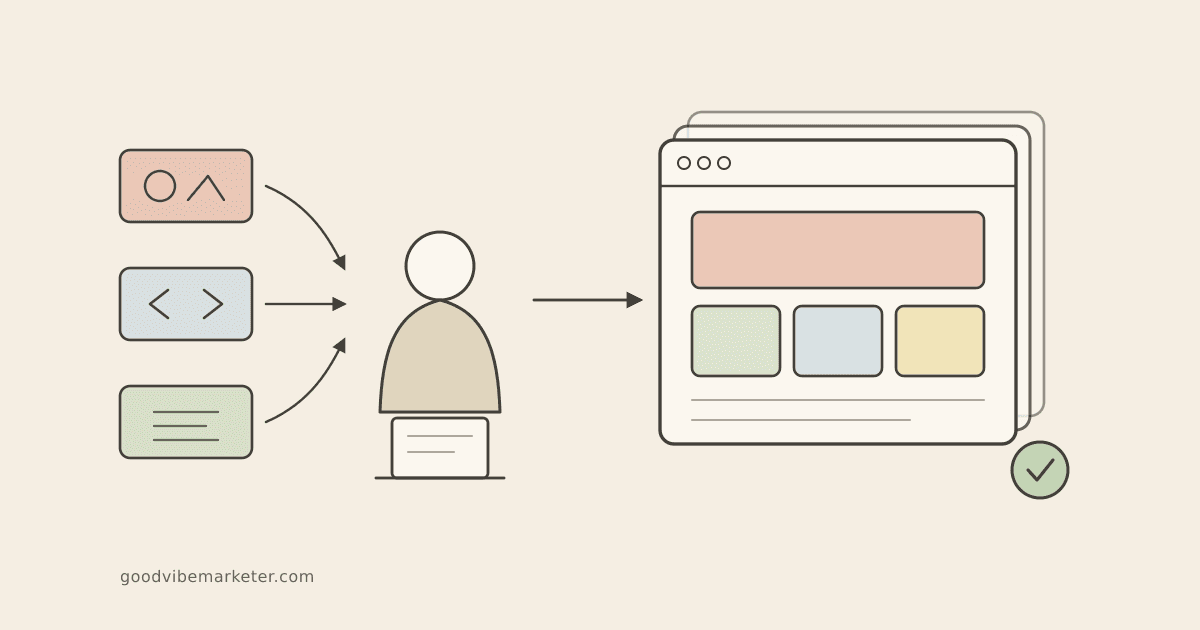
I rebuilt goodvibemarketer.com from scratch this month, off Webflow. I used Claude Code for the build and Claude Design for the look. I soft launched it this week.
I am not an engineer. I am not a designer. I am a marketer with twenty years in CRM, automation, and content systems. The kind of marketer who has always been comfortable around tools but always called in specialists when the work crossed the line.
That line moved.
It moved further than most marketers have noticed yet, and the gap between marketers who notice and marketers who don’t is going to be the most expensive gap in our industry over the next twelve months.
This article is how I did it, and why you should be doing the same with at least one project of your own this quarter.
Why Claude Code And Claude Design Matters
Claude Design has been collecting headlines for a reason. It is the first AI design tool that produces output a marketer can actually ship without having a designer rework it.
Pair that with Claude Code, which writes the underlying website, and you have something genuinely new. A marketer can describe what they want, see it designed, see it built, and see it live, in one continuous workflow. No handoffs. No agency. No development queue.
That used to be three teams.
This month it was me, in a browser tab, in evenings, with a clear brief and a willingness to keep iterating until it looked right.
I am not telling you it was effortless. I will get to the messy bits in a moment. I am telling you the configuration that produced this site did not exist eighteen months ago. The fact that it exists now, and that it works for a marketer working alone, is the part you should be paying attention to.
How I Actually Used Claude Design
The mistake most people make with an AI design tool is treating it like a magic wand. You type “make me a beautiful website” and judge whatever it returns. The output is generic because the brief was.
Claude Design rewards the opposite. The more structure you give it, the better it gets.
I started by writing a design.md file. A few pages of plain text covering the things a designer would normally hold in their head. Typography. Colour palette. Spacing logic. Component patterns. A note on tone. I borrowed structural ideas from public design systems I admire, including Cursor’s, because I wanted my site to carry the same considered feel that AI-native companies tend to ship with.
That file became the seed. When I fed it to Claude Design, the output stopped being generic. It was opinionated, restrained where I had asked for restraint, confident where I had asked for confidence. Recognisably mine.
Claude Design is not a designer. It is a renderer. The brief is the design. The tool turns the brief into pixels.
The marketers who get the most out of these tools in the next year will be the ones who learn to write briefs that hold up to that kind of execution. Not the ones who type the most prompts.
What The Job Actually Looked Like
The version where AI does everything for you is a story, not a lived experience. I want to be honest about that.
I did not write the code. I described what I wanted, in plain English, to Claude Code. It wrote the files. I read them. I asked it to change things. I broke things. I fixed them, sometimes by asking better questions, sometimes by reading what was on screen until I understood enough to spot the problem.
Some sessions were brilliant. The homepage came together in an afternoon. Some were grinding. A contact form that worked locally and broke on the live site took most of an evening to track down.
None of it required me to become an engineer.
All of it required me to think like one for a few weeks. Specifications. Edge cases. What happens when the form is submitted twice. The thinking transfers. The typing doesn’t have to.
The skill that crossed the line isn’t coding. It’s the engineering mindset. Clarity about what you want. Patience when the system pushes back. If you have those, you have most of what you need.
The Real Reason You Should Do This
Saving the subscription cost is nice. Faster site is nice. Owning the code is nice. None of those are the actual reason.
The actual reason is the agent layer.
I have already built this stack at missinglinkz.io, the SaaS tool I shipped earlier this year. On top of that codebase I run a small set of agents. An SEO agent that audits pages and proposes rewrites. A content agent that generates and updates landing copy. The newsletter pipeline that produces the briefing you are reading.
None of those agents could touch the goodvibemarketer.com site while it lived inside Webflow. Now they can.
The website used to be a thing I edited. It is now a thing my AI workflows can operate. A site you edit gets improved when you have an evening free. A site your agents operate gets improved continuously, in the background, while you are doing other things.
The first scales with your attention. The second scales with the agents.
That is the move. And it is the reason this is not just a stack change. It is a structural shift in what your marketing site can be.
What You Should Do This Week
Not migrate your site. That is too big a first step for most marketers reading this.
What you should do is build one thing.
A landing page for a campaign. A small interactive tool. A microsite for a launch. A redesign of a single section of your existing site that has been bothering you for months. Something with a real boundary, that you would normally outsource or postpone.
Open Claude Code in one tab. Open Claude Design in another. Write a brief. A real one. A short design.md, however rough. Then build the thing.
You will not finish it the first night. You might not finish it at all. That isn’t the point.
The point is to find out where the line sits for you in 2026, rather than where it sat in 2024. Most marketers I speak to are operating on a map that’s already out of date. They are leaving leverage on the table not because the tools aren’t ready, but because they haven’t tested what the tools can do for them yet.
I’m a marketer. I rebuilt my website using Claude Code and Claude Design.
You should be doing the same with one project of your own this quarter.
The question isn’t whether the tools are ready. They are.
The question is who notices first.