
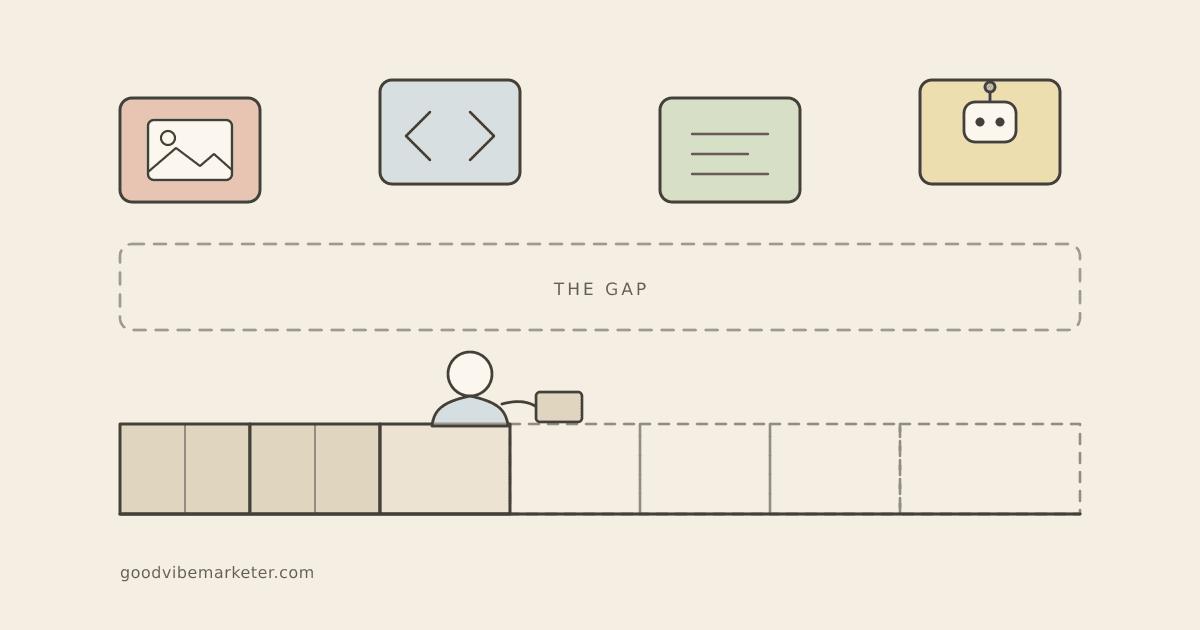
The capabilities arrived. The systems to use them well didn’t. That gap is where the next advantage lives.
Scroll LinkedIn this week and you’ll feel the same buzz everywhere. Google turning citation authority into a visible badge. Research that used to take months now done in days. AI quietly deciding which of your emails ever reach a human.
Every week at GoodVibeMarketer I read a version of that list, and every week the same thing is missing from it.
The consensus reads this as an acceleration story. More tools. More speed. More opportunity.
That’s true. It’s also the boring part.
The interesting part is what happens when a capability lands and the infrastructure to use it doesn’t. That isn’t a speed problem. It’s a structural one. And it’s forming a real advantage right now, quietly, for the teams paying attention to the unglamorous bits.
Capability Without Infrastructure Is Just Noise
Here’s what struck me reading through this week’s developments. Every one follows the same shape. A powerful capability lands. And almost immediately, a measurement gap, a trust gap, or a workflow gap opens up right behind it.
Three from this week, and the gap that opened behind each one:
- Citation labels in AI Overviews. The capability is visible source authority. The gap is that you cannot retrofit years of earned citations in a quarter.
- AI-compressed consumer research. The capability is insight in days instead of months. The gap is knowing which question was worth asking.
- AI inbox filtering. The capability belongs to the inbox, not to you. The gap is that almost nobody can measure what it is doing to their reach.
Google surfaces “Highly Cited” and “Preferred Source” labels directly inside AI Overviews. Brilliant. But the teams that benefit are the ones who spent years earning citations and funding original research that other publishers reference. You can’t retrofit that in a quarter.
MIT Sloan shows that consumer insight work that used to cost tens of thousands and take months can now happen in days. Genuinely exciting. But the teams who’ll use it well already know which questions to ask. The bottleneck was never the cost of the survey. It was the clarity to know which survey to run.
Validity finds AI inbox tools now quietly suppress brand emails before a human ever sees them. Important. But almost nobody can measure it. You can keep sending. You can’t yet see what the filter is doing to your actual reach.
Same pattern, every story. The capability is here. The infrastructure to turn it into results is lagging.
That gap is the strategy.
The Teams That Win Are Building Plumbing, Not Buying Tools
I’ve watched this film before. When digital marketing arrived, the early advantage didn’t go to the teams who bought the most tools. It went to the ones who built the measurement frameworks, the attribution logic, the content operations that turned tools into compounding systems.
The same thing is happening now.
The marketers celebrating new AI channels are focused on the front end. The marketers who’ll win this phase are building the back end. The measurement models that track performance across AI-mediated discovery. The content operations that earn citation authority on purpose, not by accident. The research workflows that make AI-compressed insight repeatable rather than a one-off experiment.
Prophet’s data makes it concrete. GenAI use has jumped to 73% globally, with 61% of consumers using it for pre-purchase search. That’s not a future trend. That’s current behaviour. Your brand is already being judged inside AI environments where the rules of visibility are nothing like the ones you’ve spent a decade optimising for.
If you can’t measure how your brand surfaces in those environments, you’re flying blind in the channel where your buyers already decide.
The smallest honest version of that measurement job, a list of buyer prompts run weekly and recorded, is written up in how to measure brand visibility in ChatGPT and Perplexity.
That’s the real story this week. Not “look at all these new capabilities.” It’s “look at how few teams can actually use them."
"Isn’t It Too Early to Build for Channels That Are Still Forming?”
Fair challenge. I’ve made this argument myself.
When a channel is brand new, there’s a case for waiting. Let the platform settle. Let the measurement tools catch up. Don’t over-invest in something that might look completely different in six months.
The problem is that the argument assumes the infrastructure gap is temporary. That the tools arrive and everyone catches up at roughly the same time.
That’s not what happened with digital. The teams who built measurement early didn’t just get a head start. They got compounding data. They learned faster. They optimised sooner. By the time the laggards caught up on tooling, the early movers had years of performance data shaping every decision.
Same dynamic here. The team that starts measuring AI-mediated discovery this quarter doesn’t just gain six months. They gain six months of data on how their brand shows up in ChatGPT, how citation signals move their visibility in AI Overviews, how inbox filtering changes their real email reach.
That data compounds. The gap widens. And the cost of catching up grows every quarter you wait.
The channel details will change. The advantage of having built the measurement layer early won’t.
The Boring Advantages Are the Durable Ones
There’s a reason this gets no airtime. “We built an attribution model for AI-mediated discovery” is not a post that goes anywhere. “We audited our content library for citation-worthiness” doesn’t pull engagement. “We rebuilt our email measurement to account for AI filtering” sounds like plumbing.
It is plumbing.
And plumbing is where durable advantage lives.
The flashy stuff, the new ad platform, the AI research tool, the conversational commerce play, is available to everyone at once. It’s table stakes within six months of launch. The infrastructure underneath it isn’t. That’s bespoke. It takes time. It needs clarity about what to measure and why.
I keep coming back to that “Highly Cited” label as the cleanest example. The badge doesn’t reward the team with the best AI tools. It rewards the team that spent years making content worth citing. The AI layer just made that old, slow investment visible in a way it never was before.
The AI layer didn’t replace the work. It amplified the returns on it.
That distinction is the whole game.
What Changes Tomorrow Morning
Pick one AI-mediated channel where your buyers are already active. ChatGPT for pre-purchase research. Google AI Overviews for discovery. AI-curated inboxes for email. Then ask one plain question: can we measure how our brand performs there today?
If the answer is no, that’s your first build. Not a campaign. Not another tool subscription. A measurement framework for a channel your buyers already use.
Then look at your content through the lens of citation-worthiness. Not traffic. Not rankings. Not engagement. Ask whether a publisher, or an AI system weighing source authority, would reference this as credible. If your highest-traffic content is generic and interchangeable, it won’t earn the signals that are now becoming visible trust markers in AI search.
The ten checks that turn that judgement into something you can actually run are set out in how to audit a B2B website for AI-search visibility.
Finally, run one AI-compressed research cycle this month. Take a positioning question you’ve parked because proper research felt too slow or too dear. Use synthetic testing or AI-moderated interviews to get directional answers in days instead of months. The point isn’t to replace rigorous research. It’s to stop making strategic bets with no evidence at all.
The capabilities are here. The infrastructure is the bottleneck.
Build the plumbing first.
Questions people ask
What does “infrastructure” mean in an AI marketing context?
Not servers. It means the measurement, workflow and content systems that sit between a capability and a result: how you track whether your brand surfaces in AI answers, how content earns citation authority on purpose, and how a research cycle gets repeated rather than run once. The tools get bought. This part gets built.
How do you measure whether your brand shows up in AI answers?
Build the list of prompts your buyers actually use during research, run them weekly against ChatGPT and Perplexity, and record whether you appear, where in the answer, and with what framing. It is manual at the start because the tooling is thin and mostly aimed at agencies. The signal is real anyway, and it turns directional within a few weeks.
What should a marketing team build first?
One measurement framework for one channel where your buyers are already active. Pick ChatGPT for pre-purchase research, Google AI Overviews for discovery, or the AI-curated inbox for email, then answer one plain question: can you see your own performance there today? If the answer is no, that is the first build. Not a campaign, not another subscription.
Does any of this need a developer?
Mostly no. The measurement work is a prompt list, a record and the discipline to keep running it. The content work is editorial judgement about whether a page is worth citing. Where it does get technical, crawler access and structured data, the checks are readable by a marketer and the fixes are usually small ones.