
This week’s shift is that one-off AI tasks are finished. The recent tooling launches made by ChatGPT and Claude integrated pipelines viable for normal teams, not just engineers. ChatGPT Work builds the brief, a copy agent writes the variants, a creative agent slices the assets. All linked. The barrier stopped being budget or tools. It became orchestration.
I want to push that one rung further. Because building a pipeline is not the leverage. It’s the next trap.
Build a bespoke pipeline for a campaign, ship it, move on, and you’ve done impressive work. You’ll also rebuild most of it from scratch next time. The compounding play isn’t building a pipeline. It’s building the system that stamps out a new pipeline every time you enter a new market, and upgrades every one you’ve already launched at the same time.
There Are Three Levels, And Most Teams Are Stuck Below The Top
Here’s the ladder I think in.
Level 0 is dead. One-off prompting. Copy-pasting from a chat window into an editor. No memory, no compounding. Every task starts from zero.
Level 1 is the integrated pipeline. Linked agents that hand work off to each other and loop on their own results. This is what most people mean by “agent pipeline.” Most teams are still trying to reach it.
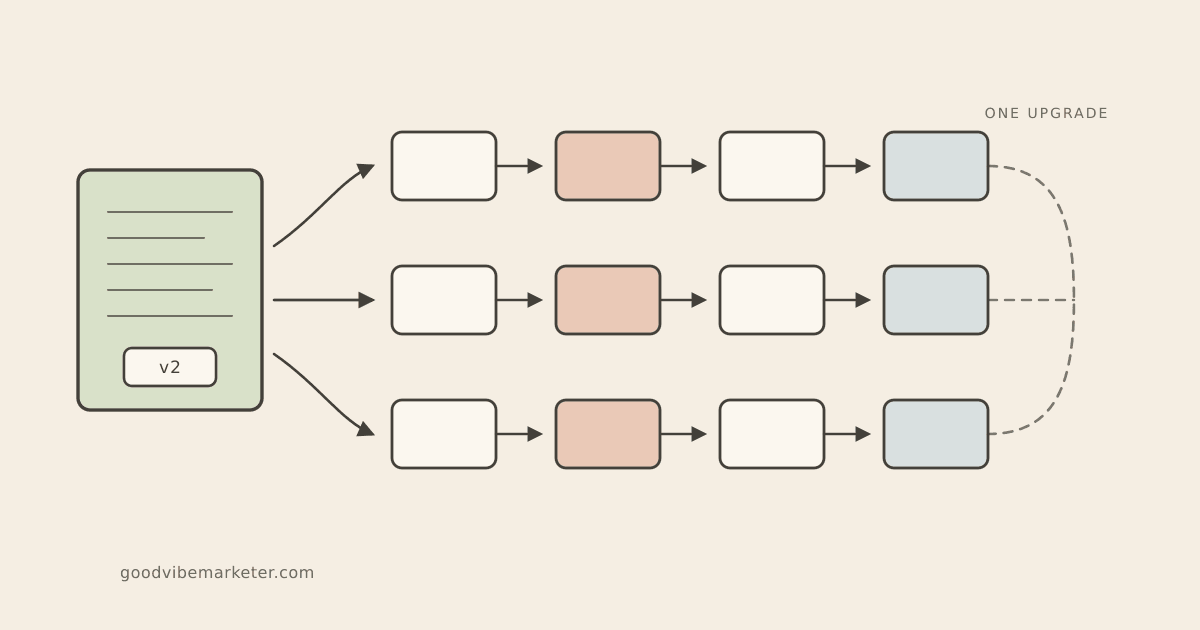
Level 2 is the system. A versioned, forkable framework that creates a Level 1 pipeline for a brand-new site in one shot, and keeps every site it has ever spun off in sync as the framework improves.
I operate at Level 2. I call the framework the Playbook, and it’s the actual product behind the sites I run.
The Playbook Is The Pipeline, Templatised
The Playbook is a versioned repository. A genericised blueprint of an entire three-agent content, SEO and AEO machine, plus the instructions to deploy and evolve it. It doesn’t describe a pipeline. It is one, templatised, built to run with Claude Code. Point a Claude Code session at it and it stamps out a working site.
It grew out of a proof of concept. I built the original three-agent loop on MissingLinkz.io. A strategist agent that researches and briefs, a writer agent that publishes daily, and a system that learns from its own search performance. Once those agents were demonstrably working, ranking, publishing, self-correcting, I didn’t treat it as a one-off win. I extracted the pattern into a reusable, versioned Playbook.
That difference is the whole article.
The Upgrade Move Is The One Nobody Builds
The Playbook has three moves.
Bootstrap spins up a new site. A one-shot spec turns the templates into a live, niche-specific pipeline. You fill in the identity, ideal customer, competitors, the wedge you’ll win on, brand voice. The scaffolding does the rest.
Upgrade brings an existing site to the latest framework. This is the part almost nobody builds, and it’s the game. Improve the framework on one site, and every other site pulls that improvement without touching its own niche content.
Maintain keeps the fleet in sync. Improvements get promoted back into the Playbook and propagated out.
The clever bit is how improvements are classified. Some are copy, portable files that drop straight in. Others are merge, methodology that lives next to a site’s own voice and strategy, so the upgrade adds a capability without overwriting the site’s identity. That’s what lets one framework serve many brands without turning them into clones.
Improve The Machine Once, The Whole Fleet Gets Better
Put it together and you get a loop that compounds at the portfolio level. Prove a capability on the reference site. Promote it into the Playbook with a version bump. Every spun-off site pulls it through the upgrade path.
PestGrade is a living example. An independent pest-control-software comparison site, spun up from the Playbook, running three agents on about $4 a month in commodity API spend. This week I took it from v1 to v2 in a single pass. Twelve months of Search Console analysis, automated keyword discovery, multi-engine AI-citation tracking, editorial-authority governance. All applied without disturbing a word of its content. All driven through Claude Code.
Isn’t that over-engineering for one site? If you only ever run one site, probably. But the moment you run two, the maths flips. The system pays for itself the first time you upgrade the whole fleet in the time it used to take to upgrade one.
What Changes Tomorrow Morning
The barrier was never budget or tools. Those are commodity now. The barrier is orchestration. And the highest form of orchestration isn’t wiring up a pipeline. It’s building the repeatable system that produces pipelines on demand and upgrades them all at once.
If your competitor hand-builds each funnel, you fork a Playbook.
If you’re still copy-pasting from a chat window into an editor, you’re not leaving speed on the table. You’re leaving the entire compounding curve on the table.
Don’t build a post. Don’t even build a pipeline. Build the system that builds both.