
The label I spent years rejecting
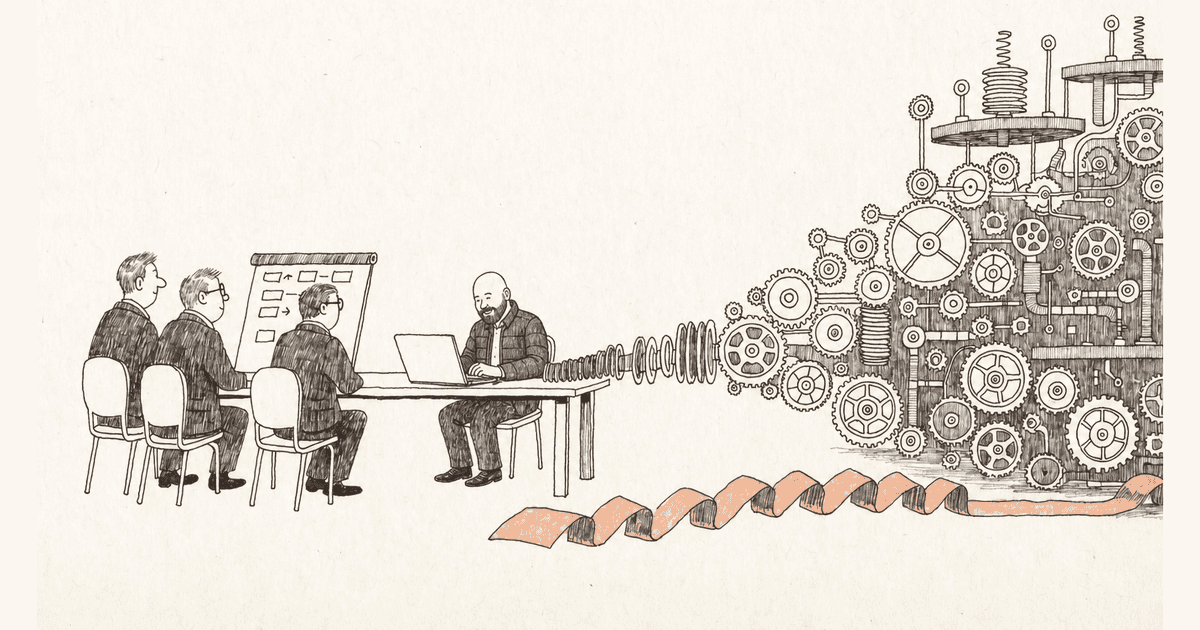
For years I rejected the “techie” label. It was not a compliment. It was a polite way to park me outside the room when marketing strategy was being decided.
The assumption underneath it was simple: if you build the workflows and the systems, you must know less about the strategy.
I understood where it came from. For a long time the org chart was built that way. Strategy was a thinking job. Implementation was a doing job. The two sat in different meetings, and only one of them was invited to the important one.
That split no longer holds, and I think most marketing leaders can feel it.
The handoff model has broken
In the past, a traditional marketer could sketch a strategy on a whiteboard and hand it to a technical person to implement. The thinking was finished before the build started.
Today, the system is the strategy.
The decisions that determine whether a campaign works are now made inside the build. What context the agents read. What data they are graded against. What they are explicitly not allowed to do. How often the plan gets revised, and on what evidence.
None of that is implementation detail. That is positioning, priorities and risk, written in a form that runs.
Which is why the handoff breaks. If the person setting direction cannot see inside the system, they are not really setting direction. They are approving a summary of it after the fact.
What a Marketing Engineer actually does
Profound’s manifesto on the role gives it a name I have started using. They describe a “full-stack marketer with the skills of a builder”, and note that the backgrounds look contradictory: “technical but creative, comfortable with code but obsessed with marketing outcomes”. Their framing is that Marketing Engineers build at the system level to automate at the campaign level. Worth reading in full: Profound’s Marketing Engineer manifesto.
Here is the part I would add from my own work, because it is where most teams stall.
A Marketing Engineer is not a marketer who has got handy with AI tools. Plenty of good marketers can get a usable first draft out of a chat window. That is a personal productivity gain, and it stays personal.
The role is different. You build and execute the systems that drive the strategy. For me that comes down to three things.
1. Context, packaged
Every agent I run reads a brief, not a prompt.
The brief is the control surface. It is where I set priorities, scope, and the things the agent is not allowed to do. Mine include a verified command reference the agent has to write against, and a rule that it cannot invent a topic the strategist did not brief.
That last rule matters more than it sounds. It means the system cannot quietly widen its own remit.
When the output drifts, I do not argue with the model. I fix the brief. For a leader, that is the useful part: a vague complaint about quality becomes a specific, reviewable edit.
2. Feedback loops that grade the result, not the run
My SEO and AEO loop runs on live data from Google Search Console and DataForSEO. It reviews what is working and adjusts my strategy weekly. Those agents now drive organic traffic for three websites I built using Claude Code.
The numbers from one of them, MissingLinkz, show what a loop looks like when it is grading results. Monitored buyer prompts went from 0% in week one, 0 of 12, to 58% in week five, 7 of 12, at an average position of 1.6 when cited. Week six came back at 50%, 6 of 12. The system monitors 14 prompts weekly. I wrote up how that loop is built in the AI agent loop that runs my SEO.
Week six is the point, not week five. Most AI reporting I see grades activity: tasks completed, posts published, runs finished. A loop that only surfaces its best week is marketing. A loop that surfaces the dip is a system you can steer.
3. Quality gates and a team that can run alone
Claude Code is the engineer in my tech stack. Grok Bot is the rest of the team. I train those agents the way I would train any human team member, until they are ready to run on their own.
The gates that protect quality are mechanical, not aspirational. On my own site, the build fails if a post has no hero, if the social share card is under 1200px wide, or if the meta description falls outside 120 to 160 characters. I set that out in the Cloudflare Pages deploy pattern I use.
Standards that live only in a document get skipped. Standards that live in the build do not.
And human review is not the exception to the system. It is part of the system. I decide what good looks like, and the final pass is where brand, taste and voice get added.
Where the role should sit
This is the question I keep getting asked, and I think the honest answer depends on the size of the team.
In a large company, the Marketing Engineer does not necessarily need to be the marketing leader. There is enough seniority and specialism around them for that to work. But they should be a leader within the team, and they should be in the important conversations about strategy and direction. Not consulted afterwards. In the room.
In an SME with three or four marketers, it is different. If someone is talented enough to be the Marketing Engineer, ideally that person should lead. Without that depth of knowledge, how can someone who lacks it direct them properly? You end up with the most capable person in the team taking instructions from a plan that cannot account for what is now possible.
Either way, the failure mode is the old one: treating the person who builds the system as the person who takes the brief.
You are not fixing the workflow any more
If you have been the “techie” in the corner of the marketing meeting, your time is here. The work has not changed as much as the value of it has. You are not fixing the workflow now. You are building the engine.
And if you are a CMO or senior marketer looking at all this from the other side, the practical move is smaller than it looks. Pick one recurring piece of marketing work. Write the brief for it properly. Put one honest measure on the result rather than the activity. That is the first loop, and it teaches you more about where AI fits in your team than any tool evaluation will.
That capability is what I help marketing leaders build, through workshops and hands-on work with their team. Amplify the marketers you have. Do not try to replace them.
Source: The Marketing Engineer, Profound.