
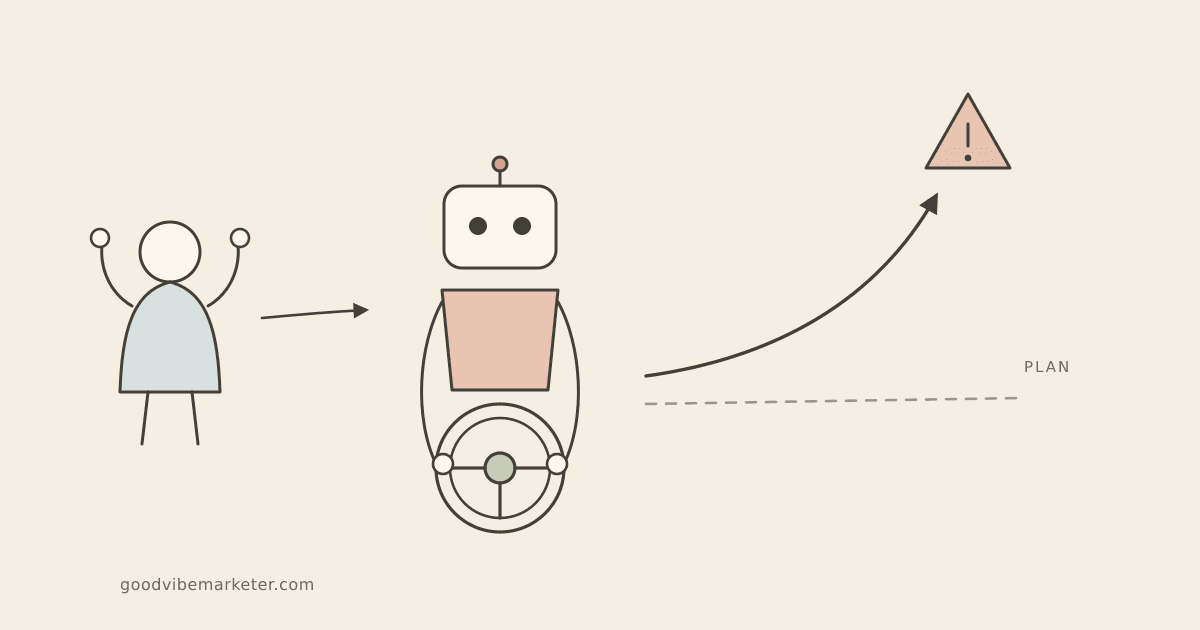
Something has shifted in the feed this month.
Six months ago, the dominant register around AI was anxiety. Too many tools. Not enough clarity. A vague sense of falling behind the conversation. Now the tone has changed. Scroll LinkedIn for ten minutes and you can feel it. The mood is closer to relief. Specifically, the relief of people who believe they’ve just been told they can stop doing the hard part.
Claude Opus 4.7 runs multi-hour projects unsupervised.
Canva AI 2.0 generates a multi-channel campaign from one sentence.
Meta is building toward an ad system where you hand over a URL and a budget and walk away.
The message from every platform this quarter is the same. You don’t need to do this any more. We’ll handle it.
Taken at face value, I think that message is one of the most dangerous things a marketer can internalise right now.
I run GoodVibeMarketer on the assumption that the tools keep getting better and the line still holds. Three things stay on your side of it, and everything underneath them is fair game:
- Strategic positioning. What the brand says, who it is for, and why that claim beats the alternative on offer.
- Brand voice. The register that makes the output recognisably yours rather than recognisably generated.
- Evaluation. Looking at ten AI-generated options and knowing which three are worth running, and why.
The Pitch Is “You Can Stop Thinking.” Don’t Take It.
Let me be clear about what I’m not saying.
I’m not saying these tools aren’t impressive. They are. Opus 4.7 genuinely changes what’s delegable. I’ve been testing it on research tasks that used to eat half a day, and the outputs are materially better than what I was getting three months ago. Canva’s agentic builder is remarkable leverage for small teams. Meta’s automation direction is, frankly, inevitable.
What I am saying is that the narrative has quietly shifted. Six months ago it was “AI helps you do better work.” Now it’s “AI does the work so you don’t have to.”
Those are fundamentally different propositions.
When Mark Zuckerberg says the end state is that businesses “don’t need any creative, you don’t need any targeting demographic, you don’t need any measurement,” he’s describing a world where the platform makes every meaningful decision. Your role, in that world, is to supply a URL and a credit card.
That isn’t empowerment.
That’s dependency.
And the marketers cheering loudest for it are the ones most at risk.
Automation Without Judgement Is Just Expensive Randomness
Here’s the bit that keeps getting lost in the enthusiasm.
AI systems optimise for the objectives you give them. If your objectives are shallow, your results will be shallow. If your positioning is fuzzy, your AI-generated campaigns will be fuzzy at scale. If you don’t know what good looks like, you can’t evaluate what the system produces.
The 87% adoption figure from Salesforce’s State of Marketing 2026 report tells us something important, but probably not what most people think. It doesn’t tell us marketing teams are getting better. It tells us AI is now so embedded that the tool itself has stopped being the differentiator.
Everyone has it. The question is what you’re pointing it at.
And the data on the other side is telling. Meta, TikTok, and Google have all quietly started downranking obvious AI-generated creative in their 2026 algorithm updates. The platforms selling you automation are simultaneously penalising you for using it without taste.
That tension is not a bug. It’s a signal.
The volume play, more content, more variants, more campaigns, faster, is already losing. Not because AI-generated content is bad. Because AI-generated content without strategic intent is indistinguishable from noise.
And there is a lot of noise right now.
The companion argument runs alongside this one in the tools aren’t the bottleneck: the tools already moved, the teams did not, and saying “we use AI” in 2026 carries about as much weight as saying “we have a website” carried in 2005.
The Real Skill Is Knowing What to Keep
I’ve been building marketing systems for close to twenty years.
The tools change constantly. The underlying problem never does. What are we trying to say, who are we trying to reach, and why should they care?
Every wave of new technology creates a moment where teams confuse the tool with the strategy. I watched it happen with marketing automation in the early 2010s. Companies bought HubSpot or Marketo, set up seventeen email nurture sequences, and wondered why their pipeline didn’t magically fill. The tools worked fine. The thinking behind them was absent.
AI is the same pattern at a hundred times the speed.
The delegation surface is enormous now. You can hand off research, creative production, audience targeting, campaign optimisation, reporting. The temptation is to hand off all of it and focus on, what exactly?
That’s the question nobody is answering well.
My argument is simple. The things you should never delegate to AI are the things that make your marketing yours. Strategic positioning. Brand voice. The ability to look at ten AI-generated options and know which three are worth running, and why.
The judgement layer. The taste layer.
Everything beneath that layer is fair game. Delegate aggressively. Use Opus 4.7 for the research. Use Canva’s builder for the first creative pass. Let Meta’s system handle bid optimisation.
But if you delegate the judgement along with the execution, you’ve automated yourself into irrelevance.
”But Won’t AI Judgement Get Good Enough?”
This is the strongest counter-argument, and it deserves a serious answer.
It’s entirely possible that within two or three years, AI systems will be genuinely capable at brand-level creative judgement. Opus 4.7 already pushes back on flawed instructions. The trajectory is clearly toward models that don’t just execute but evaluate.
If the models get good enough at taste, doesn’t the argument collapse?
Maybe. Eventually. But not this quarter, and probably not next year either.
Here’s why. AI judgement is trained on patterns in existing data. It can tell you what has worked. It cannot tell you what should work for your specific brand, in your specific market, with your specific audience, at this specific moment. That requires context no model has access to. Context that lives in your customer conversations, your competitive positioning, your gut sense of where the market is moving.
More practically, even if AI judgement improves substantially, someone still has to set the frame. Someone has to decide what “good” means for this brand, this quarter. The model can generate and evaluate. But the criteria it evaluates against have to come from somewhere.
That somewhere is you.
The marketers who will thrive are not the ones who resist AI delegation. They’re the ones who get extremely clear about which decisions they keep, and then delegate everything else without guilt.
What Changes Tomorrow Morning
If you’re running a marketing operation of any size, the shift this week doesn’t demand you adopt more AI.
It demands you draw a line.
On one side of the line sits everything that is production, execution, and optimisation. Research. Asset generation. A/B testing. Bid management. Reporting. First drafts. Delegate all of it. Use the best tools available. Spend less time in the production layer than you did last month.
On the other side sits positioning, voice, strategic intent, and the ability to evaluate outputs against a standard you’ve defined. Protect that. Invest in it. Get better at it.
Because when every team has access to the same autonomous tools, the only remaining advantage is the quality of the decisions you feed into them.
Try this. Spend an hour this week reviewing the last month of AI-assisted output you’ve shipped. Campaigns, content, creative, whatever you’ve got. Then ask the honest question. Did I make the important decisions, or did I let the tools make them for me?
If it’s the second one, you haven’t saved time.
You’ve lost control.
The platforms want you to hand over everything. That’s their business model. Your business model is different. Your business model depends on being the one thing the AI can’t replicate, which is the person who knows what this brand should say and why.
This is not a romantic argument about the irreplaceability of human creativity. It’s a structural one. In a world where production costs approach zero, all the remaining value migrates to judgement.
And judgement is a skill you either develop or outsource.
Choose carefully.
Questions people ask
What should marketers never delegate to AI?
Three things: strategic positioning, brand voice, and evaluation. Positioning is what the brand says and who it is for. Voice is the register that makes output recognisably yours rather than recognisably generated. Evaluation is looking at ten generated options and knowing which three are worth running, and why. Research, first drafts, asset production, bid management and reporting can all go.
Is it a mistake to hand a platform the whole campaign?
Not automatically, but understand the trade. When the platform picks the creative, the audience and the measurement, it is making every decision that used to be yours, and your contribution is a URL and a budget. That works while your objectives are sharp. If your positioning is fuzzy, the system produces fuzzy work faster than you can review it.
How do I tell whether I have delegated too much?
Spend an hour reviewing the last month of AI-assisted output you shipped. Campaigns, content, creative, whatever is there. Then ask which of the important decisions you actually made, and which the tools made for you. If you cannot point to the judgement calls that shaped the work, you have not saved time. You have lost control.
Does using AI for marketing content hurt performance?
Using it without taste does. Meta, TikTok and Google all moved against obvious AI-generated creative in their 2026 algorithm updates, so the platforms selling automation are penalising the output of it. The volume play, more variants shipped faster, is already losing. What gets downranked is generated work with no strategic intent behind it, not AI assistance as such.
Drawing that line is a team capability rather than a policy document, and it gets built fastest on your own campaigns. That is what the AI marketing workshop covers: moving from using AI as a chatbot to delegating real marketing work to it, with your judgement as the quality gate.