The Project
This one is close to home: the project is the site you are reading right now.
I rebuilt goodvibemarketer.com from scratch, off Webflow, and soft-launched it in a matter of evenings. I used Claude Code for the build and Claude Design for the look. No agency. No development queue. No handoffs.
I am not an engineer and I am not a designer. I am a marketer with twenty years in CRM, automation, and content systems, the kind who has always been comfortable around tools but called in specialists when the work crossed the line. This rebuild was a test of exactly where that line sits in 2026, rather than where it sat in 2024.
The Challenge: A Site I Could Edit, Not a Site My Agents Could Operate
Webflow was fine for what it was. The problem was not the design or the hosting. The problem was structural.
A marketing site trapped inside a closed platform is a thing you edit, improved only when you have an evening free. What I wanted was a site my AI workflows could operate, improved continuously, in the background, while I do other things. Those are two completely different assets. The first scales with my attention. The second scales with the agents.
None of the agents I already run could touch the site while it lived in Webflow. To change that, the site had to become code I owned.
The Approach: The Brief Is the Design
The mistake most people make with an AI design tool is treating it like a magic wand. Type “make me a beautiful website,” judge whatever comes back, conclude the tool is generic. The output was generic because the brief was.
Claude Design rewards the opposite. The more structure you give it, the better it gets.
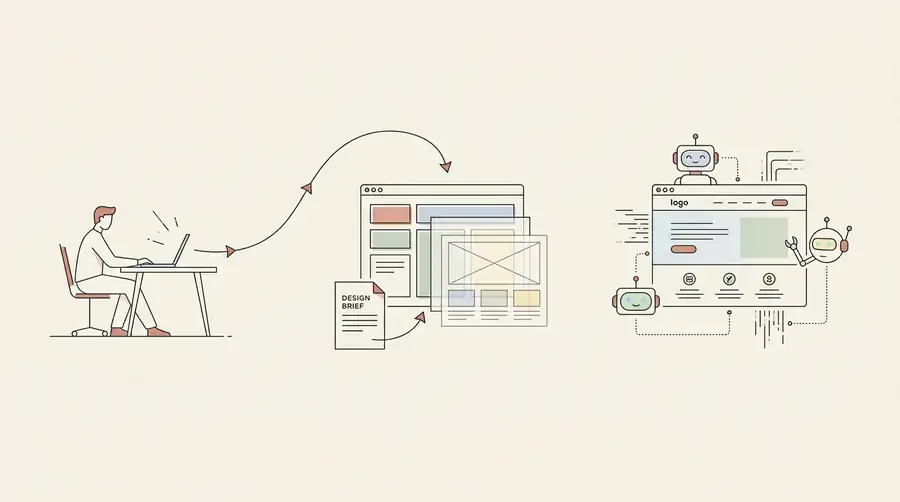
I started by writing a design.md file, a few pages of plain text covering everything a designer normally holds in their head: typography, colour palette, spacing logic, component patterns, and a note on tone. I borrowed structural ideas from public design systems I admire so the site would carry the same considered feel that AI-native companies tend to ship with.
That file became the seed. Fed to Claude Design, the output stopped being generic. It was opinionated: restrained where I had asked for restraint, confident where I had asked for confidence. Recognisably mine. Claude Design is not a designer. It is a renderer, and the brief is the design.
Then Claude Code turned the brief into a real website: the pages, the components, the content collections, the deploy pipeline. I described what I wanted in plain English, read the files it wrote, asked for changes, and kept iterating until it looked right.
What the Build Actually Looked Like
The version where AI does everything for you is a story, not a lived experience, and I want to be honest about it.
Some sessions were brilliant. The homepage came together in an afternoon. Some were grinding. A contact form that worked locally but broke on the live site took most of an evening to track down. I broke things and fixed them, sometimes by asking better questions, sometimes by reading what was on screen until I understood enough to spot the problem.
None of it required me to become an engineer. All of it required me to think like one for a few weeks: specifications, edge cases, what happens when a form is submitted twice. The thinking transfers. The typing does not have to.
The skill that crossed the line is not coding. It is the engineering mindset: clarity about what you want, and patience when the system pushes back.
The Real Payoff: An Agent-Operable Site
Saving a subscription cost is nice. A faster site is nice. Owning the code is nice. None of those are the actual reason.
The actual reason is the agent layer. I already run a small set of agents on the same kind of stack: an SEO agent that audits pages and proposes rewrites, a content agent that generates and updates landing copy, and the newsletter pipeline behind my weekly briefing. The moment the site became code I owned, those agents could reach it.
The website used to be a thing I edited. It is now a thing my AI workflows can operate. That is not a stack change. It is a structural shift in what a marketing site can be.
What I’d Tell Another Marketer
Do not migrate your whole site, that is too big a first step. Build one thing instead: a campaign landing page, a small interactive tool, a microsite for a launch, or a redesign of the single section that has been bothering you for months. Something with a real boundary that you would normally outsource or postpone.
Open Claude Code in one tab and Claude Design in another. Write a real brief, a short design.md, however rough. Then build the thing. You might not finish it the first night, and that is not the point. The point is to find out where the line sits for you now.
The tools are ready. The question is who notices first.