
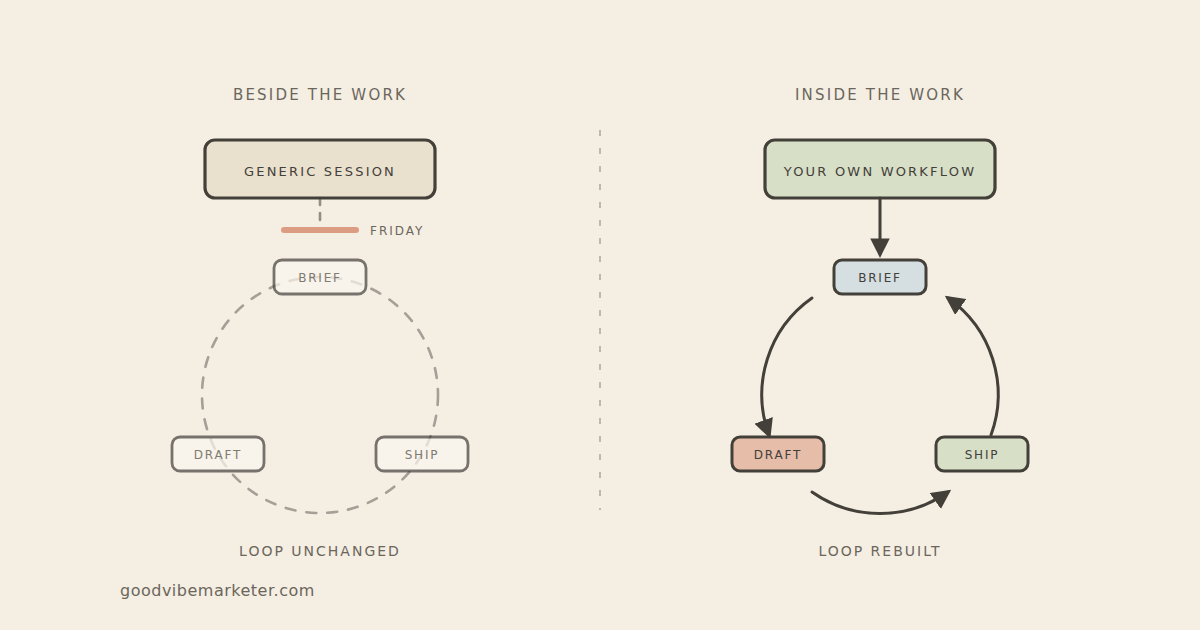
AI marketing training for marketing teams is a hands-on session run on the team’s own campaigns, briefs and tools rather than a generic curriculum. Done properly it ends with two or three workflows the team can run without help by the following Monday. Done badly it ends with notes nobody opens again.
Most teams book the second kind and are surprised when nothing changes.
The instinct behind the booking is right. Somebody senior has worked out that the team needs to actually use this stuff, not just hear about it. What goes wrong is the diagnosis underneath. The assumption is that the gap is tool knowledge, so the fix is a session that explains the tools.
It almost never is. I have sat with marketing teams who could name a dozen AI products, had accounts on five of them, and still shipped every campaign the way they did in 2023. They were not short of information. They were short of a version of their own process that had AI in it.
That is a different problem, and explaining ChatGPT to a room does not touch it. The tools were never the bottleneck, which is a point I have made at length elsewhere and which is the whole reason the format of training matters more than the content of it.
What Separates Training That Sticks From an AI Webinar
The difference is what the session is built on.
A webinar is built on a curriculum. Someone decided in advance what the important things are, in what order, and the same deck runs for every audience. That is efficient for the person delivering it and almost useless for the team receiving it, because the moment they get back to their desk they are looking at their own campaign brief, their own approval chain, their own messy spreadsheet of product claims. None of which appeared in the deck.
Training that sticks is built on the team’s actual work. Not a case study of work like theirs. Their live quarter: the campaign that needs to go out in three weeks, the brief that keeps coming back from product with corrections, the report someone rebuilds by hand every month.
That changes the mechanics of the day completely. Instead of “here is how prompting works”, it is “here is your positioning document, let’s turn it into a brief the model can actually follow, and now let’s run your next campaign through it and see where it falls over”. The falling over is the valuable part. It is where the team discovers that their brand voice was never really written down, or that the approval step nobody documented is the reason nothing ships quickly.
Three things separate the sessions that survive contact with a Monday morning:
The team builds, not watches. Hands on keyboards for most of the session. If people are taking notes for two hours, the value of the day is sitting in a notebook rather than in a workflow.
The output is a working thing, not a plan. A brief that exists, a workflow that runs, a prompt library saved somewhere the team can find it. Plans decay. Artefacts get used because using them is easier than rebuilding them.
There is a named owner for each thing built. Every workflow leaves the room attached to a person. Anything owned by “the team” is owned by nobody and will be dead within a fortnight.
That last one is boring and it is the single strongest predictor of whether a session was worth the money.
Who This Works For, and Who It Doesn’t
The teams this genuinely helps have a shape.
Roughly two to twenty people. Big enough that there are real workflows with handoffs in them, small enough that a day can meaningfully change how a decent proportion of the department works. One person, usually the marketing lead, has quietly been made responsible for “the AI question” on top of a full job, and has no time to answer it properly.
They tend to have already tried. There is a paid Claude or ChatGPT subscription, two or three half-finished automations, and a growing suspicion that everyone else has worked something out that they have not. That is not a knowledge deficit. It is an unfinished build, and it usually needs a day of someone sitting with them rather than a course.
Who it does not work for is worth saying plainly, because it saves people money.
If nobody on the team has protected hours after the session, do not book training. Whatever gets built on the day needs somebody with four or five hours a week to keep it alive through the first month while it is still slightly broken. Without that, you are paying for a very expensive demonstration.
If the organisation has not decided whether AI-assisted work is allowed to ship, training is premature. Sort the policy question first. A team that builds a content workflow and then discovers legal will not approve anything the model touched has wasted a day and learnt something bitter about their own company.
And if the real problem is that the marketing function does not have a clear strategy, AI training will not fix it. It will make the absence of one more visible, faster. That is arguably useful, but it is not what anyone thinks they are buying.
Why Being in the Room Changes What Happens Next
This is the part that sounds like a preference and is actually a mechanism.
Remote training has one structural weakness: the moment someone gets stuck, they go quiet. On a video call, being confused is a public act that requires you to unmute and announce it. So people don’t. They nod, the session moves on, and the specific thing they did not understand is the thing that stops them using it on Tuesday.
In a room, you see it. Someone’s screen has been on the same step for four minutes, or two people have started a side conversation because they both hit the same wall. You walk over. The fix takes ninety seconds and the person is back in. Multiply that by a day and it is the entire difference between a team that can run the workflow and a team that watched a workflow being run.
There is a second thing that only happens in person, and it matters more for AI than for most training subjects. Marketing teams have unspoken process. Nobody has written down that Sarah always rewrites the first paragraph, or that anything mentioning a customer name goes past the account manager first. Those steps are invisible in a documented process and completely obvious when you watch the team work for an hour. They are also exactly the steps that break an AI workflow if you do not design around them.
You cannot extract that over a call. People do not know to tell you, because to them it is not a step, it is just what happens.
So in-person is the default for the AI marketing workshop, and it runs in person in Bristol, Bath and London, remotely for teams further afield. Remote works and I run it. It is just honest to say that the in-person version does something the remote one cannot.
What to Ask Before You Book Anything
Four questions. They will tell you more than any proposal.
What will my team be able to do on their own afterwards? If the answer is a list of concepts they will understand, keep looking. You want a list of things they can do without the trainer present. Vague answers here are the reliable signal of a generic curriculum wearing a bespoke jacket.
What do you need from us beforehand? Anyone building the session on your actual work needs your material in advance. Your positioning, a recent brief, the workflow that annoys you most. A provider who needs nothing from you in advance is running the same day they ran last week.
Have you done the job, or do you advise on it? There is a large and growing category of AI training delivered by people whose experience of marketing is having trained marketers. Ask what they have built and shipped themselves. I spent twenty years in-house building marketing functions from scratch before any of this, which is most of what I bring to a session, and I still build the systems I talk about. The agent loop that runs the SEO on this site is one of them, running weekly, with the mistakes documented.
What happens in the four weeks after? Not a retainer. Just a straight answer about whether there is any support while the thing you built is still fragile. The first month is when workflows die.
Ask those four of anyone, including me. The answers sort the field quickly.
Where to Start
Before you book anything, do one piece of work internally. Write down the three workflows in your team that consume the most hours and produce the least differentiated output. Monthly reporting, first-draft campaign copy, and repurposing usually appear on that list. That document is worth more to a good trainer than any brief you could write about your AI goals.
Then have a conversation before you commit to a format. Half the teams I speak to need a focused hour with the marketing lead rather than a day with the department, and the honest version of that call sometimes ends with me saying you do not need training yet, you need to decide who owns this internally first.
If your team is at the point where AI keeps coming up and nothing has changed in how the work gets done, that is the conversation worth having. The AI marketing workshop starts with a free thirty-minute call to work out what your team actually needs, what format fits it, and whether it is worth doing at all this quarter. No deck, no proposal. Just a straight conversation about where the work is stuck.