
The data says veterans build better with AI than the people who learned to code. The catch is that most of them never try.
There is a quiet fear among experienced marketers. That the AI-native twenty-six-year-old who lives in Cursor is about to lap them. That decades of judgement are being priced down to a prompt.
The data says the opposite.
Anthropic looked at around 400,000 Claude Code sessions from roughly 235,000 people. They inferred each person’s occupation, then measured whether the session actually succeeded. Not “felt productive”. Succeeded, as in the task got done or the thing got built.
Software engineers did not win.
The engineers had no edge
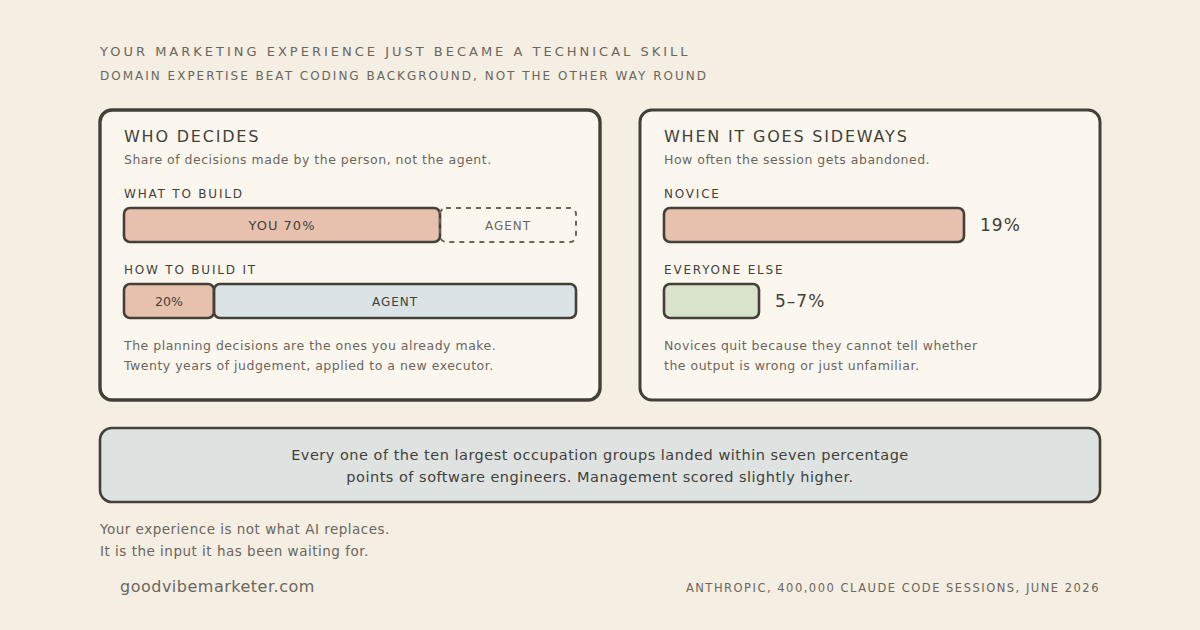
In sessions that produced code, every one of the ten largest occupation groups landed within seven percentage points of software engineers on success rate. Management occupations scored slightly higher than the engineers did.
Read that again if you have ever said “I’m not technical” as a reason to stay in the chat window.
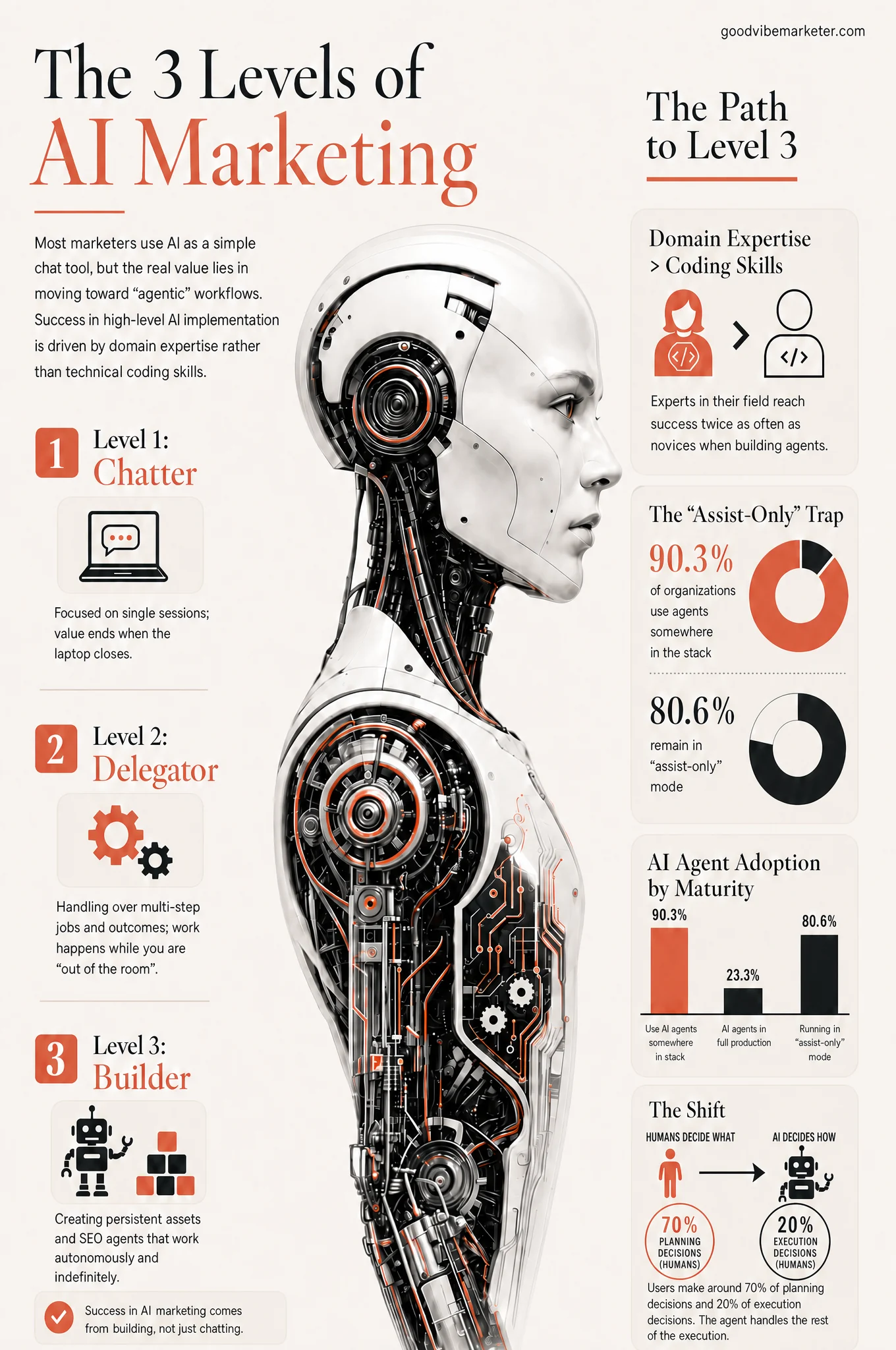
The thing that predicted success was not a coding background. It was domain expertise. Sessions where the person showed expert command of the problem reached verified success more than twice as often as novice sessions.
And here is the part that should interest anyone with grey in their beard. Most of that gain came from moving novice to intermediate, not intermediate to expert. A working grasp of your own domain gets you most of the way.
You do not need to be the best marketer in the world. You need to know your problem better than the model does. That bar is lower than you think.
The model does the how. You still own the what
Anthropic’s summary of the division of labour is the cleanest description I have seen of what building with AI actually feels like. People decide what to build. The agent decides how to build it.
On average, users made about 70% of the planning decisions and 20% of the execution decisions.
Think about what that means for a marketer. The planning decisions are the ones you already make. What the campaign is for. Who it is for. What good looks like. What to measure. Which trade-offs are acceptable. Twenty years of hard-won judgement, applied to a new executor.
The execution decisions, the syntax and the plumbing, are the bit you were never good at anyway. The model takes those.
Experience was always the asset. AI just removed the department that used to sit between your experience and the finished thing.
The real barrier is patience, not skill
There is a harder finding underneath the good news.
When sessions hit trouble, novice-rated users abandoned them 19% of the time. Everyone else, 5 to 7%.
That gap is the whole story. Sessions go sideways. The first attempt almost always needs steering. The people who succeed are not the ones who avoid the wobble. They are the ones who recognise it, know what a correct outcome looks like, and push through.
Novices quit because they cannot tell whether the output is wrong or just unfamiliar. Experts keep going because they can.
I have spent most of two decades in CRM and automation, and the honest description of the last year is this: every real system I have shipped went wrong on the first pass. What got them over the line was knowing what “right” looked like before I started.
The barrier to building with AI is not technical. It is knowing your problem well enough to specify the outcome, and having the patience to steer when the model gets it wrong.
So why are veterans still stuck at Level One?
I map AI use in marketing on three levels. Chatter, Delegator, Builder.
Level 1, the Chatter, asks and receives. Draft this, rewrite that, summarise the call. The value ends when the window closes.
Level 2, the Delegator, hands over whole jobs and walks away.
Level 3, the Builder, creates the thing that does the work. Assets that persist. Work that happens when you are not there.
Most experienced marketers are at Level 1. Which is a strange place for the people the data says are best equipped for Level 3.
The Chatter treats AI as an advanced search engine with a personality. That is fine as a starting point. But it uses almost none of the thing that makes a veteran valuable. Search engines do not need your judgement. Builds do.
The framework is not a ladder of technical difficulty. It is a ladder of how much of your expertise gets applied. Level 1 uses a sliver. Level 3 uses all of it.
What Changes Tomorrow Morning
Pick one job you know cold. Not a new one. The thing you have done a hundred times and could specify with your eyes shut.
Stop asking the model for a paragraph about it. Describe the outcome in full, the way you would brief a capable new hire, then let it build. When it goes sideways, and it will, do not close the window. Tell it what “right” looks like and go again.
That single habit is the difference between the 19% and the 5%.
Your experience is not what AI replaces. It is the input AI has been waiting for. The only question is whether you are going to keep spending it on chat.
If you want a guide to get you to the next level, consider booking a workshop with me.
Sources: Agentic coding and persistent returns to expertise, Anthropic (June 2026).