
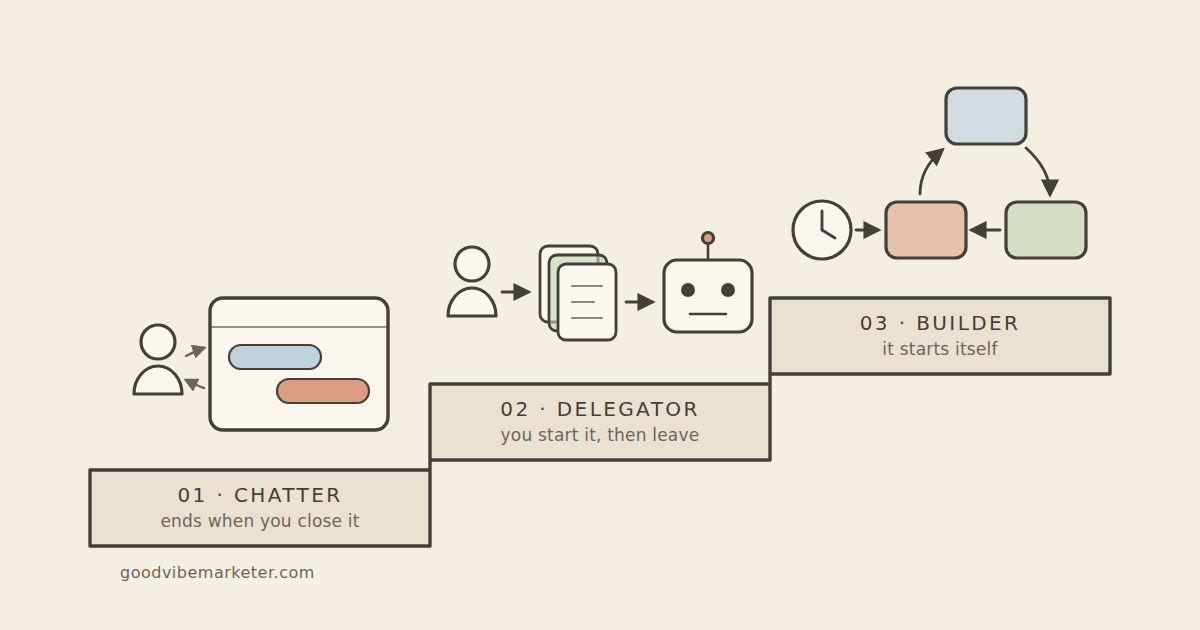
There are three levels of AI use in marketing. Level 1 is chatting: you ask, it answers, and the value ends when you close the window. Level 2 is delegating whole jobs and walking away. Level 3 is building systems that do the work without you. Most marketers are on Level 1.
Most marketers I speak to are using a fraction of what the best models offer, and they do not know it. Plenty are still dismissing AI as a fancy spell checker, or a clever next-word predictor. That was fair once. If you have not been paying attention since, you are judging today’s models by yesterday’s limits.
My favourite model is Claude, so I will use it as the example. Here is how to work out where you actually are.
Level 1: Chatter
You open a chat window. You ask for something. You get something back. You refine it. You copy and paste it. Or you open a new chat, ask a question, and have a conversation with it that you call research.
This is where most marketers live. It is a real start, and it is time you thought about spreading your wings.
Anthropic’s usage data shows the most common thing Claude produces is an explanation, at 17% of conversations. Documents and reports come next at 15%. Guidance at 11%. Code and technical work is about a sixth of everything.
In marketing terms: drafting the email, rewriting the headline, summarising the discovery call, pressure-testing a competitor’s positioning.
Are you a Chatter? You are if this is true: when you close the laptop, nothing continues. The value was in the session, and the session is over.
Level 2: Delegator
You stop asking for outputs and start handing over jobs.
Not “write me a paragraph on X” but “here are forty customer interview transcripts, build me a report on the three objections that recur most, with supporting quotes.” Then you go and do something else.
This is Cowork for multi-step work across files. Projects for campaign planning and brainstorming, with your context loaded once instead of re-explained every Monday. Claude Design for the landing page, the deck, the brand system.
The test: you are describing an outcome, not a paragraph. And you are not in the room while the work happens.
Level 3: Builder
You stop doing the work and start building the thing that does the work for you.
I use Claude Code for this. At Level 3 you are producing assets that persist. A Skill that builds a landing page to your spec, every time, without a re-brief. A scheduled task that runs that Skill on Tuesday morning, whether you are at your desk or not. A website with agents you built to maintain and optimise it. An SEO agent that researches, drafts, publishes, measures performance and adjusts strategy.
I have built all of the above. I am not a developer. I am a marketer. If I can do it, so can you.
The test: the work happens when you are not there.
So where is everyone, actually?
Scott Brinker and Frans Riemersma’s Martech for 2026 report is the best public read on this. 90.3% of marketing organisations use AI agents somewhere in their stack. Only 23.3% have them in full production. 80.6% run in assist-only mode, where the AI suggests and a human decides.
Near-universal experimentation. A thin slice of real production. Most teams have not handed over the API keys.
One caveat worth stating plainly. That 23.3% mostly describes agents bought from vendors and switched on inside existing platforms. It is not a count of marketers who built something themselves. That number is much smaller, and as far as I can find, nobody has published it.
Which is roughly the point. Buying an agent is a procurement decision. Building one is a capability.
What decides whether you can move up
Here is the good news for marketing veterans.
Anthropic analysed around 400,000 Claude Code sessions from about 235,000 people, inferred each person’s occupation, and measured whether the session succeeded.
In sessions that produced code, every one of the ten largest occupation groups landed within seven percentage points of software engineers on success rate. Management occupations scored slightly higher than software engineers did.
What predicted success was not a coding background. It was domain expertise. Sessions where the person showed expert command of the problem reached verified success more than twice as often as novice sessions. Most of that gain came from moving novice to intermediate, not intermediate to expert. A working grasp of your own domain gets you most of the way there.
Their summary of the division of labour: people decide what to build, the agent decides how to build it. On average, users made about 70% of the planning decisions and 20% of the execution decisions.
There is a harder finding underneath it. When sessions hit trouble, novice-rated users abandoned them 19% of the time. Everyone else, 5 to 7%.
So the barrier to Level 3 is not technical. It is knowing your problem well enough to specify the outcome, and having the patience to steer when the first attempt goes sideways.
What to do with this
Find your level honestly. Most people are Level 1 with the occasional Level 2 sprinkled in. That is an OK starting point, but it is not where you should want to stay. If you like being a marketer, AI is just too much fun to stay a Chatter.
I think of it as the move from Chatter to Builder. Three levels, and the gap between the bottom and the top is the difference between saving yourself an hour and building yourself a team.
If you want a guide to get you to the next level, consider booking a workshop with me.
Sources: Anthropic Economic Index report: Cadences (June 2026); Agentic coding and persistent returns to expertise, Anthropic (June 2026); Martech for 2026, Scott Brinker and Frans Riemersma, chiefmartec and MartechTribe (December 2025).