
B2B landing pages have a harder job than B2C. The decision is made by committee. Nobody buys on the page, they request a demo. Your main contact then has to defend the choice to a CFO who never saw your site.
And when these pages underperform, it’s rarely the copy. It’s three competing calls to action, a nav bar full of exits, and a headline with nothing to do with the ad someone just clicked.
That’s a structural problem. So I built something structural to solve it.
This is the sort of thing I spend my time on at GoodVibeMarketer: taking a judgement call I make over and over, writing it down once, and letting it run the same way every time.
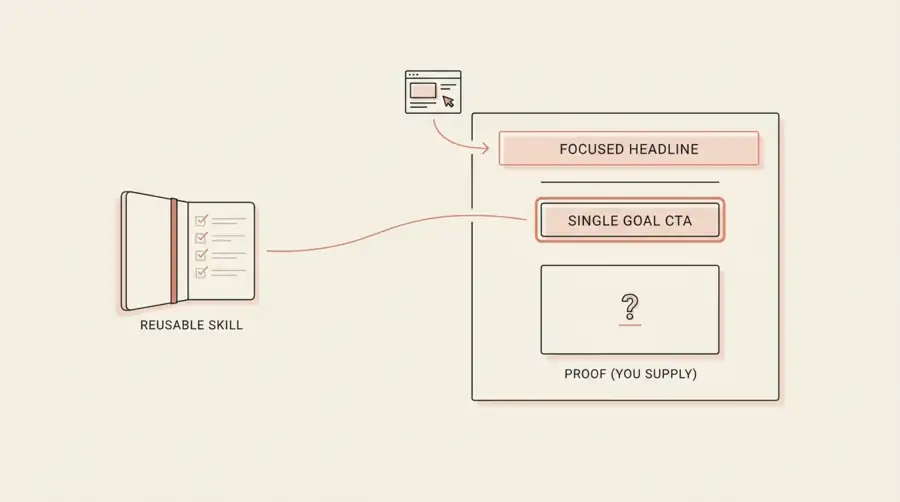
The Skill enforces four rules on every page it builds:
- One conversion action. A single thing to do, repeated down the page, with nothing competing for the click.
- No nav bar. Every link that isn’t the conversion action is an exit.
- Message match. The headline echoes the ad, email or search that sent the visitor there.
- Objections answered on the page. The doubts your contact will hear from their CFO get handled before anyone leaves.
First, what’s a Claude Skill?
A Skill is a set of instructions you give Claude once, that it then follows every time. It’s a repeatable method rather than a prompt you rewrite from scratch. Think of it as encoding an expert’s checklist so the AI applies it consistently, instead of improvising.
How I built it
I took three conversion principles most marketers half-remember, Oli Gardner’s attention ratio, CXL’s work on message match, and Eugene Schwartz’s stages of awareness, and turned them into rules Claude has to follow, not suggestions it might.
The difference matters. A prompt asking for a “high-converting landing page” gets you a generic one. A Skill that enforces one conversion action, no nav, message match to the traffic source, objections answered on the page gets you a page built to actual principles, the same way every time.
It runs in two phases. It asks a few questions (your product, your goal, where the traffic comes from), then drafts the strategy and hands it back for you to correct. You’re editing, not filling in blanks. Then it builds the page in Claude Design.
The rule I’m proudest of: it won’t invent your proof. No fabricated stats, no fictional logos, no testimonial from “a happy customer.” Where you don’t have the evidence, it leaves a marked gap telling you what to go and get. An AI that makes up your customer results isn’t saving you time. It’s handing you a problem you’ll find out about later.
See it work
One sentence about the product, three questions, and it builds the page, with the testimonial slot left deliberately empty, because I couldn’t supply one.
Want to build your own?
Once you see what a Skill can do, the obvious next thought is what else could I encode? I took the idea a long way further and built an agent loop that runs my SEO end to end. But start smaller. Two ways in, depending on how you work:
Start with the skill-creator. It’s a Skill that helps you build Skills. It interviews you about the task, drafts the instructions, and helps you test them. The fastest route if you already know the method you want to capture.
Or just record yourself doing it. Claude’s newer Record a skill feature lets you screen-record a task while narrating what you’re doing and why, and Claude turns the demonstration into a reusable Skill, with no writing instructions from scratch. It’s in the + menu of the Claude desktop app. This is the one to reach for when the task lives in your hands but you’ve never written it down.
The real skill isn’t either tool. It’s knowing which of your repeated tasks is worth encoding, and being able to articulate the rules you follow without thinking. That’s the part I write about here, and the part we work through together in the AI marketing workshops.
Questions people ask
Is the B2B landing page Claude Skill free?
Yes. It lives on my public GitHub and you can read the whole thing before you run it, which is rather the point: the rules are visible, so you can argue with them. You’ll need a Claude account to use it, and Claude Design for the build phase. There’s no paid tier of the Skill sitting behind the free one.
Do I need Claude Design to use it?
For the build phase, yes. The first phase is strategy and it comes back as text: the conversion action, the message match, the objections to answer, and the proof you don’t yet have. That part is useful on its own, and you can hand it to whoever builds your pages. Claude Design is only where the page itself gets made.
Will the Skill invent testimonials or statistics?
No. Where you don’t have the proof, it leaves a marked gap in the page telling you what to go and get. Most AI drafting tools fill that space with a plausible customer quote instead. That isn’t a time saving. It’s a claim someone will ask you to defend later, in a meeting, with nothing behind it.
Do I need to be technical to build a Claude Skill of my own?
No. A Skill is written instructions, not code. The hard part is articulating rules you follow without thinking about them, which is a writing problem rather than an engineering one. If you can brief a freelancer properly, you can write a Skill. Writing the brief is the control surface now, and it is the part that keeps paying as the tools underneath keep changing.
What’s the difference between a Skill and a good prompt?
A prompt is a one-off. You write it, get a result, and rebuild it from memory next time. A Skill stores the method outside the conversation, so the same rules apply on every run and you improve the rules rather than the wording. The same logic scales up to whole pipelines, which is where it stops being a time saver.
Get the Skill
It’s free, and it’s on my public GitHub. Grab it here →
There’s buzz lately about GitHub becoming the new CV for marketers. It’s no accident I’m sharing mine. The Skills I build are open for anyone to use, and the repo is where you’ll find them. This is the first. More are coming.