
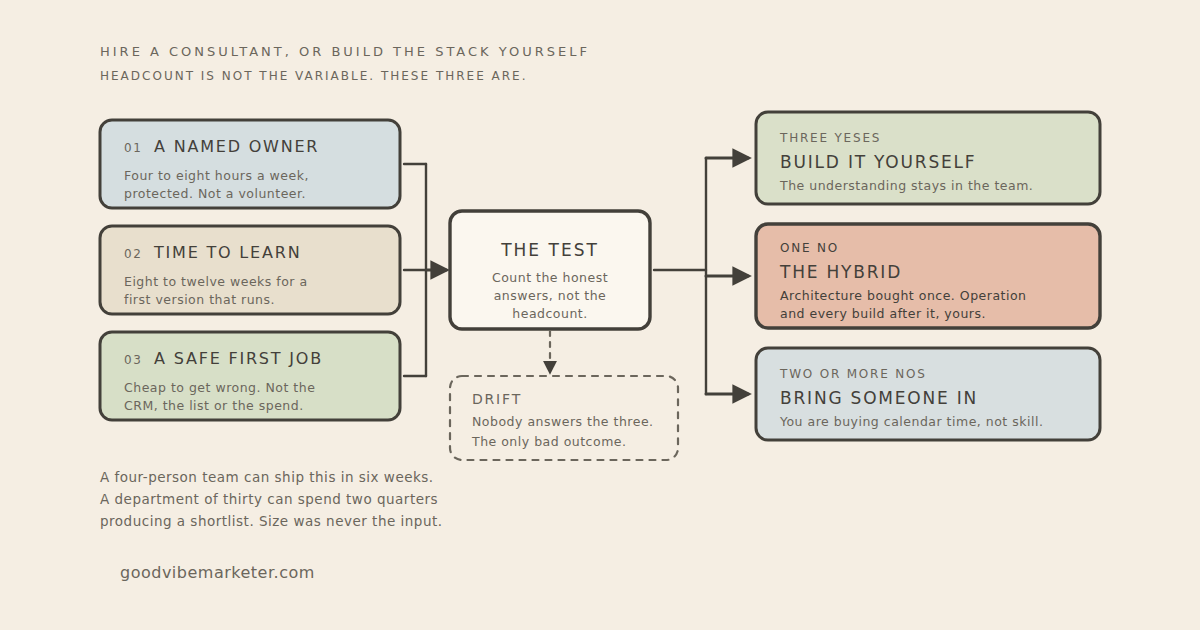
Hire a consultant when the answer to any of three questions is no: is there a named person with real hours to own the build, can the business wait the two or three months a first version takes, and is the first workflow you automate safe to get wrong. Three yeses means build it yourself.
That is the test. It has nothing to do with the size of your team.
The question most teams actually ask is “do we have the people for this?”, which sounds sensible and predicts almost nothing. I have watched a four-person team stand up a working content pipeline in six weeks, and I have watched a marketing department of thirty spend two quarters producing a tooling shortlist and a governance document. Headcount was not the variable. Neither was budget.
What separated them was whether one identifiable person had unbroken hours, a clear mandate, and permission to be visibly bad at something for a month.
That is the thing to assess. Not capability in the abstract. Capacity, ownership and the cost of the first mistake.
The Three Questions, Answered Honestly
Is there a named person with real hours? Not a volunteer, not an enthusiast who reads about AI at weekends, and not “we’ll all pitch in”. One person, named, with somewhere between four and eight hours a week protected in their calendar for at least a quarter. If you cannot say the name out loud, the answer is no. Enthusiasm without protected time produces a Slack channel full of links and nothing that runs on a Tuesday when nobody is looking.
Can the business wait? A first working version of anything genuinely useful, a research agent, a content pipeline, an enrichment workflow, takes eight to twelve weeks when someone is learning as they build. Most of that is not the building. It is discovering that the obvious approach was wrong, which is unavoidable and is where the actual understanding comes from. If there is a number attached to this quarter that depends on the system existing, you do not have eight weeks to spend learning. That is a legitimate reason to buy the time instead.
Is the first thing you automate safe to get wrong? Draft content that a human reviews before it ships is safe to get wrong. A workflow that writes to your CRM, sends to your list, or spends ad budget is not. Start in the safe category and the learning curve costs you embarrassment. Start in the expensive category and it costs you data integrity or a customer.
Three yeses is a build. One no is worth a conversation. Two or more and you are choosing between hiring help and quietly not doing it, which is the outcome most teams end up with by default.
When Building It Yourself Is the Right Call
The case for building is stronger than most consultants will tell you, and it is not about money.
It is that the understanding lives in the wrong place if you buy it. A system somebody else designed is a system you operate but cannot modify, and marketing workflows change constantly. New campaign shape, new product line, new voice guidance. If every change needs an outside call, you have bought a dependency rather than a capability.
Building also produces knowledge that transfers. The person who wires up their first agent learns what a brief has to contain, where AI output degrades, and which parts of their own process were never really defined. That knowledge shows up in every subsequent decision, including the decision about what to buy later.
So build first when the stakes are low and the clock is not running. Pick one workflow that irritates you weekly, keep a human in front of the output, and get it running end to end before you make it good. The Blueprint lays out the architecture I use on this site if you want a reference to work from rather than starting from a blank page.
One honest caveat. Building your own does not mean handing the whole job to the model and hoping. That failure mode is common enough that I wrote about it separately in the delegation trap, and it is the main reason first attempts collapse.
When Bringing Someone In Wins
Three situations where the build-it-yourself instinct costs more than it saves.
The first is when the clock is real. A commitment has been made, to a board or a client or a launch date, and the system has to work before the learning curve would let it. Paying for someone who has already made the mistakes is not a shortcut. It is buying calendar time, which is the one input you cannot manufacture internally.
The second is when the first workflow is load-bearing. Anything touching customer data, deliverability or spend has a failure mode that is not recoverable by closing a browser tab. This is exactly the territory where a first-time build should not be the thing that runs in production. Get the architecture right once, with someone who has seen it break, and then own it.
The third is subtler and more common. The team has already tried. There are three half-built automations, a tool subscription nobody cancelled, and a growing sense that this is harder than the demos suggested. That is not a skills problem, it is a sequencing problem, and it is the pattern I described in the tools aren’t the bottleneck. Teams in this state rarely need teaching from scratch. They need someone to look at what exists, say which two things to keep, and make one of them work properly.
Note what all three have in common. None of them are about the team lacking intelligence. They are about time, risk and sequence.
The Hybrid Most Teams Actually Need
The genuine answer for the majority is neither of the above, and it is boring enough that nobody sells it.
Bring someone in for the first build and the architecture. Own the operation and every build after that. The outside work is deliberately short, a focused session or a day rather than a retainer, and it ends with something running plus a document your team can read and change. Then the internal owner runs it, breaks it, fixes it, and builds the second one alone.
This works because the expensive part of an AI marketing stack is not the building. It is knowing which workflow to build first, how the handoffs between steps should be shaped, and where to put the review gate so quality holds when nobody is watching. That is a small number of decisions, made once, and they are exactly the decisions a first-timer gets wrong.
The pattern to avoid on the other side is the open-ended retainer where an external party runs the system indefinitely. That is not help, it is an outsourced marketing function with an AI label. If the engagement does not end with your team more capable than it started, the shape is wrong regardless of who is doing the work.
Judge any proposal on one question: what will my team be able to do on their own afterwards? If there is no clear answer, the answer is nothing.
Making the Call
Run the three questions this week. Write the name of the owner down, or admit there isn’t one. Put a date on when the system has to work. Pick the first workflow and say honestly what happens if it produces something wrong.
Most teams find they have one or two yeses, not three. That is not a failure, it is just information, and it tells you which of the two paths above to take rather than leaving the decision to drift for another quarter. Drifting is the only genuinely bad outcome here, because the teams that embed a coherent system early end up operating differently to the ones that accumulate tools.
If you have run the test and landed on bringing someone in, a conversation is the sensible next step rather than a proposal. The AI marketing workshop starts with a free thirty-minute call to work out what your team actually needs building and whether it is worth building at all. Sometimes the honest answer on that call is that you should do it yourself, and I would rather say that than sell you a day you did not need.