
Before hiring an AI marketing consultant for B2B, check three things: whether their results came from high-volume consumer funnels, whether they have worked inside a long sales cycle rather than advising on one, and whether they can name what they would refuse to automate. Most AI marketing credentials are ecommerce credentials wearing a B2B label.
That is not a slight on anyone’s work. It is a description of where the data is.
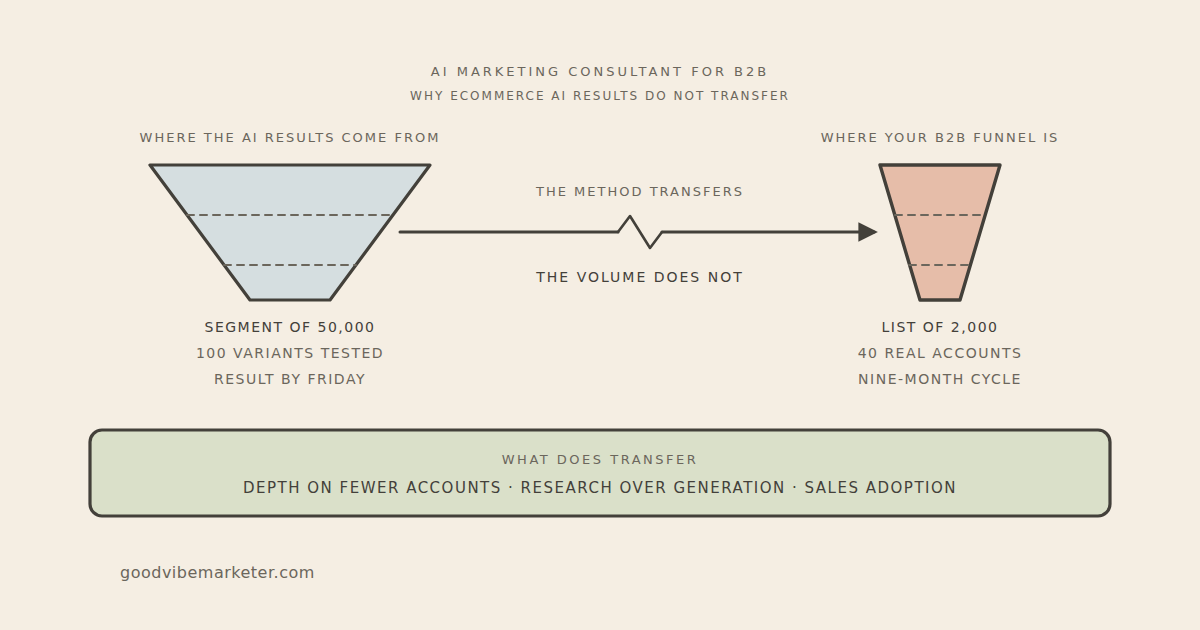
Almost every impressive AI marketing result you can read publicly comes from volume. Thousands of product descriptions. A hundred ad variants tested against a segment of fifty thousand. Subject lines optimised across a list big enough that a two percent lift is visible by Friday. Those are real results and the methods behind them are sound.
Volume is the one thing B2B does not have.
A list of two thousand, forty accounts that could plausibly buy this year, a nine-month cycle, and a decision made by four people in a room you are not in. Run consumer-scale AI tactics against that and you get output nobody reads, tests that never reach significance, and a dashboard that looks busy while the pipeline does not move. The consultant is not being dishonest. They are applying a method that works, to a shape it was not built for, confidently.
So the hiring question is not “are they good at AI”. Plenty are. It is whether their instincts were formed on your kind of problem.
What Changes About AI Marketing When the Sample Size Is Small
Four things behave differently, and they are the ones worth probing.
Personalisation stops being statistical. In consumer marketing, personalisation is a numbers game: generate many variants, let the data pick. In B2B, the person receiving your carefully personalised sequence may be one of nine people who matter this quarter, and they will notice the seams. The AI opportunity here is not more variants. It is depth on fewer targets: knowing the account’s regulatory position, their last three job postings, which competitor they just churned from. Personalisation in B2B is a research problem dressed as a copy problem.
Research and enrichment beat generation. The highest-return AI work I have done for B2B clients has almost always been about knowing things rather than producing things. Populating a CRM with intelligence that no vendor sells. Reading a market properly instead of guessing at it. On one project, GoodVibeMarketer built an enrichment workflow for a B2B insurance data firm whose HubSpot instance was full of contacts and empty of the one field that mattered, which was what each company actually did. The full write-up of that build is here, and the point relevant to hiring is that the deliverable was structured data, not content. A consultant whose reflex is “let’s produce more” will not find that work, because it does not look like marketing.
Sales alignment is load-bearing, not a nice-to-have. In ecommerce the funnel ends in a checkout. In B2B it ends in a human conversation, which means anything marketing produces with AI has to survive contact with a sales team who will simply not use it if it is wrong. Ask a consultant how they get sales to adopt something and you learn a lot quickly. If they have only worked where there is no sales team, they have never had this constraint and it shows in what they recommend.
More content is usually the wrong answer. It is the default recommendation because it is easy to scope and easy to demonstrate. It also fails in the specific way B2B fails: your buyer does not have an information shortage, they have a trust and risk problem, and thirty more posts do not touch it. Sometimes volume is right, particularly for search and answer-engine coverage. But it should be argued for, not assumed.
If a consultant cannot explain why B2B is structurally different from the funnels most AI marketing content describes, they will optimise the wrong object. Enthusiastically, and with good tooling.
The Questions Worth Asking Before You Hire
You are not testing their AI knowledge. Assume it is fine. You are testing whether it has ever met your conditions.
“What was the list size in your best result?” The single most efficient question. If the answer is in the tens of thousands, everything they learned about testing, personalisation, and iteration speed was learned in an environment you do not operate in. That does not disqualify them, but it tells you what to discount.
“Talk me through a long sales cycle you have actually worked inside. Where did AI help, and where did it not?” Note the wording. Not advised on, worked inside. There is a real difference between someone who has sat through nine months of a deal and someone who ran a three-week engagement and left before anyone knew whether it worked.
“What have you built that is still running without you?” This separates the two kinds of AI consultant. One produces recommendations and workshops. The other leaves working systems behind. Both are legitimate, but only the second has been forced to deal with the parts that break in month three. Ask what broke.
“What would you refuse to automate in a B2B funnel?” The most revealing question on the list. Anyone who has done this work has a firm list: probably outbound to named strategic accounts, probably anything the buyer will read as a personal message, probably claims that touch compliance or product capability. Someone with no such list has either not worked in a regulated or high-consideration market, or has never had something go wrong. You want the scar tissue.
“How would you know it worked?” Attribution in a nine-month cycle is genuinely hard, and a good answer says so. A bad answer offers you a dashboard. What you are listening for is whether they will commit to a leading indicator that is honest about the lag: qualified conversations, meetings from named accounts, sales team adoption, research cycle time. Anything measured weekly in a market that buys annually is theatre.
Five questions, and you can ask all of them in twenty minutes. They are more useful than a case-study deck because none of them can be prepared for in the abstract.
What a Good Answer Sounds Like
Concrete beats confident. Here is the difference.
A weak answer to the cycle-length question sounds like: “AI compresses the sales cycle by keeping prospects engaged with personalised nurture at every stage.” That is a sentence about AI. It contains no information about their experience.
A strong one sounds like: “The cycle did not compress. What changed was that our SDRs stopped spending two days a week researching accounts, because the research arrived already done and structured, so they had more conversations with the same headcount.” Same technology. Completely different claim, and a checkable one.
A weak answer on measurement offers you attribution. A strong one names the lag, picks a leading indicator, and tells you what would make them abandon the approach. People who have been wrong in public are noticeably more specific about failure conditions than people who have not.
A weak answer on what not to automate is “you always need human oversight”. A strong one is “I would not let a model write anything that makes a product claim, because in your market the claim is the liability and the model does not know which claims your legal team has already lost an argument about.”
You are listening for constraints. Anyone can describe capability. Only someone who has done the work can tell you where it stops, and the boundary is the useful part. That is the same reason I keep arguing that the tools are rarely the bottleneck: the differentiator is judgment about where to point them.
One more test, which is quieter. Ask what they would do first, then listen for whether the answer starts with your business or with their process. “It depends what your sales team is currently doing manually” is a better opening than a named framework, however tidy the framework is.
Check the Evidence, Not the Deck
Case studies are marketing. Treat them as such, and go one layer down.
Ask for the artefact. Not the results slide, the thing itself. The brief they wrote, the prompt library, the workflow diagram, the actual output. AI marketing work leaves evidence, and the quality of that evidence is legible even to someone non-technical. Vague artefacts mean vague work.
Ask what the constraint was. Real projects are shaped by limits: no budget for a new tool, a CRM nobody trusted, a compliance team with veto, a sales director who had been burned before. If a consultant describes projects with no friction in them, they are describing the version they wish had happened.
Ask about the client’s own capability afterwards. In B2B, the engagement almost always has to end with your team able to run the thing. Someone whose model depends on being permanently in the loop will build for that, whether they mean to or not.
Weigh in-house experience properly. Agency-side experience gives breadth, which is genuinely valuable. In-house experience gives something different: having been accountable for the number, having had to get the CFO to fund it, having lived with the consequences of a bad call for two years. My own background is almost entirely B2B and almost entirely client side, including building a marketing function from a single-page website with no newsletter and no blog. That is not the only useful shape of experience, but you should know which one you are buying.
And if you are still deciding whether to hire at all rather than build the capability internally, that is a different question with a different answer, and I have written about when each one makes sense. This piece assumes the decision is made.
If You Have Decided to Hire
Run those five questions past whoever is on your shortlist, including me. The point of writing them down is that they work as a filter regardless of who ends up in the room, and any consultant worth hiring will enjoy being asked.
For the broader shape of the role, what an AI marketing strategist actually does covers how these engagements tend to run in practice.
If you would rather test the thinking than read about it, that is what the first conversation is for. The AI marketing workshop runs on your own campaigns and briefs rather than a generic curriculum, one to one or with a small team, and it starts with a free thirty-minute call about where your B2B funnel actually is. Bring the awkward constraint, the CRM nobody trusts, the cycle that takes nine months. Those are the interesting parts, and they are how you find out quickly whether someone has done this in your world or only in a bigger, faster one.