
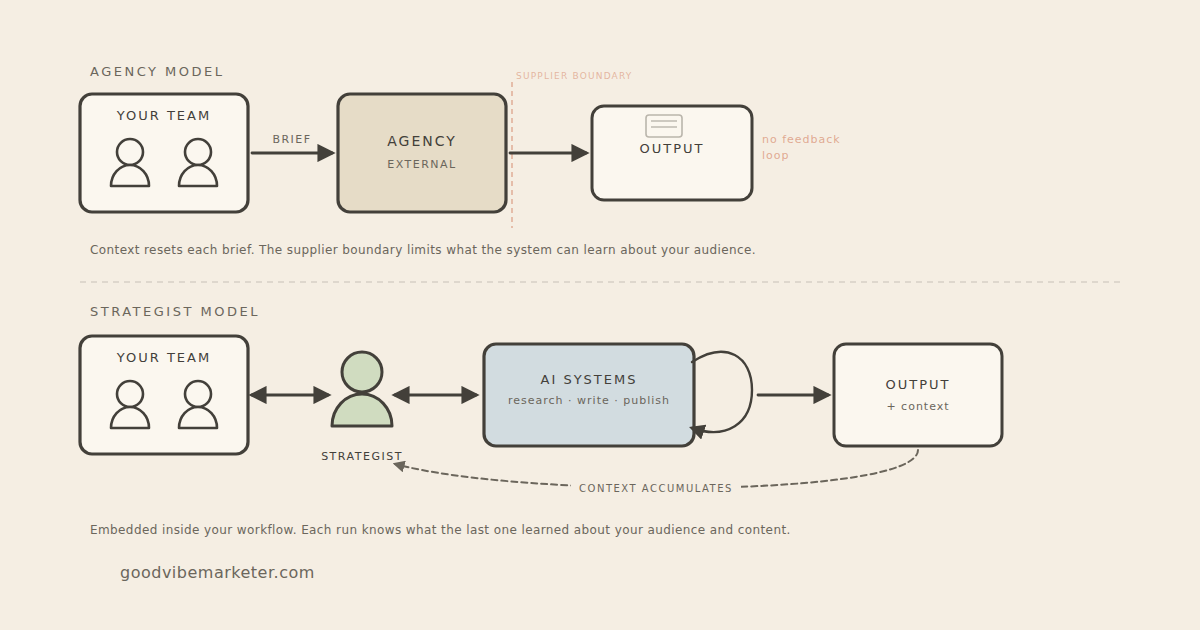
An AI marketing strategist designs, builds, and embeds AI-powered workflows directly inside your marketing operations. The output is a functioning system, not a content batch or a strategy deck. The distinction that matters: the role exists to change how your team produces things, not to produce things on your behalf.
That distinction is also why the role is easy to conflate with an AI agency. And why conflating them leads to the wrong hire. I run GoodVibeMarketer, and that conflation is the most common reason a first conversation goes nowhere.
An agency delivers output. A strategist changes the machine that produces output. Both are legitimate. They are not substitutes.
The work itself is fairly consistent from engagement to engagement. It comes down to five things:
- Audit the workflow, not the tools. Where briefs come from, where they go, and where quality breaks down.
- Pick the high-leverage workflows. Usually first-draft content, research and summarisation, newsletter curation, competitive monitoring.
- Wire agents into the systems the team already runs. The CRM data, the editorial archive, the analytics layer.
- Design the review layer. What gets checked automatically, what needs a human eye, where the standard sits.
- Hand it over. A working system plus a short brief the team can maintain and modify itself.
Why This Role Exists Now and Did Not Five Years Ago
Five years ago, building agent-driven content and research workflows required a dedicated engineering team. Marketing sat firmly on the consumption end of AI: copy suggestions, sentiment tagging, ad optimisation nudges. Useful at the edges. Nothing that changed how the function operated.
That changed quickly. The shift described in From Vibe Coding to Vibe Working captures it precisely: the line between using AI and building with AI collapsed. A marketer who understands a code repository, can write a clear brief, and knows how to wire a scheduled agent is now operating in territory that required a software engineer two years ago.
That capability created a new kind of practitioner. Not a developer. Not a traditional marketing consultant. Someone who understands marketing strategy well enough to know what to build, and understands the current generation of AI tools well enough to actually build it.
This person is rare inside organisations. Most marketing teams have people who are good with tools and people who are good with strategy. Very few hold both at once and can translate one into the other at a working level. That gap is what the role fills.
I’ve watched this pattern before, at an earlier point in my career. The print teams that resisted the move to digital paid for the same ground twice, under more pressure the second time. The AI transition has the same shape, and it’s moving faster.
The timing matters too. The decisions made now about how to structure AI in a marketing function are not easily reversed. Teams that embed coherent systems early will operate differently to those that accumulate ad hoc tool use. The strategist’s job is partly to make sure the early decisions are the right ones.
What We Do That an Agency Cannot
The structural difference is integration.
An agency works from a brief. They produce output and hand it back. The context that lives inside your organisation, your audience data, your past campaigns, your brand voice, your editorial history, gets translated into a brief, handed across a supplier boundary, and then largely lost. The next brief starts fresh. The agency’s understanding of your market improves slowly, if at all.
A strategist works inside your systems. They wire agents to the CRM data your team already maintains, to the editorial archive you have already built, to the analytics layer that already knows what content performs. The output compounds. Each run has access to what the previous run learned.
This is the gap that tools alone cannot close. Access to Claude or GPT-4o does not produce a functioning content pipeline any more than access to a word processor produces a content strategy. Someone has to design how the pieces connect, build the handoffs between agents, and embed the review process that keeps quality stable when nobody is watching.
A second difference is ownership. When a strategist’s engagement ends, the systems they built stay. Your team operates them. There is no dependency on an external supplier for every content run or research batch. The leverage is internal, and it compounds as the team learns how to use what was built.
That is a different value proposition to an agency retainer. It is also a different relationship with risk. If an agency relationship ends, the work stops. If an AI system built for your team is structured properly, it continues running.
What We Do Not Do
This is worth being direct about, because the expectations brought into these engagements vary widely.
We do not replace your marketing team. We wire AI systems to the work your team is already doing, so that work scales or improves without proportional headcount additions. The people stay. The operating model changes. The time previously spent on the most repetitive and least-differentiated work gets redirected.
We do not produce volume for its own sake. An AI content pipeline that generates two hundred articles a month is a liability if the quality gate is absent. Part of the build is designing the review layer: what gets checked automatically, what requires a human eye, where the standards are set. Throughput without that layer is not an asset.
We do not manage ad spend, run PR, or build brand positioning from scratch. Those are adjacent to what we do but they are their own disciplines.
And we do not begin without a working strategy. AI systems amplify what already exists. If the positioning is unclear, the targeting is fuzzy, or the content strategy has no editorial logic, we are not the first hire. We are the one who operationalises the strategy once it exists.
How the Engagement Actually Runs
The starting point is not a tool audit. It is a workflow audit.
Where do briefs come from in your current process? Where do they go? Where does quality break down? Where is time going that should not be? These are not abstract questions. They need real answers from the people doing the work, not from whoever wrote the job description.
From that conversation, a small number of workflows get identified as high-leverage candidates: typically the ones that consume the most time for the least differentiated output. First-draft content. Research and summarisation. Newsletter curation. Competitive monitoring. These are rarely glamorous. They are also exactly the workflows where an agent system creates genuine relief.
The build is deliberately short. You leave the session with a working system and a brief document your team can use to maintain and modify it as requirements change. Not a polished slide deck, not a sixty-page specification. Something that runs.
The format is a focused working session, one to one or with a small team: a focused hour, a half day, or a full day, depending on scope. Delivery is in person in Bristol, Bath, and London, or remote for teams elsewhere in the UK. No months-long retainer, no multi-phase programme. The engagement is sized to what actually needs building.
Questions People Ask
How is an AI marketing strategist different from an AI agency?
An agency takes a brief, produces the work, and hands it back. A strategist builds the workflow that produces the work, then leaves it with your team. You are buying capability rather than output, which is why the two are not interchangeable even when the deliverables look similar on a proposal. The longer comparison is in AI marketing consultant vs agency.
When does a marketing team actually need one?
When real work is being repeated by hand and nobody internally holds both the strategic context and the technical confidence to automate it properly. If you have a named person with protected hours and the patience to be visibly bad at something for a month, build it yourself instead. The three-question test for that decision is worth running before you hire anyone.
How long does an engagement take?
Short, deliberately. The format is a focused working session, one to one or with a small team, sized as an hour, a half day, or a full day depending on scope. Delivery is in person in Bristol, Bath, and London, or remote for teams elsewhere in the UK. No retainer, no multi-phase programme.
Do we need a marketing strategy in place first?
Yes. AI systems amplify whatever logic they are given, so unclear positioning or fuzzy targeting gets produced faster rather than fixed. If the editorial thinking is not settled, the first hire is someone who settles it. A strategist operationalises a strategy that already exists, and is the wrong first call when one does not.
If you want to understand what this looks like on your domain, the AI marketing workshop is where to start. A free thirty-minute call to map the opportunity before anything else. No obligation, no sales process. Just a conversation about whether the problem is the kind of problem this engagement solves.