
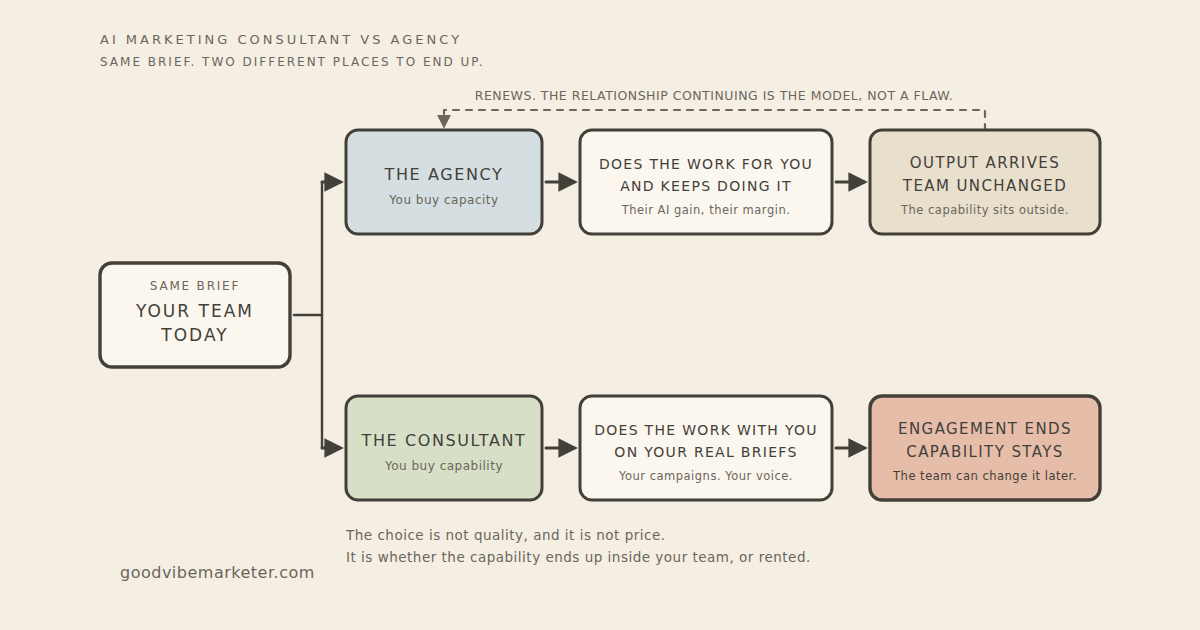
An AI marketing agency does the work for you and keeps doing it. An AI marketing consultant makes your team able to do it and then leaves. Both can be the right call. The choice is not about quality or price, it is about whether you want the capability in-house or rented.
Which sounds like a distinction without a difference until you look at where each one ends.
GoodVibeMarketer sits on the consultant side of that line, so read what follows as a view from inside one of the two models rather than a neutral survey. The case for the agency is further down, and it is a real one.
Most marketing leaders frame this as a buying decision. Two suppliers, two proposals, compare scope and cost, pick one. That framing quietly assumes the deliverable is the same thing in both cases and only the delivery model differs.
It is not the same thing. One engagement ends with content in your calendar. The other ends with a team that can produce it. You can buy either, but you cannot buy the second one by accident while shopping for the first.
So the real question is not consultant or agency. It is whether, in eighteen months, you want AI marketing to be something your team does or something you pay for.
An Agency Is Built to Own the Work, Permanently
This is not a criticism. It is the design.
An agency’s economics depend on retained accounts. The good ones invest in understanding your market, build a team around your brand, and run a function you would otherwise have to staff. The model works because the relationship continues, and the value compounds for you as their knowledge of your business deepens.
That has real advantages. Capacity from day one, no hiring cycle, no learning curve to fund internally, and someone accountable when the work does not land. If you need output and you need it in three weeks, an agency is a rational purchase and a consultant is not.
What it does not do is change what happens inside your building.
The AI part makes this sharper than it used to be. When an agency adds AI to its delivery, the gain is theirs first. They produce faster, with fewer people, at the same fee. Your cost may not fall and your team’s capability certainly does not rise. You have bought the output of an AI-assisted workflow without acquiring the workflow.
Six months in, your team is exactly where it was. That is fine if you never wanted them anywhere else. It is a problem if the plan was for AI to change how your department operates, because the department has not touched it.
A Consultant Is Built to Make Themselves Unnecessary
The consultant model runs the other way. The engagement is short by design, and the deliverable is what your team can do afterwards.
In practice that means working on your live campaigns and your real briefs rather than a generic curriculum. Your product, your voice guidance, your messy approval process. The output of the session is a workflow that runs on Monday, plus the person on your team who now understands why it is shaped the way it is and can change it when the campaign changes.
The format follows from that. It can be a focused hour, a half day or a full day, one to one or with a small team, because the unit is a decision made properly rather than a volume of output delivered. Anything longer usually means the scope has drifted back towards doing the work, and anything shorter tends to be a talk rather than a build.
That last part is the whole point. Marketing workflows are not stable. New product line, new positioning, a competitor doing something irritating. A system you cannot modify is a system that decays the moment conditions move, which is why buying a finished machine you do not understand ages badly.
The honest limitation: this is slower to show output. An agency produces work in week one. A consultant produces capability over a few weeks, and capability looks like nothing on a dashboard until it starts producing. If your quarter depends on volume shipping immediately, this is the wrong purchase and you should say so.
There is also a version of consulting that is really just agency work with a shorter contract. The test is simple. Ask what your team will be able to do on their own afterwards. If the answer is vague, you are buying delivery with a different label, and the same instinct applies that I wrote about in the delegation trap: handing the whole job over feels efficient right up until you need to change something.
Where the Agency Genuinely Wins
Three situations where hiring the agency is the better decision, and pretending otherwise would be self-serving.
- Sustained volume you cannot staff. A headcount problem, not a capability problem.
- Specialist, occasional work. Deep expertise and expensive tooling you need a handful of times a year.
- Nobody internally has hours. Capability transfer needs one person with protected time to absorb it.
Each one gets a paragraph below.
You need sustained volume you cannot staff. Twelve campaigns a quarter across four markets is a headcount problem, not a capability problem. No amount of training makes three people into eight. Buy the capacity.
The work is specialist and occasional. Paid media at scale, technical production, anything where the expertise is deep, the tooling is expensive and you need it four times a year. Building that in-house is a bad trade. Rent it.
Nobody internally has hours. This is the most common and the least admitted. AI capability transfer requires someone on your side with protected time to absorb it. If every marketer you employ is at capacity and will still be at capacity next quarter, consulting will be politely received and then quietly abandoned. An agency needs nothing from you except a brief and a signature, and sometimes that is the realistic option. I unpacked the version of this test that applies to building your own stack in hire a consultant vs DIY AI marketing stack, and the named-owner question is the one that decides it either way.
There is a fourth that people expect to see on this list and it does not belong: the idea that AI moves too fast for an internal team to keep up, so the specialism has to be outsourced permanently. The tools move fast. The judgement underneath them, what to automate, where to put the review gate, what good output looks like for your market, moves at the speed of your business. That part is not a specialism you can rent, because nobody outside your company has it.
Notice none of these are about the agency being better at AI. They are about volume, specialism and internal capacity. If your reason for choosing an agency is that AI is complicated and they seem to know about it, that is not a reason. That is deferral.
The Local Picture Is Not Balanced, and It Should Inform the Choice
Look at who is available around here and the market has an obvious shape.
The South West is well served by full-service agencies, most of which now market AI services alongside everything else. That is a competitive, capable supply. What is much thinner on the ground is practitioners who will sit with your team and make them able to do the work, rather than taking the work away.
Part of that is economics. Teaching a team is worse business than retaining them, so most of the market has correctly chosen the retained model. Part of it is background. Making a marketing team capable is a different skill to running campaigns for them, and it tends to come from having run marketing in-house rather than from having served clients. Twenty years of building marketing functions from the inside is where I take my view of this from, which is covered on the about page rather than here.
This is also where being in the room matters, and it is the least discussed variable in the whole decision. Remote-delivered AI consulting has a specific failure mode: the session goes well, everyone is enthusiastic, and by Friday the team is back in the old workflow because the new one required a decision nobody was there to make. In person, that decision gets made while someone is standing next to them. Being close enough to turn up is not a convenience feature. It is most of why the work sticks, which is the argument behind the in-person workshop in Bristol and why in-person delivery is the default rather than the upsell.
How to Decide in One Question
Skip the proposals for a moment and answer this: in eighteen months, do you want your marketing team producing AI-assisted work themselves, or do you want a supplier producing it for you?
Both are legitimate operating models. Plenty of good companies run entirely on the second and always have.
But answer it deliberately, because the default answer is the second one, and most teams arrive there without ever choosing it. They hire an agency for capacity in a busy quarter, the arrangement works, it renews, and three years later the AI capability sits with the supplier along with everything else. That is not a bad outcome. It is just an outcome nobody decided on.
If the answer is in-house, the sequence is capability first and capacity second. Get one workflow running with your own people, understand where it breaks, then buy volume around a system you actually understand. Doing it the other way round means the agency’s workflow becomes your process by default, and you inherit a way of working you did not design.
Questions people ask
Can an agency just train our team instead?
Some will, and it is worth asking. The test is whether capability transfer is in the scope or a side effect of it. An agency’s economics rest on the account continuing, so training that reduces your need for them runs against the model rather than with it. Ask what your team will be able to do without them in six months, and whether that answer appears anywhere in the contract.
What does an AI marketing consultant actually deliver?
A workflow that runs on your own campaigns, plus someone on your team who understands why it is shaped that way and can change it when the campaign changes. What an AI marketing strategist actually does sets out the five things the work covers and what it deliberately does not. The deliverable is capability, not a content batch.
How does the cost compare to an agency retainer?
It is the wrong comparison, and it catches people out. A retainer is a recurring cost for as long as you want the output. Consulting is a one-off cost against something your team keeps afterwards. The number worth comparing is what you expect to be paying in eighteen months, not this month. Figures are settled on a call rather than published.
Which is right if we have no AI experience at all?
Either. Inexperience is not the deciding factor, and teams over-weight it. What decides it is whether one person has protected time to absorb a new way of working. AI marketing training for marketing teams covers why that matters: it is run on the team’s live work, and every workflow built leaves the room attached to a named owner.
If you are weighing this up, a conversation is more useful than a proposal. The AI marketing workshop starts with a free thirty-minute call, run on your actual situation rather than a pitch deck, and part of that call is working out whether consulting is even the right shape for you. If your honest answer is volume rather than capability, I will tell you to hire the agency, because a workshop that lands on a team with no time to use it helps nobody.