
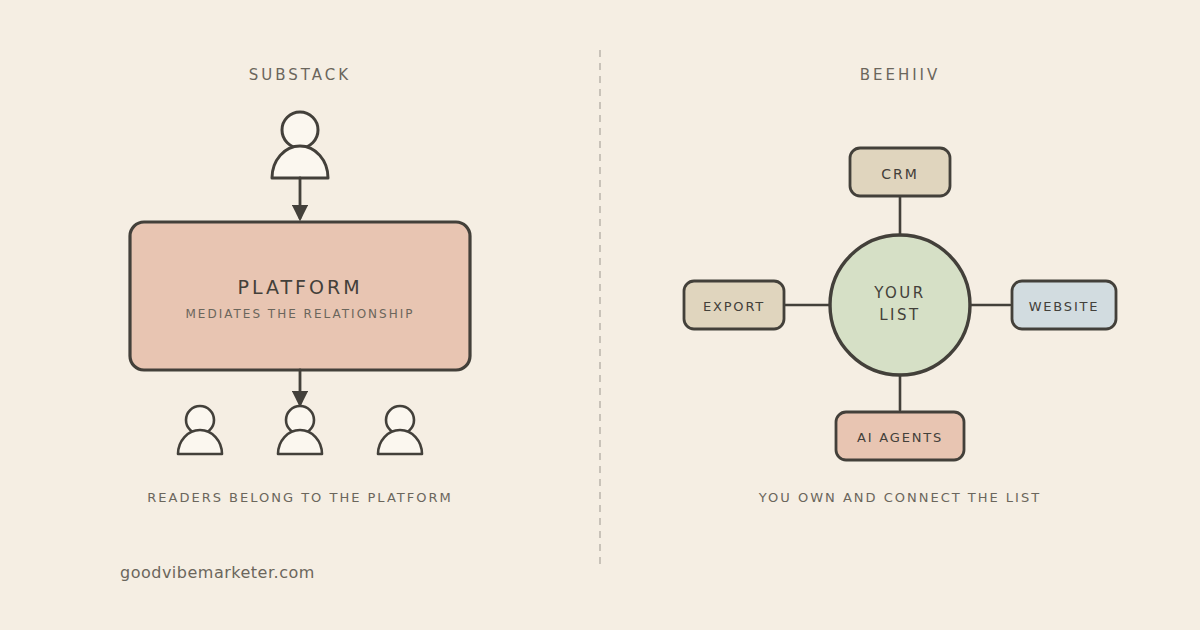
For B2B marketers, Beehiiv is the better choice in 2026. Not because Substack is bad, but because they are building for different outcomes. Beehiiv treats your list as infrastructure you own and can extend. Substack treats it as a media product within their platform. For B2B, that distinction matters more than interface or pricing.
Most comparisons between these two platforms focus on surface details: interface design, pricing tiers, which one has the better analytics dashboard. Those things are real but peripheral. The question that actually determines which platform fits a B2B marketing team sits underneath all of that. GoodVibeMarketer publishes its own weekly newsletter on one of these two platforms, so what follows is a comparison made from inside the decision rather than from a feature grid.
At what point do this platform’s incentives stop aligning with yours?
Substack is building a media company. Its discovery features, paid subscriptions model, and community design are all oriented toward a creator economy where audience is the asset and attention is the product. That works for independent journalists, niche media publications, and consumer creators building direct revenue from their readers.
For B2B marketers, the goal is different. You are building a CRM extension. You are generating leads that feed into sales conversations. You are running an owned channel that sits alongside your content, your website, and increasingly, your AI agents. The list is not the product. It is the infrastructure.
That gap in orientation is where the comparison gets interesting.
Five axes decide it for a B2B team, and each one gets a section below:
- List ownership: Beehiiv exports the full subscriber relationship. Substack exports email addresses.
- Deliverability: Beehiiv gives you custom domain sending and list hygiene control. Substack shares sender reputation across the platform.
- Automation and integrations: Beehiiv has native automations and a working API. Substack has scheduled sends.
- Monetisation: Substack is built around paid subscriptions, which is the wrong model for a lead-generation newsletter.
- AI and agent integration: Beehiiv behaves like a composable layer. Substack is a finished product.
Who Actually Owns the List
This is the most important axis and the one most teams underestimate until they try to migrate.
On Substack, readers subscribe to your publication via Substack. They hold a Substack account. They discover content through Substack’s network, and their relationship is partly with the platform, not just with you. When you export your list from Substack, you get email addresses. You do not get the full subscriber relationship: the engagement history, the segmentation signals, the behavioural data that makes a list a usable commercial asset rather than a contact list.
Beehiiv’s model is cleaner for B2B purposes. Your subscribers are subscribing to your newsletter. The data is yours from day one. Full export includes subscriber history, engagement rates per issue, link click data, and custom tag segments. Migration to another provider, if you ever need it, is straightforward and complete.
This matters most when you start thinking about the list as a live data asset. For B2B teams building AI-driven content pipelines, the subscriber record needs to connect to your CRM, your segmentation logic, and your automation stack. Knowing that a specific subscriber has opened your last eight issues, clicked on two links about a particular topic, and shares an industry tag with twelve other active readers gives you useful signal for sales conversations. On Beehiiv, that data is yours to query and act on. On Substack, it lives in Substack’s systems.
Over time, the compounding effect is significant. B2B marketers who treat their list as infrastructure accumulate a data asset. Those who treat it as a publication accumulate a readership. Both are valuable. Only one connects naturally to a revenue process.
Where B2B Emails Actually Land
Deliverability is the unsexy topic that determines whether any of this matters.
Both platforms have strong baseline deliverability. The difference is in what you can control.
Substack uses a shared sending infrastructure. Your sender reputation is partly shared with other Substack publishers. For most senders this is fine. For B2B senders whose audience sits inside corporate email environments, shared infrastructure creates problems that are difficult to diagnose from your end.
B2B email addresses at large organisations typically sit behind Microsoft 365 or Google Workspace environments with aggressive filtering. These systems use reputation signals from the sending IP and domain, not just the content of the email. On Substack, you share IP reputation with every other publisher on the platform. A spike in complaint rates from another publisher’s list can affect your deliverability in ways you cannot anticipate and cannot fix from inside the platform.
Beehiiv gives you custom domain sending, more granular control over the technical sending configuration, and better tooling for list hygiene. You can identify disengaged subscribers and suppress them systematically before they pull down your sender score. For B2B email, which needs to land in inboxes that IT departments actively defend, that control is worth having.
What You Can Automate and Connect
This is where Beehiiv pulls significantly further ahead for B2B use cases.
Substack has no native automation beyond scheduled sends. You cannot trigger a welcome sequence based on how someone subscribed. You cannot tag a subscriber who clicks a specific link and route them into a different experience. You cannot connect Substack to your CRM via native integration. Zapier workarounds exist, but the data transfer is shallow and unreliable under load.
Beehiiv has automations built in: welcome sequences, tag-based routing, engagement scoring. It also has a proper API that allows real integrations. A practical example: a B2B team publishes a case study issue. Subscribers who click the case study link get tagged automatically. That tag syncs to HubSpot via the Beehiiv API. The sales team sees warm, engagement-ranked leads the same afternoon, without anyone manually exporting a CSV.
That kind of connected workflow is not theoretically possible on Substack. It is a core use case on Beehiiv.
The infrastructure gap between what you can see on the surface and what you can actually build underneath it is where competitive advantage forms quietly. Newsletter platforms are not exempt from this. The teams that have wired their email list into their broader marketing stack are operating with segmentation and sales signals that disconnected platforms simply cannot provide.
Monetisation: The Model That Doesn’t Fit B2B
Substack is designed around paid subscriptions. The platform optimises for this at every level: the recommendation network, the discovery features, the retention mechanics. If you want your newsletter to generate direct revenue from subscribers, Substack makes that easy and natural.
For most B2B marketing newsletters, this is the wrong model.
B2B newsletters serve lead generation, brand authority, and customer retention. The value of the list is not subscription revenue. It is the conversations the list opens, the trust it builds, and the pipeline it contributes to over months and years. Building a paid subscription mechanic into a lead-generation newsletter creates friction that works against the commercial goal. Asking your best prospective customers to pay to receive your marketing is an awkward proposition, and most will simply not bother.
Beehiiv supports paid subscriptions if you want them, but the platform does not push the model on you. Its Boosts programme, which pays a small fee when a subscriber also signs up to partner newsletters, is a more B2B-compatible way to offset costs if the newsletter itself needs to justify its budget. More importantly, Beehiiv’s product design does not assume paid subscriptions are the point. The default orientation is toward list growth and engagement, which maps naturally onto B2B goals.
There is also the question of perception. A Substack newsletter signals “independent creator” to the reader. That positioning works for certain types of thought leadership but can undercut the credibility you want a B2B brand newsletter to carry. Beehiiv-powered newsletters feel indistinguishable from any other branded email, because they are.
AI and Agent Integration: The Emerging Differentiator
This is the axis most comparisons ignore, and it is the one that will matter most over the next two years.
As marketing teams build agent-native workflows, the newsletter platform needs to function as a composable piece of infrastructure rather than a finished product. A content agent needs to draft the issue. A publishing agent needs to schedule and send it. An analytics agent needs to pull engagement data and feed it back into content planning and audience segmentation. A CRM sync needs to know which subscribers clicked through to a pricing page or a case study.
Beehiiv’s API makes this composition possible. It is not perfectly designed for agentic workflows yet, but it is the kind of platform you can build around. The subscriber object carries enough segmentation data. The send API is clean enough to automate reliably. The webhook support covers the key trigger events. Beehiiv is a composable layer, which is the characteristic that matters when you are wiring it into a broader content system.
Substack is not built to be a composable layer. It is a finished product, and that is a deliberate and reasonable choice for the market they are targeting. For independent creators building direct subscriber relationships, the polished, self-contained surface is the product. For B2B marketing teams integrating a newsletter into an AI-driven content and lead generation system, that finished-product orientation is the wrong shape.
The question to ask is not “which platform has more features today?” It is “which platform can I build around for the next three years?” For most B2B teams, that answer is Beehiiv.
A platform choice like this one sits inside a wider shape. The Editor’s Stack describes the five stages a B2B content operation moves work through: research, a brief, a writer agent, a human review gate, and the publish pipeline your newsletter platform is part of.
Questions people ask
Is Beehiiv or Substack better for a B2B newsletter?
Beehiiv, for most B2B teams. It gives you full ownership of subscriber data, custom domain sending, native automations, and an API that connects the list to a CRM. Substack is the better product for independent creators earning subscription revenue from readers. The choice follows the outcome you want, not the interface you prefer.
Can you move a newsletter from Substack to Beehiiv?
You can move the list. What you cannot move is everything attached to it. A Substack export gives you email addresses, so the contacts travel but the engagement history does not, and segmentation starts again on the other side. That asymmetry is the reason to decide on ownership early, before the list gets large.
Does Substack ever make sense for a B2B brand?
Sometimes. If the newsletter is a personal thought-leadership vehicle for a founder, discovery inside Substack’s network is real distribution you do not have to build yourself. The trade is that the list stays a readership rather than a commercial data asset. That is a fair trade for a founder brand and a poor one for a marketing team.
How does a newsletter platform fit into an AI content workflow?
It is the publishing end of the pipeline. A content workflow built on Claude Code runs a brief, a queue, a scheduled agent, and a human review gate before anything ships. The platform at the end of that has to accept programmatic sends and hand engagement data back, which is an API question rather than an editor question.
The Good Vibe Marketer newsletter runs on Beehiiv. It is part of a broader publishing system where agents handle research, drafting, and distribution while editorial judgement stays human. If you want to follow how that system develops and see what an agent-native content operation looks like from the inside, subscribe below. One issue a week, no filler.