
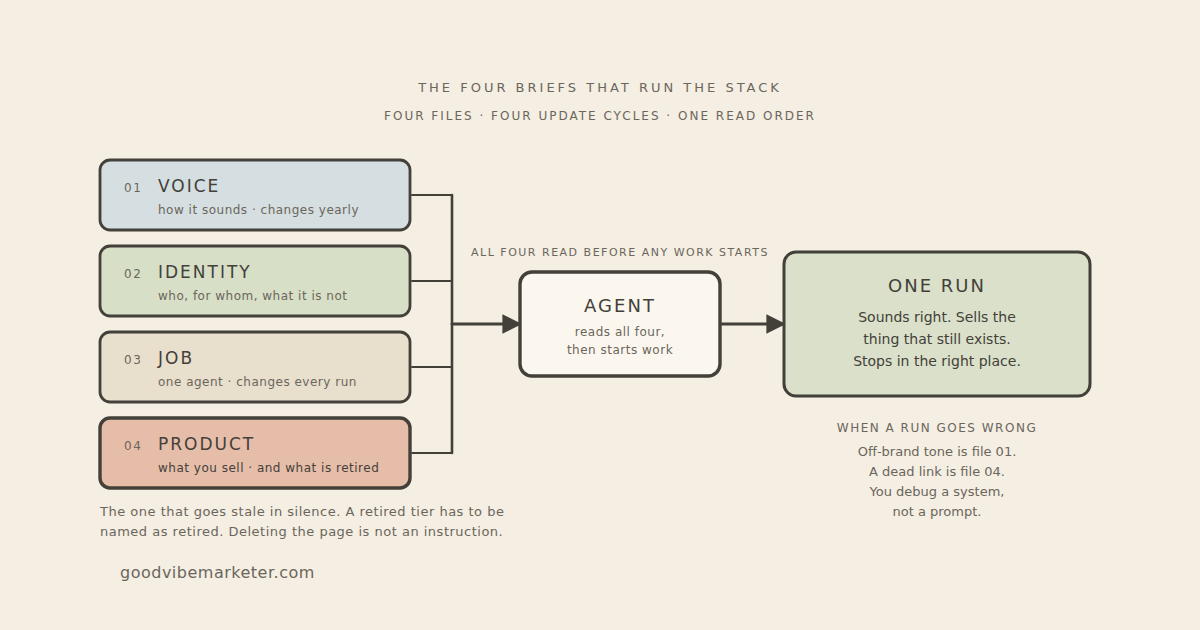
Four briefs should govern an AI marketing stack: voice (how the output sounds), identity (who is writing, and who they are writing for), job (what a given agent does on a given run), and product (what you actually sell right now). Keep them as four separate files. Every agent reads all four before it writes a word.
That is the direct answer. Here is why the obvious version of it fails.
Most teams get to this point from the prompt side. The prompt works, so it gets longer. Then it gets pasted into a shared doc called something like “AI guidelines” or “our GPT instructions”, and that doc becomes the place all the context lives. One file. Everything in it.
It feels tidy. It breaks within about six weeks, and the reason is not length.
The four kinds of knowledge in that file change at completely different rates. Voice changes maybe once a year. Identity shifts when the positioning does. Product changed last quarter and will change again. The job changes every single run. Bundle them together and every small product correction drags your voice rules back through review, while the one thing that actually went stale sits buried on page four where nobody edits it.
The separation is the design. Four files, four owners, four update cycles, and any agent can read the ones it needs without inheriting the ones it does not.
I am going to use my own setup as the worked example, because it is the one I can show you honestly. The content pipeline that publishes this blog runs on exactly these four files. When something goes wrong with an article, it is almost always because one of them was wrong first.
Brief One: Voice, the File You Write Once and Argue About Later
The voice brief answers one question: what does the output sound like when it is right?
Most brand tone-of-voice documents fail here, and they fail in a predictable way. They give you adjectives. Confident. Approachable. Human. An AI system handed three adjectives produces the statistical average of every brand that has ever claimed them, which is the exact house style of a mid-tier SaaS newsletter.
What a voice brief needs instead is contrast and prohibition.
Contrast means paired examples. Not “we are plain-spoken”, but the sentence written badly next to the sentence written well. “AI represents a shift in organisational capability” against “AI doesn’t replace marketers, it exposes the gaps in how they think.” Two versions of the same idea teach a model more than a page of adjectives, because the difference between them is the thing you are actually specifying.
Prohibition means a hard list. Banned words. Banned constructions. Spelling convention. Punctuation you never use. These read as petty when you write them down and they are the highest-value lines in the file, because they are the only instructions in it that can be checked mechanically. An agent can verify it did not use a banned word. It cannot verify it sounded confident.
Keep the voice brief free of anything else. No product detail, no audience segmentation, no campaign context. It should be equally correct for an agent writing a LinkedIn post, a landing page or a support email.
Brief Two: Identity, the One Almost Nobody Writes
Identity is the brief that goes missing. Teams write voice because tone-of-voice documents already existed before AI. Nobody had a reason to write identity down, because it lived in the heads of the four people who had been there longest.
The identity brief covers who the brand is, who it is speaking to, and what it is explicitly not.
The first part is straightforward biography and positioning: the credible history, the specialism, the thing this brand has actually done that others have not. Twenty years in B2B, built marketing functions from nothing, lived through one structural technology shift already. That last detail is not colour. It is the reason a given argument in an article is allowed to be made with confidence.
The second part is the audience, and it needs the same treatment described in the piece on how to write a brief for AI marketing platforms: the role rather than the job title, the situation that made them start looking, what they already tried.
The third part is the one that earns the file its place. A “what this is not” list. Never sound like a motivational productivity coach. Never sound like a tech bro evangelist. Never sound like a corporate transformation consultant. Each of those is a real failure mode that AI-generated marketing copy falls into by default, and naming them is what stops the drift.
The identity brief is also where hard editorial rules live. Facts that must never appear. People who are never named. Claims the brand will not make about itself. Absence is not an instruction to a model. If you have not written the rule down, you have not set it.
Brief Three: The Job, Rewritten Every Time the Work Changes
Voice and identity describe the brand. The job brief describes one agent doing one specific piece of work, and it is the only one of the four that is written per agent rather than per company.
A job brief contains the sequence, the inputs, the output, the constraints and the definition of done. In practice:
Which files to read, in what order, before starting. The exact place the output goes, as a real path. The shape the output must take, including anything that will fail a build or a check downstream. The hard rules, written as prohibitions rather than preferences. And a cost cap, if the agent can spend money, because an agent with a research tool and no budget will happily run forty searches to write eight hundred words.
The definition-of-done line matters more than it looks. “Write a good article” is not a completion condition. “One commit per article, tracker updated, build passing” is. Agents optimise toward whatever you gave them as the stopping condition, so if the stopping condition is vague, the work stops in a vague place.
Job briefs are the ones you rewrite most, and that is fine. They should be cheap to change, which is precisely why they should not be entangled with your voice rules.
Brief Four: Product, the One That Silently Goes Stale
The product brief is the shortest of the four and causes the most damage when it is wrong.
It contains what you sell today. The names you use for it. The URLs that resolve. How a reader converts, in priority order. Anything you will never claim, most importantly price if you do not publish one.
Then it contains the part most teams leave out: an explicit list of what you no longer sell.
This is the failure I have actually hit. A tier gets retired, the page redirects somewhere sensible, and everyone moves on. But the model has months of prior copy in its context describing that tier, and no instruction saying it is gone. So the agent keeps writing calls to action for a product that does not exist, pointing at an anchor link that no longer resolves. Nothing errors. The article looks fine. It is just selling something you cannot buy.
Deletion is not communication. If a tier is retired, the brief has to say the words “this is retired, never mention it” and list the dead URLs by name. A short table of retired things at the bottom of the product brief will save you more rework than any other paragraph in the four files.
The Handoff: What One Run Actually Looks Like
Here is how the four combine on a single job, in this case the agent that writes this blog.
It opens the voice brief and learns it writes UK English, short paragraphs, no em dashes, and cannot use any word on the banned list. It opens the identity brief and learns whose experience it is drawing on, which audience it is aimed at, and the four things it must never sound like. It opens the product brief and learns there is exactly one thing being sold, that pricing is never quoted, and which three URLs are dead. Then it opens the job brief, which tells it to pick the next unpublished item from the plan, write to a specific path, draw a hero image, update the tracker, and stop.
Four files, read in a fixed order, before a single sentence gets written. The job brief is the only one that knows what today’s work is. The other three are the same as they were last week, which is the point: consistency across runs is not something you prompt for, it is something you store.
The value shows up when a run goes wrong. Because the four are separate, a bad article has a traceable cause. Off-brand tone is a voice brief problem. A dead link in the call to action is a product brief problem. Wrong topic, wrong structure, wrong file path: job brief. You are debugging a system rather than rewriting a prompt and hoping, which is the same shift described in why the brief became the control surface.
Write the Product One First
If you write only one of the four this month, write the product brief. It is the shortest, it is the one most likely to be wrong today, and it is the only one where being wrong costs you a conversion rather than a rewrite.
Then voice, because the banned list alone will lift the floor on everything the stack produces. Then identity. The job briefs come last, and they come one per agent, once you can see what work you are actually trying to hand over.
None of this requires new tooling. Four markdown files in a repository, or four documents in whatever your team already uses. The hard part was never the format. It is that writing these down forces you to decide things your team has been comfortably disagreeing about for years, which is why the exercise stalls halfway.
That is usually the point where it helps to have someone in the room. The AI marketing workshop is time spent writing these four on your own brand, with your own campaigns and your own live constraints, rather than a generic curriculum about AI. It runs one to one or with a small team, over a focused hour, a half day or a full day. If you want to talk about whether that fits your team, book a discovery call and we will work out what you actually need.