
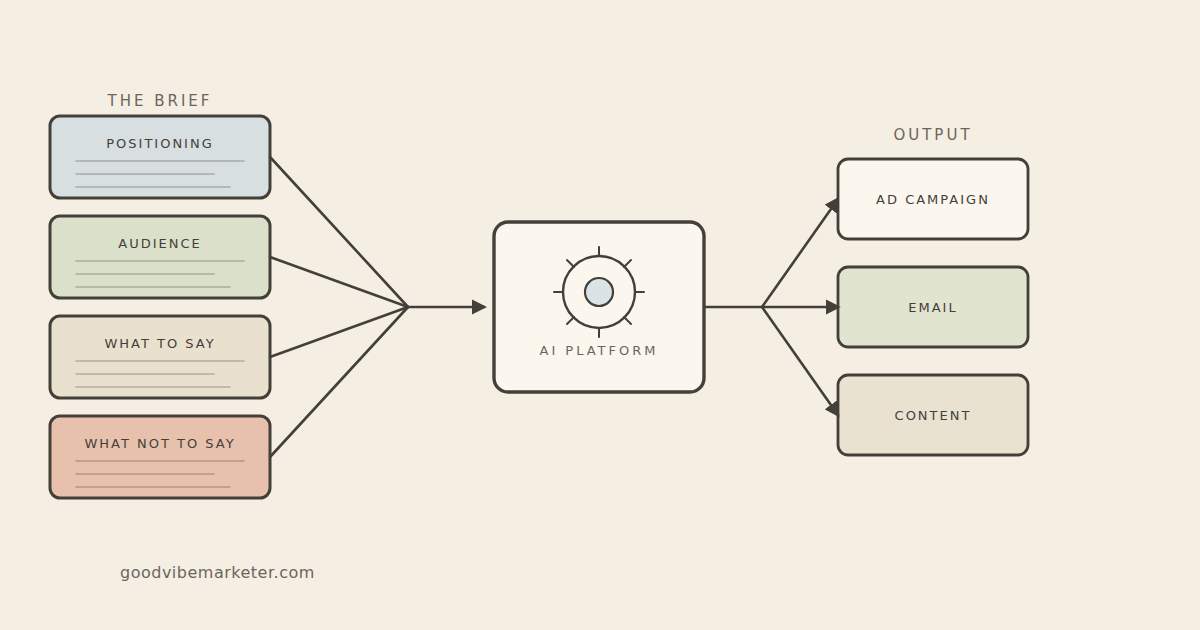
A brief for an AI marketing platform needs four parts: positioning (who you are and what makes you different), audience (who you’re reaching and how to identify them), what the campaign should say, and what it must never say. Leave any one of these out and the system has nothing precise to work with.
Most marketers know how to write briefs. They have been doing it for years. The brief goes to the agency. The account manager reads it. Fills the gaps from memory, draws on what they know about the client, and the campaign runs.
That model depends on a human who already knows your brand sitting between the brief and the output. AI marketing platforms don’t have that human. There is no account manager quietly supplementing the vague bits from institutional knowledge. When Google’s AI Max, or an agent-based workflow, reads your brief, whatever isn’t written down simply does not exist.
This changes what a good brief requires. Not longer. More explicit. Structured in a specific way that most marketers have never had reason to produce before.
The brief as the control surface article covered why major platforms replaced manual controls with brief-driven AI and what that means for the skill that survives. This piece covers the other half: the anatomy of a brief that actually works.
Part One: Positioning
Positioning is the section most marketers get wrong by being too broad.
“We’re a B2B SaaS company that helps marketing teams work faster.” That is a category description. An AI platform handed that sentence will produce output indistinguishable from every other B2B SaaS company in its training data. The platform is not being lazy. It has nothing to differentiate with.
What positioning needs, for an AI system to work with it:
A one-sentence claim that only you can make. Not “we help teams work faster” but “we’re the only [category] built specifically for [precise use case], with [the feature or approach that makes it true].”
A proof point that makes the claim credible. Not the claim alone. If you say you’re the only platform that does X, the brief should include the fact or evidence that backs it up. Without it, the AI is being asked to assert something it cannot substantiate.
The context you’re competing against. What does the buyer usually consider before they find you? This is the element most briefs skip entirely. Positioning only means something relative to alternatives. If you don’t tell the platform what it is competing against in this buyer’s mind, it defaults to the middle of the category.
A useful positioning entry might read: “We help B2B marketing directors managing a team of fewer than five people who run campaigns without a dedicated ops resource. Most of them are currently using spreadsheets or a legacy MAP they haven’t properly configured. We’re the only platform that sets up in a day and produces usable reporting from week one. Unlike ClickUp or Asana, we’re built specifically for multi-channel campaign dependencies, not general project management.”
That is specific enough for an AI platform to produce something that sounds like your brand, not everyone else’s.
Part Two: Audience
The audience section is where briefs get vague in a different way. “Decision-makers in mid-market SaaS” is not an audience definition. It is a LinkedIn filter setting, and an AI platform optimising against it will produce content aimed at the average of mid-market SaaS, which is exactly where your competitors already are.
An audience definition that works for an AI platform needs to be specific enough that someone who has never met your customer could still identify them in the real world. That means three things:
The role, not the title. Titles vary widely by company. The underlying job-to-be-done does not. “Marketing directors responsible for pipeline generation, not brand perception” is more useful than “CMO or VP Marketing.” The first description tells the AI what this person cares about. The second just tells it what they are called.
The situation they are in when they start looking. Not their demographics or firmographics. The trigger. What has happened recently that made them start searching? The best audience entries describe a state of mind, not a segment.
What they have already tried. What did they do before they went looking for you? This context tells the platform what objections to address and what assumptions it can skip.
“Someone who has just inherited a HubSpot instance they don’t trust and is three months away from a board review” is a real audience definition. You can write copy for that person. You can set targeting for that scenario. The AI has a specific human to aim at.
“Mid-market decision-makers” gives the AI a statistical average and nothing more.
This is a specific instance of the wider infrastructure gap: teams invest in powerful platforms and then give them under-specified inputs. The platform is capable. The brief is the bottleneck.
Part Three: What to Say
This section covers message, but not just the message. It covers the hierarchy of the message.
AI platforms don’t know what you lead with versus what you prove with. They don’t know what claim should open the campaign and what should sit in the body copy as supporting evidence. That distinction has to be in the brief, or the platform makes a guess, and its guess is trained on what tends to perform on average across all campaigns, not what is true for your brand.
Three elements to include:
The primary claim. One sentence. What you want the reader to believe after a single exposure to this campaign. Not your brand promise in full, just the one thing that should land first.
The proof architecture. What makes the claim believable? A customer story? A specific outcome with a number attached? A feature that competitors lack? Name the type of proof and the specific example. “Use case studies” is not enough. “Reference the Meridian Foods case study where we saved them twelve hours per campaign cycle” gives the AI something to work with.
The tone guardrail. Not a full brand voice document (that is a separate piece of work). The specific register this campaign should strike. “Reassuring to a buyer who has been burned before” is different from “authoritative to a sceptical director evaluating vendors.” Both could be appropriate for the same product at different moments in a buying cycle. Specify which one this campaign needs.
One addition that consistently improves results: write the primary claim in the words your customer uses to describe their problem, not the words your marketing team uses to describe your solution. AI platforms optimise for engagement signals. If your claim uses language your customer has never typed, there is no signal to optimise toward.
Part Four: What It Must Never Say
This is the section most briefs do not have at all. It is often the most important one.
Constraints are what make AI output usable rather than generic. Without constraints, the platform fills the space with whatever performs on average. That default tends toward urgency language, feature-stacking, superlatives, and the kind of breathless benefit-claiming that sounds like every other campaign in your category.
The constraints you need to specify:
Claims you cannot make. Any assertion you are legally or commercially prevented from making. Name them explicitly, not as a category. “Do not claim FDA approval” is useful. “Avoid exaggerated claims” is not.
Phrases that undermine your positioning. If part of your brand is being calm and considered, urgency language is a constraint. If you are a premium product, discount framing and “limited time offer” language undermine your positioning every time they appear. List the specific patterns you want excluded.
Comparisons to avoid. If you do not want to be mentioned alongside a specific competitor, or a category framing that misrepresents you, say so explicitly. “Do not compare us to Salesforce or position us as a CRM alternative. We are a campaign operations tool.” That instruction is runnable. Without it, the platform fills context gaps with adjacent category references.
Tones that would misrepresent you. “Not breathless. Not urgent. Do not imply scarcity. Do not use outcome language we cannot substantiate.” These are usable constraints. “Don’t be too salesy” is not.
The what-not-to-say section is where your positioning actually lives, compressed into the negative space. A brand that knows precisely what it will not say is a brand that has done the hard work of knowing what it is.
A Worked Example
Here is what a one-page brief looks like when all four sections are filled in correctly. This is a B2B SaaS product launch: a project management tool aimed at marketing operations leads.
POSITIONING
We are the only project management tool built specifically for marketing operations. Buyers typically try Asana, Notion, or ClickUp first and find none of them handle multi-channel campaign dependencies well. We solve that specific problem, not general project coordination.
AUDIENCE
Marketing ops leads in Series B to D SaaS companies. Responsible for tool stack, workflow design, and cross-functional sprint coordination. Typically brought in to fix chaos after the company scaled past 30 people. Trigger: they have just been blamed for a missed campaign deadline that was not their fault.
WHAT TO SAY
Lead with control, not speed. This buyer does not want to go faster; they want to stop firefighting. Primary claim: “Finally, a tool that understands how marketing campaigns actually work.” Proof: the Redbrick case study showing a missed product launch prevented by catching a cross-team dependency two weeks before the deadline. Tone: calm, matter-of-fact, slightly conspiratorial (“finally, someone gets it”).
WHAT NOT TO SAY
No urgency language. No superlatives. Do not reference Asana or ClickUp by name. Do not claim we are the only tool you will ever need. Do not mention AI in the headline: this buyer has heard too many AI promises and will disengage immediately.
That brief is runnable. Any AI marketing platform can take that input and produce something that sounds like a specific brand rather than a category average. Without it, the same platform produces campaigns indistinguishable from every other ops tool that left the brief vague.
The Constraints Are the Work
The useful insight across all four sections is that the hardest part of writing an AI marketing brief is not the positive case. Any company with a competent marketing team can fill in “what to say” well enough. The differentiating brief is the one that specifies what not to say with the same precision.
Those constraints are where positioning actually lives. The things you will not claim. The tones you will not strike. The comparisons you will not invite. Writing them down forces the clarity that account managers used to carry in their heads.
And once that clarity is written, it compounds. A good brief gets better every time you run it against a live campaign and discover what the output reveals about what you had not yet made explicit. The brief becomes a working document, not a one-off input.
That is the architecture change underneath the tool change. The knowledge moves from informal institutional memory into a document that agents and platforms can actually use.
If you want to see how this maps to a full agent-driven content system, the Blueprint covers the three briefs that run the Editor’s Stack: voice, identity, and the job itself. Each follows the same four-part logic described here, applied to the specific agents they control.