
An AI consultant works out where AI actually changes how your business operates, builds or specifies the first working version, and leaves the team able to run it without them. A good one is judged on what you can do after they have gone. A bad one sells tools, hands over a strategy deck, and creates a dependency.
Now the part nobody types into the search box.
If you have searched for an AI consultant near me, your instinct is right and your reason is probably wrong. Most people search locally because local feels convenient. Shorter journey, easier to arrange, someone who might know a few of the same companies.
Convenience is not why proximity matters here.
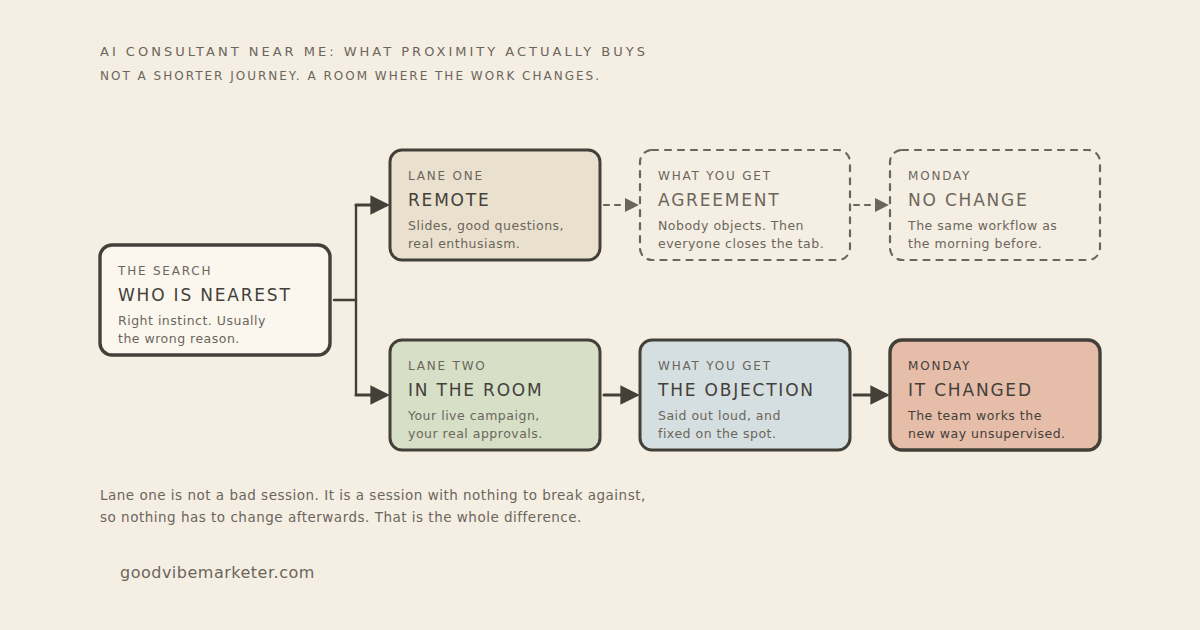
It matters because AI work only changes how a team operates if somebody is in the room while they do it. Remote-delivered AI consulting is the single biggest reason these engagements get received politely, agreed with enthusiastically, and forgotten by Friday. A video call is a performance. A room is a working session where someone says “that will not work, everything we publish goes through legal first” and the plan changes on the spot, in front of the people who have to live with it.
So the real question is not who is nearest. It is who can sit with your team while they do the work, and whether that changes what they can do the following Monday.
What an AI Consultant Actually Does
The title is doing a lot of work at the moment, and it covers at least three different jobs. Worth knowing which one you are buying.
The first is diagnosis. Looking at how the work currently moves through your team, and identifying the two or three places where AI changes the economics rather than just the speed. This is less glamorous than it sounds and it is where most of the value sits, because the obvious candidates are usually wrong. Teams almost always want to start with content generation. The bigger wins are normally in research, enrichment, and the tedious internal steps nobody has ever documented.
The second is building. Standing up a working version of one thing. Not a pilot, not a proof of concept, an actual workflow that runs on a Tuesday when nobody is watching. If a consultant cannot build, they are advising on architecture they have never had to operate, and it shows in the handover.
The third is capability transfer. Making sure the people who own the work afterwards understand why it is shaped the way it is, so they can change it when the campaign changes. Marketing workflows are not stable. A system your team cannot modify is a system with a shelf life of about one quarter.
What an AI consultant should not be doing is running your marketing for you indefinitely under an AI label. That is an outsourced function with better branding.
Why a Consultant and an Agency Solve Different Problems
This is the comparison most buyers are actually making, and the honest version is simple.
An agency is built to do the work for you and keep doing it. That is not a criticism, it is the business model, and for some jobs it is exactly right. If you need output at volume and you do not need the capability in-house, an agency is the efficient answer. The South West is well served here. There are good agencies in Bristol now offering AI services, and several of them are genuinely capable.
A consultant who has run marketing in-house is built to make your team capable and then leave. The engagement is designed to end. That means the deliverable is not a set of assets, it is a team that operates differently.
The two produce opposite outcomes after twelve months. With the agency, the work happens and your team is roughly where it started. With the consultant, the work happens more slowly at first and your team can do it themselves by the end.
Neither is better in the abstract. They answer different questions. If you want the capability rented, brief an agency. If you want it owned, that is a different kind of engagement, and I have written separately about when to hire someone versus building the stack yourself, which is the decision underneath this one.
The thing to watch for is an agency positioned as a consultant. The tell is in the proposal. If the scope has no end date and no answer to what your team will be able to do alone, you are looking at a retainer wearing a different jacket.
The Four Questions Worth Asking Before You Hire Anyone
Four questions. They take about ten minutes and they separate practitioners from presenters more reliably than any case study deck.
“What will my team be able to do on their own afterwards?” This is the one that matters most, and a surprising number of people cannot answer it. Watch for a specific answer. “Your content lead will be able to write and modify the brief that drives the pipeline, and change it when your positioning changes” is an answer. “Your team will be AI-enabled” is not.
“What have you built recently, and can I see how it works?” Not what have you advised on. Built. Someone who has actually shipped AI systems will describe the parts that broke, because those are the memorable bits. Someone who has only presented on AI will describe the outcome. I run this site’s SEO through an agent loop I built and still maintain, which means when I say a workflow needs a review gate I am describing a mistake I made, not a principle I read.
“Where does this go wrong?” Anyone who says it does not is either inexperienced or selling. AI workflows degrade in specific, predictable places: briefs that were never precise enough, review gates in the wrong position, automations that touch systems where being wrong is expensive. Someone who has operated these systems will name their failure modes without hesitating.
“Have you sat on my side of the table?” There is a real difference between people who have sold marketing services and people who have owned a marketing number. Twenty of my years were spent in-house, client side, building marketing functions from scratch rather than selling to them, which is most of what the about page covers. It matters because in-house work teaches you the constraints that never appear in a proposal: the approval chain, the legacy tool nobody will let you turn off, the colleague who will quietly refuse to use the new process.
If you get four straight answers, you are probably talking to the right kind of person. If you get four sets of terminology, keep looking.
Why Being in the Room Changes the Outcome
Here is the pattern I keep seeing, and it is the reason this article is not really about geography.
Remote AI training and consulting nearly always follows the same arc. Good session, engaged questions, genuine enthusiasm. Then everyone closes the tab and returns to the workflow they had that morning, because the workflow they had that morning is what their calendar, their tools and their manager are all set up for. Nothing about the room changed, so nothing about the work changed.
In-person is different for an unglamorous reason. In the room, you use the team’s real work. Their live campaign, their actual brief, their genuinely messy approval process. When something does not fit, it fails visibly, in front of everyone, and it gets fixed there rather than becoming a note that nobody actions.
You also get the objections. In a video call, the person who thinks this is nonsense stays on mute. In a room, they say it out loud, which is the most useful thing that can happen, because that person is usually the one who has spotted the constraint everybody else missed. Their objection is normally correct and normally solvable, but only if you hear it.
This is also why the format matters more than the day rate. A session that runs on your team’s own work, in the room, changes what happens on Monday. A generic session delivered remotely produces agreement, which is not the same thing and is far easier to sell. This connects to something I have argued before: the tools were never the bottleneck. The bottleneck is whether the way people work actually changes, and that is decided in rooms rather than in tool selection.
So when you search locally, search for someone who will turn up, not for someone whose postcode is closest.
If You Are Actually Nearby
Some plain facts, because the local part of this should be literal rather than implied.
I live and work in Bristol. That is the one place where “based here” is true, and it means an in-person session anywhere in the city is a short trip rather than a day of travel. Bath is about fifteen minutes on the train, so a morning there is a morning, not an expedition. London is a direct train and I run sessions there, including for a client based in the city. For teams elsewhere in the UK, remote works, and I will say honestly that it works less well for exactly the reasons above.
What that looks like in practice is an AI marketing workshop run on your team’s own campaigns and briefs rather than a generic curriculum. A focused hour, a half day, or a full day, one to one or with a small team. The point of running it on your own work is that there is nothing to translate afterwards, because you have already done the translating in the room.
If you are in Bristol or the South West and you have got as far as searching for someone, the sensible next step is a conversation rather than a proposal. There is a free thirty-minute call on the Bristol page where we work out what your team actually needs, and whether it needs me at all. Sometimes the honest answer on that call is that you have one capable person who mostly needs permission and a few protected hours, and I would rather say that than sell a day you did not need. If you are nearby, that first conversation is easier in person anyway.