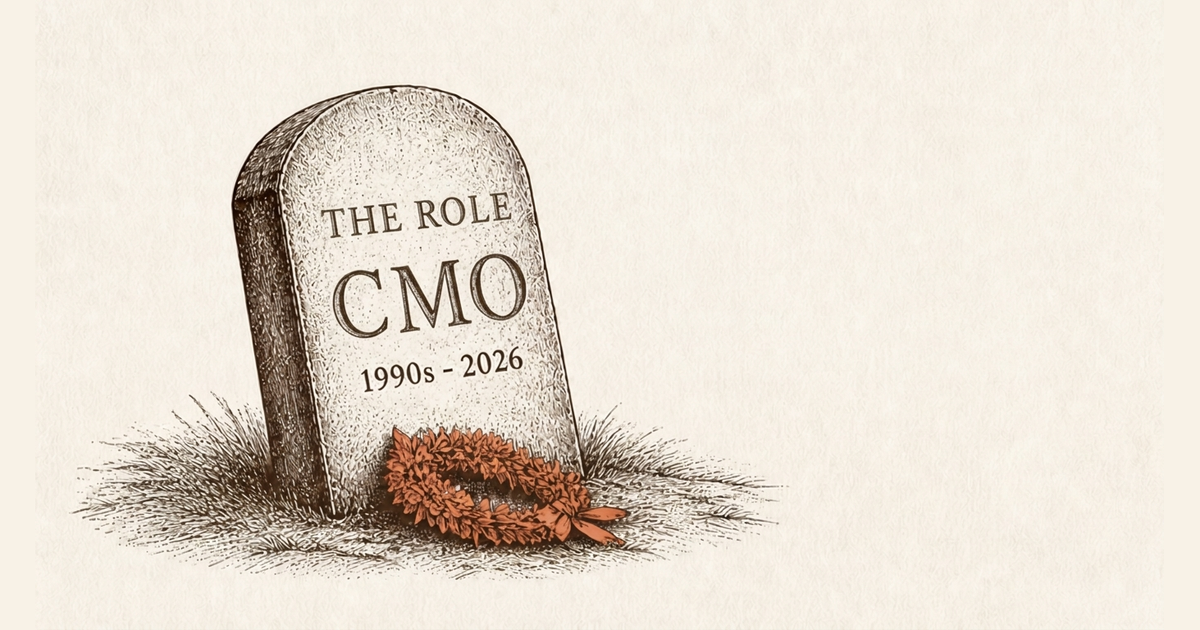
Forrester’s latest Fortune 500 analysis puts the CMO title at 36% of companies. A year earlier it was 49%. The year before that, 55%.
Marketing executives who sit on the executive team or report directly to the CEO: 52%, down from 58%. Third consecutive year of decline.
Spencer Stuart has average tenure at 4.1 years, against 7.6 for CEOs. Roughly a third of large caps now run without an enterprise-level marketing chief at all. Starbucks, Walgreens and General Motors didn’t replace theirs. They redistributed the job.
So, dying?
No. But something is dying, and it pays to be precise about what.
The title is being re-labelled, not deleted
Forrester resist the extinction reading of their own numbers, and they’re right to. The work isn’t evaporating. It’s being consolidated into Chief Growth Officer and Chief Commercial Officer roles that carry revenue accountability the old title never did. Spencer Stuart’s data suggests most departing CMOs are leaving upward, into COO seats, divisional president roles, occasionally the top job.
That’s not a funeral. That’s a re-scope. Marketing capability is still valued at the top. The specific shape of the seat is what’s being renegotiated.
What’s actually dying is a management style
For twenty years, the route to the top of marketing was specialisation. Be exceptional at paid, or brand, or product marketing. Get promoted out of doing it. Run people instead.
Which meant the person at the top had deep expertise in one lane and a briefing-level grasp of the other four. Enough to nod along in a review. Not enough to tell whether the work was any good.
That was survivable when the function was forty people. There were enough specialists underneath to cover the gaps, and enough process to hide behind. The org absorbed the shallowness.
It doesn’t work when the team is just a handful of people.
Small teams have nowhere to hide
Marketing headcounts are shrinking, and they’ll keep shrinking. Not because marketing matters less, but because output per person has gone up sharply and boards have noticed. The thirty-person department is becoming a six-person team of AI-native marketers producing more than the thirty did.
Here’s what that does to leadership.
In a big team, the leader’s job is largely coordination: routing work, unblocking, translating between functions. In a team of six, coordination is nearly free. What’s left is the work itself, and the weekly conversation is about the work itself.
If your contribution to that conversation is “looks great, when can we ship it,” you are overhead. The team knows it before you do.
You cannot earn the respect of a small team of highly capable and talented marketers by managing them. You earn it by being useful about the thing in front of you.
Taste, and systems thinking
Two capabilities matter more than they used to.
The first is taste. Knowing what good looks like, instantly, across every discipline you didn’t specialise in. Not the ability to make it, but the ability to recognise it and say precisely what’s wrong. When your team can generate forty variants in an afternoon, generation stops being the constraint. Judgement becomes the constraint. The bottleneck moves to the person deciding which one ships, and that person had better have an eye.
The second is systems thinking. The high-level strategist wrote the plan and handed it down. The job now is designing the machine that produces the work: what runs automatically, what needs a human, where the handoffs are, what happens when it breaks. That’s an architectural skill, and it’s closer to engineering than to strategy decks.
Hands-on is not a demotion
The fear behind all this is that hands-on means junior. That a CMO who’s in the tool has lost the plot.
The evidence points the other way. Anthropic analysed 400,000 Claude Code sessions across 235,000 people and measured whether the work actually succeeded. Every major occupation group landed within seven percentage points of software engineers. Management occupations scored slightly higher.
What predicted success wasn’t a technical background. It was expert command of the problem, and most of the gain came from moving novice to intermediate, not intermediate to expert.
Twenty years of marketing judgement and experience is not a liability in this transition. It’s the scarce input. The only thing that wastes it is refusing to touch the work.
The test
Forget whether you have the title. Here’s the test that matters.
Sit down with an AI-native marketer, look at what they’ve built this week, and say something they hadn’t already thought of.
If you can, the seat is safe under any name. If you can’t, the org chart will work that out eventually, and the Forrester numbers suggest it’s already started.
The CMO isn’t dying. The hands-off CMO is.
If that is a test you would rather pass than read about, the way through it is to do the work. The AI marketing workshop is built for that: a hands-on session run on your own campaigns and briefs, one to one or with your team, in person or remote. There is a discovery call on that page if you want to talk it through first.