
To measure brand visibility in ChatGPT and Perplexity, you build a list of the prompts your buyers use during research, run them weekly, and record whether your brand appears, where, and with what framing. The tooling is thin and mostly aimed at agencies. The measurement is manual to start with, but the signal is real.
That’s the short answer. The longer one starts with a harder truth.
Most teams discovering this problem go looking for it in the wrong place. They open GA4, filter by source, and wonder why there’s nothing there. They check Search Console for new query data. They look at their SEO tool for AI-related signals. None of it shows them what they want to see, not because the tool is broken, but because the channel works differently.
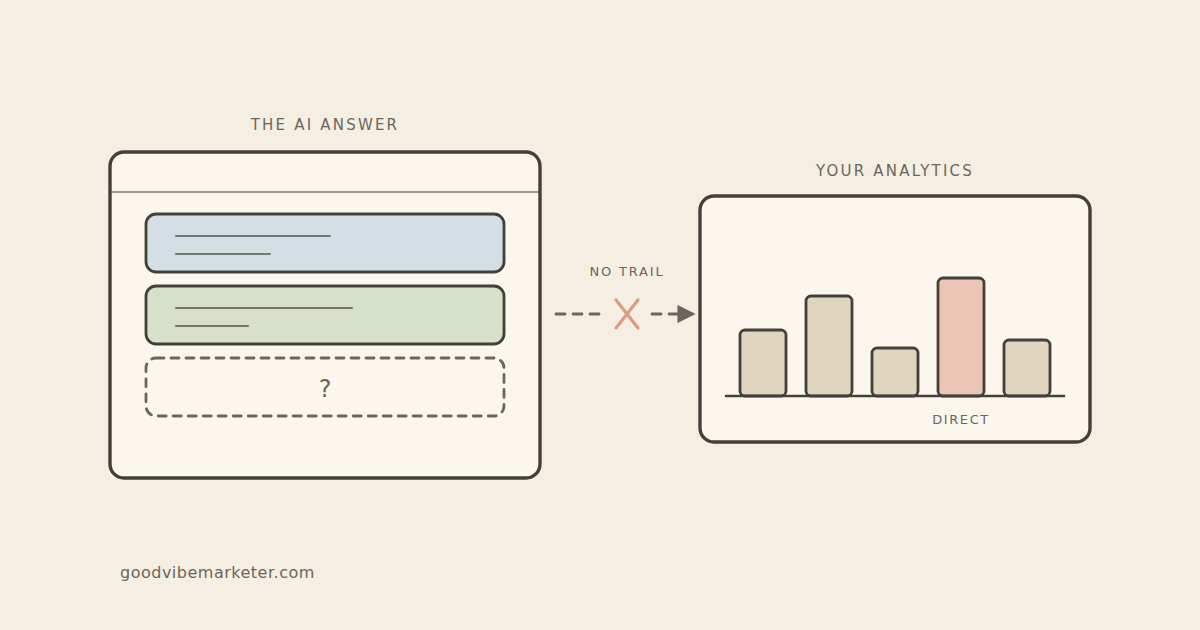
When a buyer asks Perplexity which B2B marketing tools to evaluate, gets a response that cites two competitors and ignores your brand, then clicks through and books a demo with one of them, that attribution registers in your analytics as organic or direct. The AI interaction is invisible. The decision-shaping moment never happened, as far as your data is concerned.
As I wrote earlier this year, the capabilities arriving in AI-mediated discovery are outpacing the measurement infrastructure by a significant margin. That gap is where competitive disadvantage forms quietly, without any alert firing.
What GA4 and Search Console Cannot See
Traditional search has a clear data trail. A user searches. Google indexes the query. They click a result. The click fires a session. Attribution traces the path.
AI search has a different shape. The user types a question into ChatGPT or Perplexity. The model synthesises an answer from its training data and, in Perplexity’s case, from live web retrieval. The user reads the answer. They might click a source, or they might act directly on the recommendation without ever clicking anything.
The portion that does click registers as a referral or direct visit, depending on whether the source appends UTM parameters (most don’t). The portion that acts without clicking leaves no trail at all. The query that triggered the whole thing is never recorded in any system you own.
This is not a gap that will be patched by a Search Console update. It is a structural difference in how the channel delivers intent. Until ChatGPT and Perplexity build advertiser-grade attribution and expose it via API (which would undermine a significant part of their pitch), first-party measurement means building your own observation layer.
How AI-Mediated Discovery Works in Practice
Before you can measure something, it helps to understand the mechanism.
When a user asks an AI assistant about a product category, the model draws on two sources. Its training data, which reflects the web up to its knowledge cutoff, weighted heavily toward content that appeared on high-authority, frequently-cited pages. And, in retrieval-augmented systems like Perplexity, live web results pulled in real-time and synthesised into the response.
The brands that surface consistently are not the ones with the most content. They are the ones whose content has been referenced, cited, and linked to by sources the model treats as authoritative. This matters for measurement because it tells you what to track: not just whether you appear, but the framing you appear with, and which sources are carrying your brand into the model’s awareness.
There are three things worth measuring in any AI visibility audit:
Presence. Does your brand appear in the response at all? For which query types? At what position in the answer?
Framing. What words does the model use when it mentions your brand? Positive, neutral, comparative, or attributed to a specific claim? The framing shapes the impression even if the mention is technically present.
Attribution. In Perplexity and similar retrieval systems, which sources are being cited alongside your brand? Understanding which third-party pages carry your brand into AI responses tells you which relationships and publications matter for your citation strategy.
The Minimum-Viable Measurement Loop
You do not need a vendor contract to start this. You need a prompt library and a tracking sheet.
Build your prompt library first.
Write twenty to thirty prompts that reflect how your buyers research your category. These are not keyword queries. They are conversational questions:
- “What are the best tools for [problem you solve]?”
- “How do [your category] tools compare for [specific use case]?”
- “What should I look for when evaluating [your category] help?”
- “Which [your category] providers do teams in [your market] typically use?”
These prompts model actual discovery behaviour, not keyword search. The goal is to replicate what a real buyer would type.
Run them weekly.
Split the prompt library across ChatGPT and Perplexity. Run each prompt fresh, not in a conversation thread with context carried over from previous questions. Record the date, the platform, the prompt, whether your brand appears, its position, and the exact framing used. Twenty-five prompts across two platforms, once a week, takes roughly ninety minutes.
Track movement, not snapshots.
A single week of data tells you very little. What you are looking for is trend: are more prompts returning your brand this month than last? Is the framing improving? Are competitors appearing consistently in places where you are absent? The signal emerges over eight to twelve weeks of consistent runs.
Work backwards from the gap.
When a competitor appears and you do not, look at the sources Perplexity cites alongside them. Those sources are the pathway into the model’s awareness for that topic. If a particular trade publication or analyst report keeps appearing alongside your competitor’s name, that is the citation surface worth building toward. This is where measurement turns into strategy.
Why Most Teams Cannot Stand This Up
The measurement loop described above is not technically complex. But it does not fit inside any existing marketing function cleanly.
It does not sit with SEO, because the signal is not from a search engine and does not respond to traditional optimisation. It does not sit with content, because the output is not content. It does not sit with analytics, because no existing tool surfaces the data. And it does not sit with whoever runs the weekly standup, because it does not fit any reporting cadence anyone currently has.
The result is that it belongs to nobody. The measurement conversation happens once. Someone agrees it matters. There is no owner, no budget, no tool, and six months later nothing has changed.
This is not a technology problem. It is an ownership and infrastructure problem. The same structural gap that allows competitors to build compounding citation authority while most teams are still debating where the work belongs.
For most B2B marketing teams, the practical path forward is either to designate a clear owner with time in their week to run it, or to get external help to build the process and hand it over. The second route produces a working system faster, but both start in the same place: a decision that AI-mediated visibility is a real channel that deserves real measurement.
If you want to work through what a practical measurement system would look like for your specific market, the fastest starting point is a conversation. You can book a free 30-minute call through the AI marketing workshop page and we can map out what the process would look like before you commit any resource to building it.
Before any of that, it is worth knowing what the pages themselves look like to an answer engine. How to audit a B2B website for AI-search visibility is the ten-check version of that question, and it is the cheaper thing to do first.