
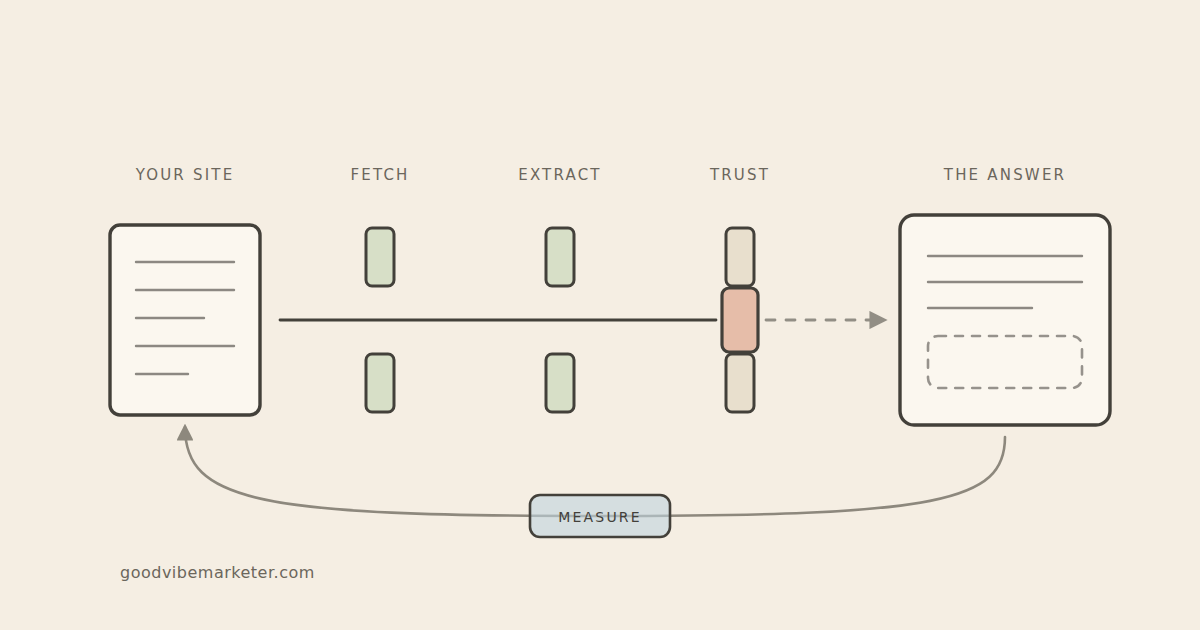
To audit a B2B website for AI search visibility, run four passes over it: can a machine fetch the page, can it lift a clean answer out, does it have a reason to trust the source, and can you tell afterwards whether you were cited. Ten checks in total.
That is the whole audit. The awkward part is that your last SEO audit almost certainly scored none of it.
I run these audits at GoodVibeMarketer, mostly on B2B sites that rank perfectly well and still never get named in an answer.
A conventional audit is built around a ranked list. It measures crawl budget, title tags, internal link equity, Core Web Vitals, keyword coverage, and it grades all of it against the question of whether you appear at position four rather than position nine. That question still matters. It is just no longer the only one being asked about your site, and on a growing share of buyer research it is not the question that decides anything.
When a model answers instead of listing, there is no position four. There is a paragraph, and either your name is in it or it is not. Nothing in a standard audit tells you which. The measurement infrastructure is running behind the capability, and audits are part of that lag: the template most agencies are still running was designed for a retrieval system that returned ten links.
So this is a different audit. It is not longer than the SEO one. It is mostly cheaper to run, because eight of the ten checks are things you can look at yourself in an afternoon without a tool contract.
Here are the four passes and the ten checks inside them, before the detail.
Pass one, can a machine fetch the page:
- AI crawler access in
robots.txt. - Content present in the HTML without JavaScript.
- Status codes and redirect chains on the pages that matter.
Pass two, can it lift an answer out:
- Every important page answers its own question in the first forty words.
- Headings that match questions a buyer would actually type.
- Structured data present, validated, and not contradicting the page.
Pass three, is there a reason to cite you:
- Entity consistency across every place your name appears.
- Named authors with a footprint that resolves off-site.
- Off-site corroboration on the sources that already get cited.
Pass four, can you tell whether it worked:
- A repeatable way to observe your own citations.
Pass one: can a machine actually fetch the page?
Nothing else on this list matters if the answer here is no. Start with the plumbing.
Check 1: AI crawler access in robots.txt. Open yourdomain.com/robots.txt and read it properly. You are looking for GPTBot, ClaudeBot, PerplexityBot, CCBot and Google-Extended. Plenty of B2B sites are blocking some or all of them, usually because someone pasted a blocklist from a publisher trade article in 2023 when the training-data argument was loud, and nobody revisited it. Publishers had a real commercial reason to block. A B2B company selling a considered purchase almost never does. Good looks like: a deliberate decision, documented, that you can explain.
Check 2: does the content exist without JavaScript? Fetch a key page with curl and read what comes back. If your product pages, pricing explainers or blog posts are assembled client-side, some crawlers will see an empty shell. Google renders JavaScript. Several of the AI crawlers do not, or do it inconsistently. Good looks like: the words you want quoted are present in the raw HTML response.
Check 3: status codes and redirect chains on the pages that matter. Run your top twenty commercial URLs and check what they actually return. Old redirects that got chained through two hops, a page that 302s when it should 301, a soft 404 sitting where a service page used to be. This is dull, and it is the check that most often turns something up, particularly on sites that have been through a restructure.
While you are here, you will read that you need an llms.txt file. It costs almost nothing to publish, so publish one if you like, but be honest about what it is: a proposed convention that the major AI companies have not committed to reading. Treat it as a cheap bet, not a fix. If a consultant frames it as the reason you are invisible, that is a tell.
Pass two: can it lift an answer out without guessing?
Once a model has your page, it has to decide what your page says. This is where most B2B sites lose, and they lose on writing rather than on technology.
Check 4: does every important page answer its own question in the first paragraph? Take your ten highest-intent pages and read the opening forty words of each. If they open with scene-setting, a company origin story, or a sentence about how the landscape is evolving, there is nothing extractable at the top. A model summarising your page has to infer what it is about, and inference is where you get flattened into a generic category description with someone else’s brand attached. Good looks like: the first paragraph would work as the answer if it were lifted out whole.
Check 5: do your headings match questions a buyer would actually type? Not keyword strings. Questions. “How long does implementation take” beats “Implementation”. Headings are the seams a retrieval system cuts along, and a heading that is a single noun gives it nothing to match against. Good looks like: you could read the H2s alone and reconstruct the buyer’s decision sequence.
Check 6: is your structured data present and accurate? Organization, Article, BreadcrumbList, and FAQPage where you genuinely have questions and answers. Validate it rather than assuming, because the common failure is not missing schema, it is schema that contradicts the page: an Organization block with an old trading name, an Article with no author, a FAQPage marked up on a page with no questions on it. Structured data is not a ranking trick here. It is how you stop a machine from having to guess your entity.
Three checks, and none of them need a developer. This is the pass to run first if you only have a morning.
Pass three: is there a reason to cite you and not someone else?
Passes one and two make you legible. They do not make you worth quoting. There is usually a competitor whose page is no better than yours, and gets named anyway.
Check 7: entity consistency. Search your company name and see what the web thinks you are. One name, spelled one way, on your site, your Companies House record, your LinkedIn page, your Crunchbase entry, your Google Business Profile. B2B companies quietly accumulate variants: the legal entity, the trading name, the name after the rebrand, the name on the old case studies. Every variant splits the signal. Good looks like: one canonical name, one /about page that states plainly what the company does and where it operates, and no contradictions between sources.
Check 8: named authors with a real footprint. Content attributed to “the team” or to nobody is content with no verifiable expertise behind it. Check that your substantive pages carry a named author, that the name resolves to a page on your own site, and that the person exists elsewhere on the web in a way that corroborates the claim. This is not about vanity bylines. It is the cheapest available signal that a human with relevant experience stands behind the page.
Check 9: off-site corroboration. This is the one that takes longest and matters most. Run the ten prompts your buyers would use, look at which sources get cited alongside the brands that do appear, and ask whether you are named on any of them. The discovery layer rewards authority rather than visibility, and authority here means being referenced by things the model already treats as credible. Good looks like: a short, specific list of publications, directories, comparison sites and industry bodies where your absence is costing you, which is a working PR brief rather than an audit finding.
Pass four: can you tell whether any of it worked?
Check 10: is there a repeatable way to observe your own citations? Almost always the answer is no, and this is the check that turns the other nine from a one-off tidy-up into something you can manage.
You need a fixed panel of twenty to thirty buyer prompts, run on a set cadence across the assistants your market actually uses, with the results recorded: whether you appeared, in what position, in what framing, and which sources were cited alongside you. I have written up how to build that measurement loop in more detail, and the short version is that it is manual, it takes about ninety minutes a week, and there is currently no good way around that for most teams.
Without it, you are optimising against a channel you cannot see, and every argument about what to fix next is settled by whoever is most confident in the room.
The order matters more than the score
The temptation with a ten-point audit is to produce a scorecard, colour it red and amber, and hand it over. Resist that. A score implies the ten items are worth roughly the same, and they are not.
Run them in order, because the dependencies are real. Fixing your heading structure while ClaudeBot is blocked in robots.txt is work that cannot pay off. Building a citation campaign before your entity is consistent means the citations you earn point at three different versions of your company.
Sequence it like this. Pass one is a morning, and it is binary: either the door is open or it is not. Pass two is a week of editing, and it is the pass with the best return per hour because it is entirely within your control. Pass three is a quarter, because you are changing what other people publish about you, and nobody does that in a fortnight. Pass four starts on day one and never stops, since it is the only thing that tells you whether the other three passes moved anything.
The other reason to sequence rather than score: an audit that lands as a thirty-page document with no order of operations gets read once and filed. One that lands as “do these three things this week, these four this quarter, and start the measurement panel on Monday” gets done. That difference is not about the quality of the analysis. It is about whether the output is shaped like work.
Questions people ask
Is an AI search visibility audit the same as an SEO audit?
No. An SEO audit grades you on position: title tags, internal link equity, Core Web Vitals, keyword coverage. This one asks four different questions. Can a machine fetch your page, can it lift a clean answer out of it, does it have a reason to trust you over a competitor, and can you tell afterwards whether you were cited. Different question, mostly different checks.
How long does an AI search visibility audit take?
Pass one is a morning: read robots.txt, fetch a key page without JavaScript, check status codes on your top twenty commercial URLs. Pass two is about a week of editing. Pass three runs over a quarter, because you are changing what other people publish about you. Pass four starts on day one and never stops.
Do I need an llms.txt file to get cited?
No. It is a proposed convention that the major AI companies have not committed to reading. Publish one if you like, since it costs almost nothing, but treat it as a cheap bet rather than a fix. If a consultant tells you a missing llms.txt is the reason you are invisible in ChatGPT, they have skipped the nine checks that matter more.
What should the audit hand me at the end?
Four things: a verdict on whether machines can reach and read your pages, the exact passages to rewrite, a named list of places you need to be mentioned, and a measurement panel. Not a score out of ten. I have written up what an AI search audit actually produces, with a worked example run on my own site.
Where do I start if I only want the short version?
Start with pass two, because it is the pass with the best return per hour. If you want the signals rather than the checks, the citation checklist names the eight that earn a mention in an AI answer, and most of them sit inside passes two and three of this audit.
If you would rather not run this yourself, that is a reasonable position, and the most useful thing is usually to walk through your actual site rather than the general principle. You can book a free 30-minute call through the AI marketing workshop page. It is a scoping conversation rather than a pitch: where you are stuck, which of the three problems you are most likely to have, and whether this is worth doing at all. A plumbing problem, a writing problem and an authority problem take very different amounts of work to put right, and knowing which one you have is most of the value.