
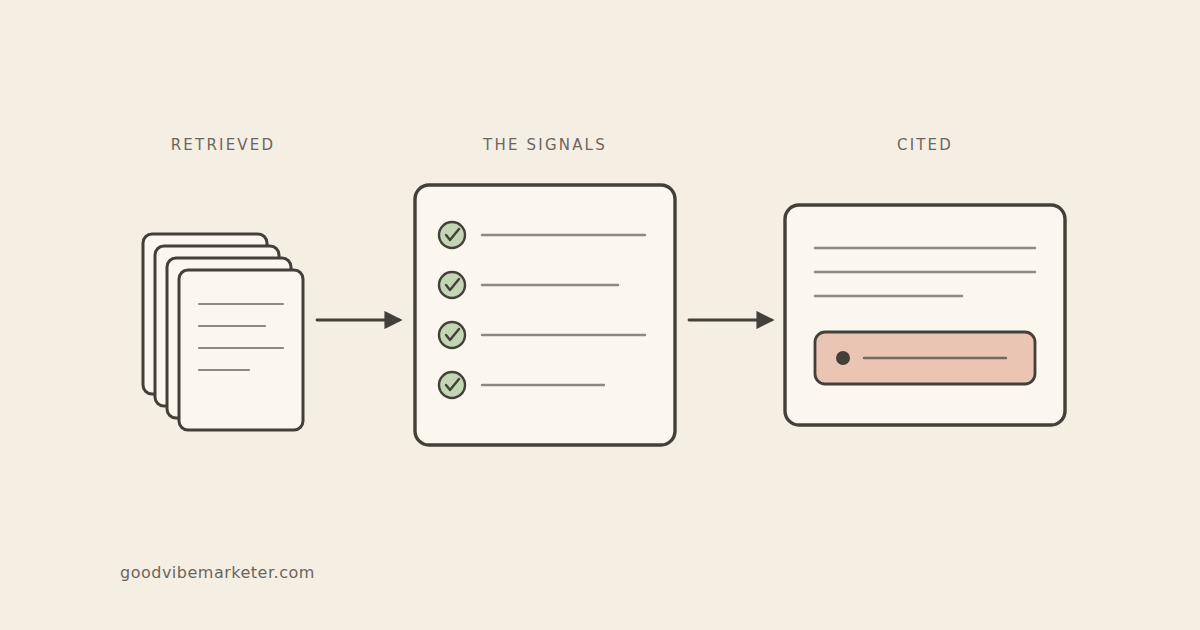
The eight signals that earn citations in AI search engines are: direct-answer structure, extractable formatting, schema markup, an llms.txt file, genuine topic depth, citation surface presence, entity consistency, and sourced claims. Most B2B sites are strong on two or three. The gap is where the citations go.
That is the short answer. Now here is the part worth understanding.
“Do good SEO” is not wrong advice. Write quality content. Build links. Use keywords properly. All valid. None of it addresses the structural difference between ranking in traditional search and being cited in an AI response.
In traditional search, you compete for a position on a results page. The user sees ten options, clicks one, lands on your site, and makes up their mind on your turf.
In AI-mediated search, there is no results page. The model synthesises an answer from what it has read and trusts. Your brand either appears in that synthesis or it does not. Research from AirOps suggests only 15% of pages an AI model retrieves actually end up cited in the final response.
That is not a ranking problem. It is a trust problem. The signals below are about building the kind of content an AI model treats as safe to cite.
The capabilities arriving in AI search are outpacing the infrastructure most B2B teams have built to respond to them. This checklist is the starting point for closing that gap.
Format Pages So AI Can Extract the Answer
AI models do not read a page the way a human reader does. They scan for extractable units: a direct answer in the opening paragraph, a numbered list that can be quoted, a definition that holds up without the surrounding context.
Most B2B web copy is written for a human who scrolls, builds understanding from navigation and headings, and reads in a context the brand controls. AI models need the answer in the first sentence. The elaboration can follow.
Signal 1: Direct-answer structure. The opening paragraph of every important page should answer the implicit question in the headline, in plain language, in the first two sentences. If the page is titled “How to [X]”, the first fifty words should contain how to [X]. The context and the nuance can come after.
Signal 2: Extractable formatting. Use numbered lists for processes. Use definition patterns for terminology. Use headings that describe what follows rather than headings that tease it. A heading that says “Signal 1: Direct-answer structure” is easier for a model to extract from than one that says “The first thing you need to know.”
Minimum implementation: Take your ten most visited pages. Rewrite the opening paragraph of each so the first two sentences answer the implicit question in the headline. Then review every list or multi-step process on those pages and confirm it is formatted as a numbered or bulleted list, not buried in prose.
Mark Up What You Mean
Schema markup tells a machine what type of content it is reading. FAQPage schema signals that a question exists and here is its answer. HowTo schema makes a process legible as a numbered sequence. Article schema identifies a substantive piece with an author, a date, and a subject.
These are not ranking tricks. They are signals that reduce ambiguity for any system reading your page, including AI models deciding whether a piece of content is the kind of thing they can stake a citation on.
Signal 3: Schema markup. FAQPage, HowTo, and Article are the three to start with. They map directly to the content formats AI systems are most likely to extract and repeat. If your site generates pages programmatically, adding schema at the template level means every page benefits at once.
Signal 4: llms.txt. This is an emerging convention, not yet universal. A plain text file at the root of your domain that tells AI crawlers which pages are authoritative, what the site is about, and which content to deprioritise. It takes about an hour to do it properly. Waiting until every site has one means competing with the teams who acted early.
Minimum implementation: Add FAQPage schema to any page that already contains a question-and-answer structure. Add Article schema to every blog post. Write a basic llms.txt pointing to your ten most important pages, with a one-line description of what the site covers.
Build Authority on Fewer Topics
AI models cite sources they treat as authoritative. Authority, in this context, means sustained and specific depth on a narrow set of topics. Not a site that has touched thirty subjects once. A site that has covered five subjects thoroughly.
This is where traditional SEO wisdom and answer engine optimisation align: topic clusters work, because they build a different kind of signal. Fifteen pieces on a single subject, each going further than the last, creates the kind of depth a model can draw on confidently. Fifteen pieces on fifteen subjects, published to hit keyword targets, creates noise.
Signal 5: Genuine topic depth. Choose three to five subjects where you have real expertise and where your buyers actually research. Write with specificity. Link between pieces in the same cluster. Do not dilute the cluster by adding loosely related posts for volume.
Signal 6: Citation surface presence. AI models are shaped by what the rest of the web cites. Getting your analysis into trade publications, analyst reports, or third-party resources that AI systems treat as credible extends your reach into those models in ways that publishing only on your own domain cannot.
The AI discovery layer rewards authority, not visibility. A citation in one strong external source can do more for your AI citation rate than ten self-published posts covering the same territory.
Minimum implementation: Identify the publications and resources that appear consistently in Perplexity responses for your topic area. Look at which sources a model cites when it discusses your competitors. Build relationships with those outlets. Contribute data. Write opinion pieces. The goal is not backlinks for SEO metrics. It is appearing in the sources AI systems already treat as reliable.
Earn Trust Signals the Models Can Verify
Two things make AI models more confident about citing a source: consistent entity signals and verifiable claims.
Signal 7: Entity consistency. Your brand should appear the same way across the web. The same name, the same domain, the same description, whether a model is reading your website schema, your LinkedIn company page, your Google Business Profile, or press coverage from the last two years. When a model encounters your brand repeatedly and finds the description consistent, it builds a more confident representation of what you are. Inconsistency across those sources reads as noise.
Signal 8: Sourced claims. Cite your sources. Not for link-building purposes, but for the reason a journalist would: if an AI model can follow your reference trail and verify the claim independently, it is more likely to treat that claim as credible enough to repeat. Assertions that cannot be checked are harder to stake a citation on.
This connects to something worth reading in full: the brief is the new control surface. The same precision that makes a brief useful for AI agents makes your content useful for AI citation. A piece that specifies its claims, names its sources, and avoids the comfortable vagueness of generic thought leadership is a piece a model can actually use.
Minimum implementation: Audit your brand name and description across your website, LinkedIn company page, Google Business Profile, and press coverage from the last two years. Make them consistent. Then take your ten highest-priority content pieces and add primary source links to any factual claim that could be contested.
If you are building this from scratch and want the full architectural picture of how these signals connect into a running content and SEO system, the Blueprint covers the stack.
If you would rather start by finding out where your own site currently stands, work through how to audit a B2B website for AI-search visibility first. The eight signals above are what to fix; that piece is the ten checks that tell you which of them you are failing.