
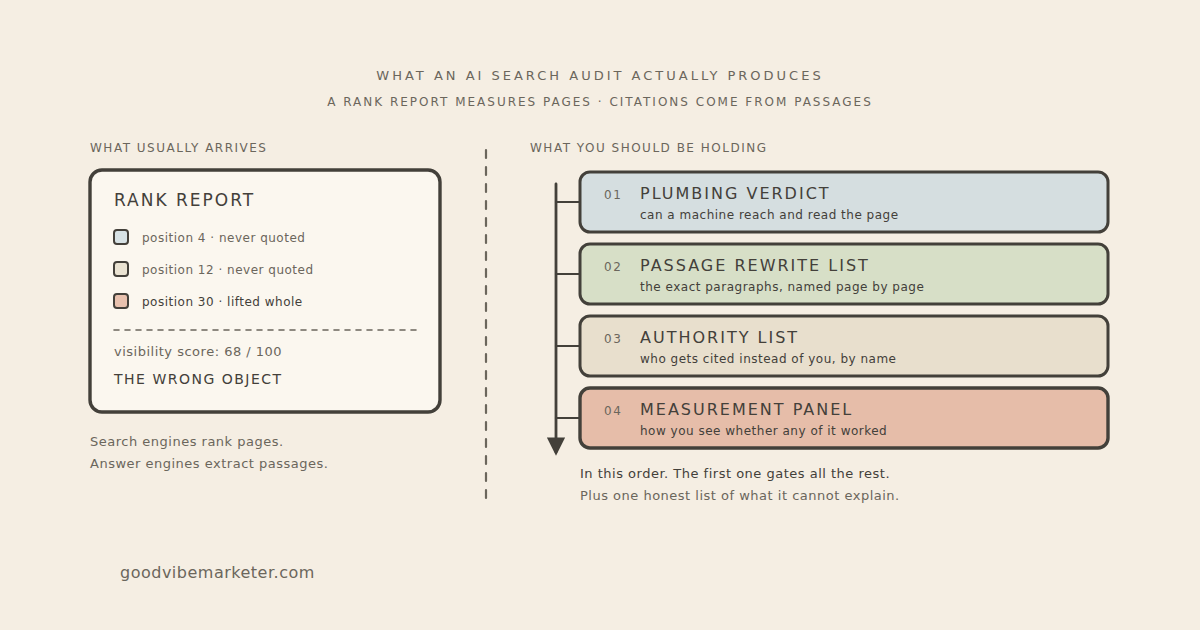
An AI search audit for a B2B website should hand you four things: a verdict on whether machines can reach and read your pages, a list of the exact passages to rewrite, a named list of places you need to be mentioned, and a measurement panel that tells you afterwards whether any of it worked. Not a score.
That is the deliverable. What usually turns up instead is a rank tracker with a new label on the cover.
The problem with that is mechanical rather than moral. Search engines rank pages. Answer engines extract passages. When a model answers a buyer’s question it is not choosing between ten links, it is choosing which few sentences to lift and whose name to put next to them. A report that grades you on positions is therefore measuring an object the channel does not use.
The gap runs both ways. A page can hold position four and never get quoted, because its opening forty words are scene-setting about how the landscape is evolving. A page at position thirty gets lifted whole, because its first paragraph answers the question and needs no editing to work on its own.
Here is what a real audit covers:
- The plumbing. Whether AI crawlers are allowed in, whether the words exist without JavaScript, and whether your commercial URLs return what they should.
- The passages. Whether each important page answers its own question in the first paragraph, and whether the structure gives an extractor anything liftable.
- The authority. Whether your entity is consistent everywhere it appears, and which third-party sources get cited instead of you.
- The observation loop. Whether you have a repeatable way to see your own citations, which is the only thing that turns the first three into something you can manage.
The method behind those four is separate work, written up elsewhere as ten checks across four passes. This article is about the output: what you end up holding, and how to tell whether it is worth anything. The worked example is GoodVibeMarketer’s own site, because that is the one where I can show the unflattering findings as well as the tidy ones.
What a real audit hands you
Four artefacts. If you can’t point at all four when the engagement ends, you bought a document rather than an audit.
A plumbing verdict, in one paragraph. This is binary and cheap to establish. Either GPTBot, ClaudeBot, PerplexityBot and CCBot can reach your pages or they cannot. Either the sentences you want quoted are in the raw HTML or they are assembled client-side and some crawlers see an empty shell. Either your top twenty commercial URLs return 200 or a few are quietly chained through two redirects since the last restructure. It takes a morning and it gates everything else, which is why it belongs on page one in plain language.
A rewrite list, at passage level. Not “improve your content”. A list of named pages with the specific opening paragraph that needs replacing, and what it needs to say instead. This is the most valuable artefact and the one most commonly missing, because producing it requires reading your pages rather than running them through a tool.
An authority list, shaped like a PR brief. Which publications, comparison sites, directories and industry bodies get cited when a model answers your buyers’ questions, and which of them do not currently mention you. This one takes a quarter to act on rather than a week, because you are changing what other people publish. It also separates the sites that get cited from the sites that merely deserve to. The discovery layer rewards authority rather than visibility, and an audit that stops at your own HTML has skipped the part where citations get decided.
A measurement panel you own. Twenty to thirty buyer prompts, written down, with a cadence and a record of what came back. Without it, every argument about what to fix next gets settled by whoever sounds most certain in the meeting.
The worked example: what an audit found on my own site
This site is a fair test case: built by someone who does this for a living, on modern infrastructure, with the AEO checks in mind from the start. So the findings are not the obvious ones, which makes them more useful.
The plumbing passed, completely. Robots.txt allows every AI crawler and blocks only the API routes. All 42 posts render server-side, carry one H1, a self-referential canonical, Article and BreadcrumbList schema, and a share card at the right dimensions. Every title sits at 60 characters or under and every meta description falls inside the 120 to 160 band, with zero violations across the blog. That took three earlier rounds of tidying and it is now genuinely clean.
Then the extraction pass, which is where it fell over. Only 9 of 42 posts contained a single list, table or subheading. Of the twenty posts published in one six-week run, eighteen contained none at all.
Worse, two of those posts were explicitly enumerated. One promised eight signals in the headline, another ten checks, and both delivered them as bold run-in headings inside paragraphs. A human reads that fine. An extractor sees <strong> wrapped in <p> and comes away with prose. The headline promised a checklist and the HTML delivered an essay.
No FAQ block on any audited post, while the three location pages on the same site carry FAQ sections with matching schema. The pattern was already in the house and simply never reached the blog.
The brand name was absent from the body of eight consecutive audited posts. When a model summarises a page with no entity named in the text, the summary carries the argument and not the source of it.
And the finding that annoyed me most: the highest-impression page on the site had zero internal links. A project write-up that pulls more impressions than anything else, pointing nowhere, donating none of that authority to a commercial page.
A cluster problem, not a page problem. Four separate posts answered roughly the same buying question. Each was individually well-formed. Three of the four had zero or one impression. No single-page audit finds that. It only appeared because the audit looked across the set rather than down a checklist.
Here is the part a sales-shaped audit would have left out. Twenty posts shipped in a month and produced zero clicks. Several sit at positions between 71 and 77. The audit does not explain that, and I recorded it as unexplained rather than attaching it to whichever finding was nearest. Two of those pages are, on every check available, clean.
That distinction matters more than any individual finding. An audit that pins every symptom on something conveniently fixable is a sales document. A real one sorts findings into three piles: this is broken and here is the fix, this is fine and stop worrying about it, and this is happening and I cannot yet tell you why. The third pile is how you judge whether the person writing it is being straight with you.
What changed as a result: the metadata is fixed and stayed fixed, the location pages’ structured data now matches the offer it describes, and half the cluster consolidation has shipped. What has not: the list markup finding is still open on most of the blog, and the brand name is still missing from bodies written before it was flagged. Findings do not fix themselves by being written down, which is the argument for keeping the list short and ordered.
How to tell a real audit from a relabelled rank report
Four tells, and you can apply them before you buy rather than afterwards.
It reports passages, not positions. Ask what the findings look like. If the answer describes rankings, keyword gaps or a visibility score out of 100, you are being sold SEO reporting with different vocabulary. If it describes specific paragraphs on specific pages, that is the right object.
It is sequenced by dependency, not coloured by severity. A red-amber-green scorecard implies the items are worth roughly the same and can be done in any order. They cannot. Rewriting headings while ClaudeBot is blocked in robots.txt is work that cannot pay off. Earning citations before your entity name is consistent means the mentions point at three different versions of your company. A real audit arrives as an order of operations: these three this week, these four this quarter, measurement panel starts Monday.
It names what it could not explain. Every site has symptoms with no clean cause. An audit with a tidy explanation for absolutely everything has stopped investigating and started closing.
It leaves you able to run it again. The prompts, the cadence, the record. If the deliverable only works while the consultant is holding it, you rented a snapshot. Standing up that measurement loop is manual and takes about ninety minutes a week, and there is no good way around that yet.
One more question worth asking anyone you are considering: describe a finding from your last audit in full, including the bit the client did not want to hear. The answer tells you whether they audit or whether they pitch.
Questions people ask before buying one
How long does an AI search audit take?
The audit itself is a few days on a normal B2B site. Acting on it is the longer horizon: the plumbing pass is a morning, the passage rewrites about a week of editing, and the authority work runs across a quarter because it depends on other people publishing things. Anyone quoting one duration is describing the document, not the work.
Can I run this myself?
Most of it, yes, and you should if you have the time. Eight of the ten checks need no tool contract and no developer. The two that are harder alone are the authority pass, which needs someone willing to tell you unwelcome things about your market position, and the discipline to keep the measurement panel running past week three.
How is this different from the SEO audit I already had?
Different object. An SEO audit asks whether you appear at position four rather than nine. This one asks whether a machine can lift a clean answer out of your page and attach your name to it. The two overlap on the plumbing and diverge after that. Your last audit almost certainly scored none of the extraction or entity checks, because the template predates the question.
How soon should I expect to see results?
Slower than you want, and I would rather say so. My own site is the honest evidence: everything technical is clean, the fixes shipped, and there are still pages at position 74 with nothing to show. What an audit reliably gives you in the short term is a correct list of work in the right order. What it cannot give you is a date.
Where to start
Before you commission anything, do one thing yourself. Take your ten highest-intent pages and read the first forty words of each out loud. If any of them would not work as the answer to the question the page exists to answer, you have found the audit’s most valuable finding for free, and learned something about how much of the rest you could do in-house.
If you would rather walk through your actual site than the general principle, that is usually the more useful conversation. You can book a free 30-minute call through the AI marketing workshop page. It is scoping rather than a pitch: which of the four problems you are most likely to have, whether it is worth doing at all right now, and whether the sensible version is something your team runs themselves. A plumbing problem, a passage problem and an authority problem take very different amounts of work to put right, and knowing which one you have is most of the value.