
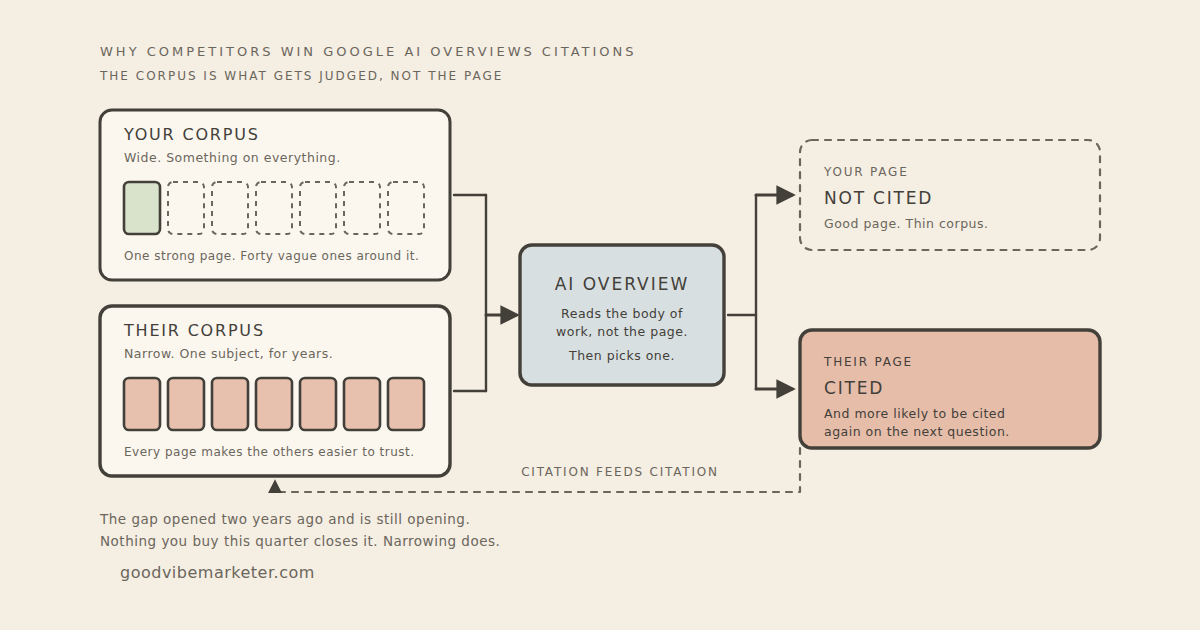
Google AI Overviews cite sources that were already trusted before AI Overviews existed. The citation goes to pages with established topical depth, direct answers and claims that can be checked. Your competitors are not winning with a new tool. They are collecting on content investments they made two or three years ago.
Which is a deeply unsatisfying answer, so most teams reject it and go shopping instead.
There is a whole category of software now promising citation tracking, AI Overview monitoring and answer engine optimisation. Most of it works. It will tell you, accurately and in a nice dashboard, that you are not being cited. What it will not do is change why.
Because the citation decision is not made about a page. It is made about a body of work.
That is the shift, and it is the most underestimated one in search in a decade. Not because it is subtle, but because it is slow. Everything about it rewards patience, and nothing about the way marketing teams are measured allows for patience.
The Teams Already Winning Mostly Were Not Trying To
Look at who gets cited in your category. Not the aggregate, the actual citations, on the actual questions your buyers ask.
You will usually find it is not the biggest brand or the loudest one. It is some outfit with a modest site that has been writing about one narrow thing, repeatedly and specifically, for years. Often a competitor you had stopped worrying about.
Four things tend to be true of them.
They have written about the same narrow subject many times, so the model sees a consistent body of material rather than a single page making a claim. They answer questions in the first paragraph, usually because they were writing for impatient humans long before machines were reading. Their claims are specific enough to be wrong, which is what makes them worth repeating. And their entity is coherent: the same organisation name, the same description, the same named person, across the site and everywhere off it.
Here is the uncomfortable part. Almost none of them did this for AI. Most of them are not tracking citations at all. They wrote genuinely useful things about a narrow topic for a long time, and the new retrieval layer found them already sitting there.
Meanwhile the team that spent the quarter producing an AEO strategy deck is losing to a company that has never heard the term. I wrote about this dynamic before the tooling arrived, in why the AI discovery layer rewards authority rather than visibility, and everything since has made the point sharper rather than softer.
The Advantage Is Structural, So It Compounds Against You
In classic search, one page could win. A well-optimised article on a mediocre site could outrank a better site, because the unit of evaluation was the page. That is why the tactical playbook worked, and why an aggressive quarter could genuinely move the needle.
Retrieval does not work that way. The system reads across your material and forms a view of whether you are a credible source on this subject. One excellent page attached to forty vague ones is not a strong signal. It is a strong page surrounded by evidence that you are not really a specialist.
Three mechanisms make the gap widen rather than hold steady.
The first is coverage depth. Each additional genuinely specific page on the same narrow subject strengthens every other page on that subject, because the corpus is the thing being assessed. Advantage accrues to whoever started earlier.
The second is reference. Sources that other credible sources point to are safer to cite, and being cited makes you more likely to be cited again. That is a feedback loop, and feedback loops do not reward late entrants who move fast. They reward whoever is already in the loop.
The third is coherence. Every inconsistency in how you describe yourself, across your site, your profiles and third-party mentions, is a small reason to prefer someone else. These are cheap to fix and almost nobody fixes them, which is precisely why they are worth fixing.
The instinct at this point is to catch up on volume. Forty posts this quarter, cover everything, force the issue. That reliably makes it worse: you are adding thin material to a corpus already judged thin, and diluting the few pages that were doing real work. The gap is not a content-quantity gap. It is closer to what I described as the infrastructure gap, where the durable advantage sits in what you have built and maintained rather than what you shipped last month.
The One Move Worth Making This Quarter
Pick one claim territory and become the most complete, most specific answer inside it. One. Not a content calendar, not a pillar-page programme. A deliberate narrowing.
The territory has to be small enough to be credible and specific enough to be searched. Not “AI marketing”. Something closer to “AI content workflows for B2B marketing teams of five to twenty people”. If your positioning statement would fit any of your competitors, it is too wide, and a model has no reason to treat you as the specialist.
Then do four unglamorous things.
Write down the twelve to fifteen questions a real buyer asks inside that territory, in their words rather than keyword phrasing. Map what you already have against that list, honestly. Most teams find wide, shallow coverage: something on everything, authority on nothing.
Rewrite rather than add. Take the pages that already sit closest to the territory and make them the best answer that exists, which usually means a direct answer in the first forty words, specifics instead of hedges, and a source link on every claim that could be contested. Consolidate near-duplicates into one strong page rather than leaving three weak ones competing with each other.
Fix the entity. Same name, same description, same attributed author, everywhere.
Then keep publishing inside that territory and only that territory for two quarters. The discipline is the hard part, not the writing. This is the same argument as writing a proper brief: the constraint is what produces the quality, whether the thing reading it is a model or a person. If you want the diagnostic version of this, the AI search visibility audit covers the technical checks that sit underneath.
The Lag Is the Whole Problem
You will do all of this and see nothing for a quarter. Possibly two.
That is the actual reason your competitors are going to win these citations, and it has nothing to do with intelligence or budget. It is that most teams start, see a flat line at the next quarterly review, conclude it is not working, and move the resource to something with a faster feedback signal. The compounding never gets to start.
The ones who win are simply the ones who did not stop. Which is a boring competitive advantage, and boring competitive advantages are the durable kind, because they cannot be bought in a procurement cycle.
So the decision in front of you is not which citation tracker to buy. It is whether you are willing to be narrow for two quarters while the numbers stay flat.
I write about this shift each week as it plays out across B2B, including what is actually moving in AI search rather than what the tooling vendors say is moving. If you want the ongoing version rather than a snapshot, subscribe below. One issue a week, no filler.
If being narrow for two quarters is the plan and you would rather not run it alone, that is what the AI marketing workshop is for: a session on your own stack and your own quarter, not a demo.