
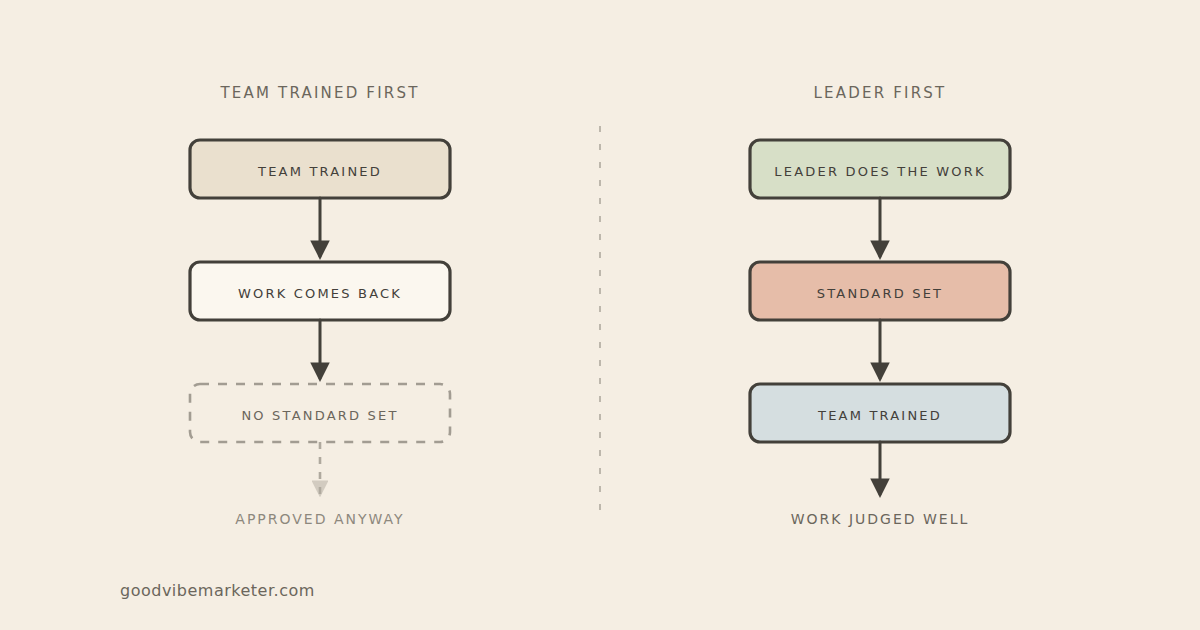
One-to-one AI marketing coaching for a CMO is private, hands-on work on the leader’s own decisions and workflows rather than the team’s. It produces the thing team training cannot: a marketing leader who has personally used these tools well enough to judge what comes back, set a standard, and defend it.
Most leaders buy this in the wrong order.
The instinct, when the board asks what marketing is doing about AI, is to book something for the team. It feels like the responsible move. It is visible, it is delegable, and it turns an uncomfortable question into a line item. Fifteen people get trained, an answer exists, everyone moves on.
The sequencing is usually backwards. A leader who has not personally done this work has no basis for judging what the team brings back. And what a team brings back after AI training is more output, produced faster, in a form that looks finished. Plausible and good are very hard to tell apart at speed, and telling them apart is now the leader’s job.
That is the actual gap. Not tooling, not a shortlist of platforms, not a market briefing. Judgment. And judgment does not transfer by slide deck. You build it by doing the work yourself once, on something whose outcome you care about, before you ask fifteen people to do it at scale.
What Coaching for a Marketing Leader Actually Covers
It starts with the leader’s own week, not the department’s process.
Every marketing director has a handful of things that eat their calendar and produce nothing anyone would call strategy. The board update that takes a day and a half. The agency output that needs rewriting before it can be shown internally. The quarterly plan assembled from six half-finished documents. The competitor question that gets asked in every leadership meeting and answered from memory because nobody has time to check properly.
Those are the first sessions. Not because they are the highest-value AI use cases in the abstract, but because they are yours, you know what good looks like on them, and you will notice immediately when the model gets it wrong. That noticing is the whole point. You cannot calibrate against work you were never going to inspect closely.
The second layer is harder and more valuable. It is turning the things you know into something a model can follow. Most marketing leaders carry an enormous amount of undocumented judgment: what the company is allowed to claim, which competitor comparisons are fair game, the particular way the CEO wants numbers framed, the phrasing that makes sales wince. None of that is written down anywhere, which is precisely why AI output from your team keeps landing slightly wrong.
Writing that down properly is a specific skill, and it has become the main control surface a leader has over AI output. I have covered how to write a brief that a model can actually follow in more detail, but the short version is that a brief written for a person relies on shared context, and a model has none.
The third layer is the standard itself. What is a marketing leader now willing to sign off on, and what evidence do they need before signing. That question sounds procedural and it is the thing that decides whether AI helps your department or quietly degrades it over eighteen months.
Why “I’ll Get the Team Trained” Is the Expensive Version
It is not that team training is wrong. It is that it does nothing for the problem the leader personally has, and it creates a new one.
Train fifteen marketers and volume goes up immediately. Drafts arrive faster. Reports get longer. The campaign brief that took three days takes an afternoon. Every one of those outputs still needs a decision from someone senior, and now they arrive in triple the quantity, each looking confident and well-formatted.
A leader who has not done the work themselves has two options at that point, and both are bad. Wave things through, which is how organisations end up publishing a great deal of competent, undifferentiated, faintly wrong content. Or become a bottleneck, reading everything closely, which cancels out the speed the training was bought for.
This is a version of the trap I have written about before, where handing the work to AI without keeping hold of the judgment creates a dependency rather than an advantage. It applies at team level and it applies harder at leadership level, because the leader is the last check before something goes out with the company’s name on it.
There is a quieter cost too. A leader who cannot demonstrate this work has trouble governing it. When someone in the team asks whether it is acceptable to use AI for customer-facing copy, or whether the research a model produced needs verifying, the honest answer requires having hit those problems yourself. Policy written by someone who has not used the tools reads exactly like what it is, and teams route around it.
And there is the credibility question nobody says out loud. Plenty of marketing leaders do not want to be the least capable person in a room they are meant to be leading. Working it out privately first is not vanity. It is the sensible way to avoid learning in front of people who report to you.
What You Should Be Able to Do Afterwards
The test is not whether you feel more confident about AI. Confidence is cheap and often arrives before competence.
Four concrete things, and they are worth holding any coaching engagement to, including mine.
You can tell a good output from a plausible one, quickly. Given a piece of AI-assisted work from your team, you can say what is wrong with it in specific terms, not “this feels generic”. Usually the fault is traceable to a missing instruction rather than a bad model, and you can name which one.
You have your own briefs written. Positioning, voice, the claims you can and cannot make, the audience. Written once, properly, in a form your team can point a model at. This is the single highest-return artefact a leader can produce, and almost nobody has it. It also makes every subsequent bit of team training twice as effective, because the team is no longer inventing context from scratch.
You have two or three of your own workflows running. Not theoretical. Things you personally do most weeks that now take a fraction of the time. Board reporting, competitor tracking, first-pass analysis of campaign data. If a leader finishes coaching with no changed habit of their own, nothing has actually happened.
You can set a standard and explain it. What AI-assisted work must clear before it ships, what always needs a human, what never gets automated. Stated in a paragraph, defensible in a leadership meeting, and grounded in things you have seen go wrong yourself rather than an article you read.
That last one is what the organisation is really buying. Everything else is how you get there.
Where the Team Workshop Fits, and Why It Comes Second
The team session is a real and separate thing, and it should still happen. The order matters more than most people expect.
Run it after the leader has done the work and it lands differently. There are briefs to build on, a standard to design against, and someone in the room who can settle arguments about what good looks like without deferring to the trainer. The session stops being an introduction and becomes an implementation.
Run it first and you get enthusiasm with no destination. People leave with tools, apply them to their own patch, and produce fifteen slightly different interpretations of how the company sounds. Six months later somebody has to reconcile all of that, and the reconciliation costs more than the training did.
There is also a scoping benefit. Leaders who have spent a day on their own workflows are much better at commissioning the team version. They know which two workflows are worth the department’s time and which sounded promising and were not. The brief for the team session writes itself, because it comes from evidence rather than from a vendor’s suggested agenda.
So the honest sequence is: leader first, then team, and I have written separately about what makes team training stick when you do get to it. Some organisations genuinely need to start with the team, usually where the marketing lead is already fluent and the department is not. That is a fine reason. “I do not have time to learn this myself” is not, because the time gets spent anyway, later, in worse conditions.
Where to Start
Before you book anything, do one honest audit. List the decisions you personally made last month that you would struggle to explain the criteria for. Then list the three things in your own week that consume the most hours and produce the least distinctive output. Those two lists are the real agenda, and they are more useful than any capability framework.
If you want the wider context on what this kind of work involves, what an AI marketing strategist actually does covers the engagement shape in more detail. My own basis for it is twenty years in-house rather than agency side, including building marketing functions from nothing more than once. I have been the person accountable for the answer, which is a different position from advising the person who is.
If you are the one expected to have a view on AI and you would rather work it out properly than perform it, that is worth a conversation. The AI marketing workshop runs one to one as well as with teams, and it starts with a free thirty-minute call about where you actually are. No deck, no proposal, and no assumption that the answer is a session at all. Sometimes the answer is that you need to decide who owns this internally first, and that is a useful call to have had.