
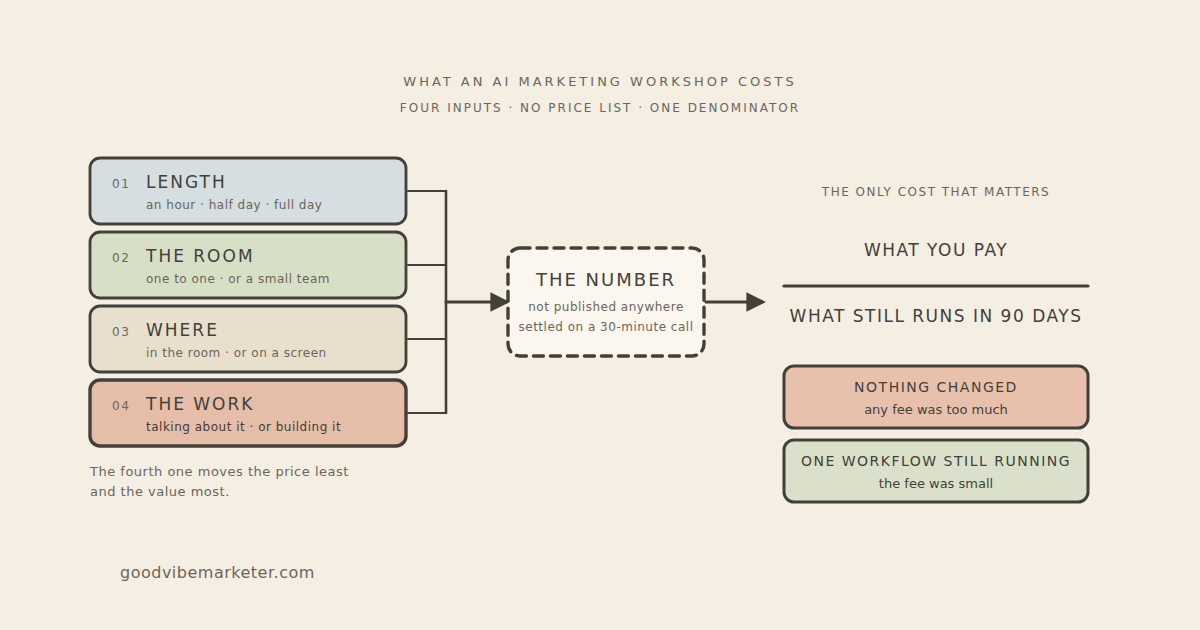
An AI marketing workshop is priced on format, not from a list. Four things move the number: how long the session runs, whether it is one person or a small team, whether it is in person or remote, and how much of the time is hands-on building rather than discussion. The figure is settled on a free thirty-minute call.
That is the honest answer. It is also the least useful one, because the number is not really what you are trying to work out. Every GoodVibeMarketer workshop is quoted off those four inputs and nothing else.
What you want to know is whether the money comes back. And that is not decided by the day rate. It is decided by whether anything is still running ninety days later.
I have watched teams sit through a full day of AI training, enjoy it, fill a notebook, and return on Monday to precisely the workflow they had the previous Thursday. That session was not expensive. It was worthless, which is a different problem and a far more common one. A paid session that leaves one workflow running beats a free one that leaves nothing.
So price it the way you would price any other capability. Cost divided by what still works after the room empties.
The Four Things That Actually Move the Number
None of them are mysterious, and any provider who will not walk you through them is hiding something.
- Length. A focused hour, a half day, or a full day.
- Who is in the room. One to one, or a small team.
- Where it happens. In person in Bristol, Bath or London, or remote anywhere else in the UK.
- How much of it is building. A day of discussion costs less to run than a day that ends with something deployed.
Length. Sessions run from a focused hour to a full day, with a half day in between. An hour is right when there is one specific thing in the way and you know what it is. A full day is what you need when the outcome has to be a working thing rather than a clearer head. Most teams overbuy on length and underbuy on specificity, which is the wrong way round.
Who is in the room. One to one, or a small team. One to one moves faster because there is no lowest common denominator to manage. A team session costs more in total and less per head, and it has a second effect that matters more than the arithmetic: the workflow you design during the day gets adopted, because everyone who has to use it helped build it. Adoption is the whole game. One trained person surrounded by an untrained team is a bottleneck with better vocabulary.
Where it happens. In person in Bristol, Bath and London. Remote for teams anywhere else in the UK. In person costs more, and it is still the format I push people towards. Not because of the travel, but because a screen share gives everyone a private exit. Somebody’s camera is off, somebody is answering Slack, and the awkward part where a person has to actually try the thing in front of a colleague never happens. That awkward part is where the behaviour changes. If you are near me, the Bristol sessions are the easiest version of this to arrange.
How much of it is building. A day of strategy is cheaper to run than a day that ends with something deployed, because the second one carries more preparation and more risk of the messy reality of your actual stack. It is also worth more. Strategy sessions produce agreement. Build sessions produce a thing that runs whether or not anyone stayed motivated.
Those four are the honest inputs. The workshop page lays out the formats; the combination that fits your team is what the call is for.
Why There Is No Price List
Every so often somebody asks me to publish a tier table. Small, medium, large, with numbers next to them. I understand the appeal, and I think it would make the work worse.
A published price forces a fixed scope. A fixed scope forces a fixed curriculum, because that is the only way to protect the margin. And a fixed curriculum is precisely the thing that makes AI training forgettable, since it means the session is built around a generic set of examples rather than the campaigns sitting in your actual quarter.
The moment you publish “half day, this price”, you have promised to deliver the same half day to a two-person startup and a twelve-person marketing department inside a manufacturer with a legal review process. Those are not the same day. Pretending otherwise is how you end up with slides about prompt engineering.
There is a second reason, and it is more self-interested than it sounds. A price list makes people buy the tier rather than the outcome. They pick the middle one, because everyone picks the middle one, and then the session has to be reverse-engineered to fill the time they bought. I would rather work out what you need and then say how long that takes.
Sometimes what you need is nothing. That happens more than you would expect, usually with teams who already have a capable owner and just need permission to spend the hours. I wrote up the test I use for that in hire a consultant vs DIY, and if you run it honestly and come out on the build-it-yourself side, do that instead.
The Cost That Never Appears on the Invoice
Here is the number most buyers forget to add up.
A full day with six people in the room is six person-days of marketing capacity, gone. Depending on the team, that is very often larger than the fee. It is certainly large enough that it should change how you choose the format, and yet I have never once been asked about it during a procurement conversation.
This cuts both ways. It is an argument for keeping the group tight, which usually means the two or three people who will genuinely own the work rather than everyone who expressed interest. It is also an argument against the cheap option that wastes the day, because a low fee attached to six wasted person-days is the most expensive thing on this page.
And there is a third cost, the quiet one. Every quarter a team spends circling this decision is a quarter of compounding that does not happen. The gap between teams who embedded a working system early and teams still assembling a tooling shortlist is not a tooling gap, and it is widening. That is the argument I made in the tools aren’t the bottleneck, and cost inertia is one of the main ways teams end up on the wrong side of it.
How to Compare Quotes Without a Price List
If you are weighing two providers and neither publishes numbers, four questions will separate them faster than any proposal document.
Whose work are we using on the day? If the answer is case studies, examples or a sample brief, you are buying a lecture. It should be your campaigns, your voice guidance, your messy spreadsheet.
What do I have at the end that I can open on Monday? A working prompt library, a running workflow, a written brief. Something with a file name. “Notes and momentum” is not a deliverable.
What will my team be able to do without you afterwards? This is the one that matters most and gets asked least. If the honest answer is “call me”, the engagement is a dependency wearing a training badge.
What happens if it does not stick? Watch how they answer. Anyone who has done this a few times has a view on why sessions fail, and it is usually about follow-through rather than content.
Price the answers, not the day. Two quotes with the same number in front of them can be a factor of ten apart on those four questions, and that spread is the only one worth optimising.
Questions people ask
How much does an AI marketing workshop cost?
There is no published price and no tier table. The figure is set by four things: how long the session runs, whether it is one person or a small team, whether it is in person or remote, and how much of the time is hands-on building rather than discussion. It is settled on a free thirty-minute call once the scope is clear.
Is a team workshop better value than one to one?
It depends what you are buying. One to one moves faster, because there is no lowest common denominator in the room. A team session costs more in total and less per head, and it buys adoption, since the people who have to run the workflow helped build it. The separate piece on AI marketing training for marketing teams covers what makes a team session stick rather than fade.
Is an in-person session worth paying more for?
Usually, yes. Remote works, and it is the right answer for teams outside the South West. But a screen share gives everyone a quiet exit: cameras off, Slack open, and nobody has to try the thing in front of a colleague. That moment of mild discomfort is where working habits actually change, and it is hard to reproduce through a browser tab.
Should I hire an agency instead?
Different instrument. An agency is built to own the work on an ongoing basis. A workshop is built to leave capability behind and then stop. If what you want is the output produced for you every month, a workshop is the wrong purchase and you should say so early. The consultant versus agency comparison sets out where each one genuinely wins.
What the Call Is Actually For
The thirty minutes is scoping, not selling. We work out what is genuinely in the way, whether a workshop is the right instrument for it, and which combination of length, group and location fits. The number falls out of that conversation, because it cannot be worked out before it.
If you want to start there, book the free thirty-minute call from the AI marketing workshop page, or send me the situation in a paragraph through contact and I will tell you whether it is worth a call at all. Occasionally the answer is that you should spend the money on protecting someone’s calendar instead. That is a cheaper fix and I would rather say it than sell you a day you did not need.